

Studies show that acquiring a new customer costs a business between four and 10 times more than it takes to retain a customer. This is caused by the amount of effort it takes to find, target and successfully sell a new consumer a product or service when compared to selling something to a customer who has already previously purchased something from a company.
Econsultancy reports that 82% of companies they surveyed agreed that customer retention costs less to execute than customer acquisition. However, Econsultancy also found that companies were more focused on acquisition marketing. In addition, 63% of marketers surveyed by Kissmetrics stated that customer acquisition was the most important advertising goal for their company.
Acquiring customers will always be a vital aspect of the growth and continued profitability of any organisation. However retaining customers has a major impact on the bottom line due to its relatively low cost, high return on investment and long-term benefits.
When evaluating your acquisition efforts, consider calculating customer acquisition cost (CAC). This metric is determined by dividing all marketing expenses used to acquire new customers by the number of customers acquired during the period in which the money was spent. This can be used to create a measurable number concerning the acquisition of both new customers and the return business of retained customers to see the differences in marketing for your brand.
The Value of Customer Retention
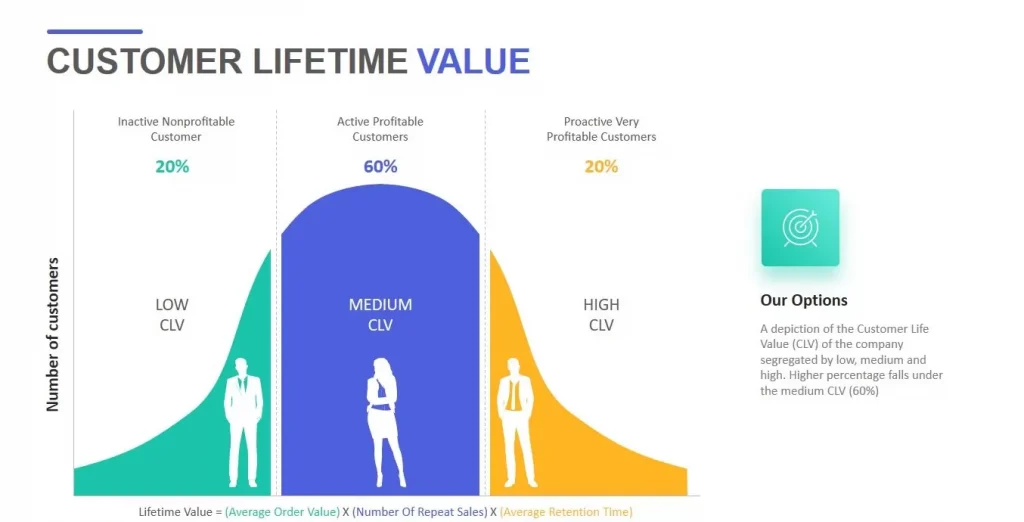
Keeping a previously acquired customer has been shown to not only typically cost less in terms of marketing, but has also been shown to result in higher value purchases. According to Invespcro, increasing customer retention rates by 5% can increase profits by 25% to 95%. In addition, the average repeat buyer spends 33% more than a new customer. When combined with lowering the cost of marketing efforts, the higher spending of return customers can result in a greater ROI for a company in the long term.
Retained customers are also shown to gain value over time, as Annexcloud reports that the typical return customer will spend 67% more by their third year of buying from a business than in their first six months. This means that long-term customer retention, not simply enticing a second purchase, will yield results that increase profitability over time.
As discussed by Optimove, the specific value of a retained customer can be determined by collecting data regarding total purchases, retention marketing expenses, customer acquisition costs and the general overhead of the efforts made to retain customers. Determining the price of your business’s customer retention efforts can help you optimize your retention marketing and balance your budget regarding both acquisition and retention efforts.
The Competition for Lost Customers
It is important to note that a previous customer who does not return for another purchase is most likely to have turned to another company within the industry. According to Kissmetrics, 61% of consumers will go to a competitor after ending a business relationship.
There are a variety of reasons why a consumer may be lost to a business; however, many studies find that poor customer service is a frequent reason. In addition, persuading a lost customer to return to a business is often very difficult. According to Accenture, 68% of customers will not return to a company once they have left out of dissatisfaction. As such, companies must make an effort to better understand what will encourage their customers to remain with them for future purchases to avoid losing them to the competition.
While traditional loyalty programs are having less effect on customer retention, Socialannex surveys show that 62% of customers believe that the brands to which they are most loyal are not doing enough to reward them for their loyalty. As such, brands must rethink what is a valuable reward for loyalty and what can make their audiences feel known and valued so that they give the competition less consideration when it comes time for another purchase.
Targeting Audiences for Retention and Acquisition
While both retaining and acquiring customers benefit a company in their ways, the ability to provide both audiences with effective marketing is more crucial than ever. Today, technology allows for a greater understanding of individual consumers for targeted marketing and a single customer view.
Whether an individual is a longtime customer looking for a new product or a potential customer looking for a company that will best suit their needs, being able to create a single customer view and market directly to the unique interests and demands of an audience member will play a crucial role in future acquisition and retention.
For strategies on how to encourage loyalty and successfully retain your customers, read https://www.swifterm.com/getting-and-keeping-customers-through-digital-marketing/
Find New Ways to Retain Your Customers
Competition for customers and the willingness of pre-existing consumers to turn to your competitors is higher than ever in the modern age. However, engaging and retaining customers is still possible through new strategies that leverage modern technology, especially hyper-personalisation.
Customer retention: the current operational framework
Customer retention can now be considered through SwiftERM’s autonomous individualisation. Product relevance is recalculated for each identifiable customer from that customer’s own behavioural and transactional evidence, rather than being assigned by a fixed segment, campaign or predetermined journey. This distinction matters because an individual’s interests can change between visits, purchases and periods of inactivity. A current decision therefore needs current evidence.
SwiftERM evaluates the products that are becoming most relevant to each person and applies that decision autonomously. The operating model does not depend on a marketer continually creating segments, selecting products or scheduling another campaign. It is designed to use first-party behavioural and transactional signals already associated with an identifiable customer, so the decision remains specific to that customer rather than a broad cohort.
For Customer retention, the practical test is not whether a retailer can create more rules. It is whether the system can recognise a change in an individual’s buying intention, reassess the available products and act without waiting for a manual campaign cycle. The output must remain traceable to the customer evidence and the ecommerce catalogue used to make the decision.
Implementation also needs disciplined data handling. Product identifiers, availability and customer events must remain consistent enough for relevance to be recalculated. Existing ecommerce operations should retain control of catalogue truth, order truth and customer permissions. Autonomous individualisation then operates within those established boundaries instead of inventing a parallel customer record or an ungoverned product feed.
The commercial value of Customer retention should be assessed through observed customer response, orders and turnover, not through the volume of campaigns produced. That keeps attention on whether product selection becomes more useful to the individual and whether the retailer captures demand that would otherwise remain unrecognised. It also separates autonomous decision-making from conventional automation that simply executes a previously written rule faster.
This current framework preserves the original article’s subject while bringing its explanation into line with SwiftERM’s present capability: one identifiable customer, individually recalculated product relevance, and an autonomous decision made from that person’s own changing evidence. The same principle applies as catalogue choice, customer behaviour and commercial conditions continue to change over time.
In operational terms, the retailer retains the commercial context while the software performs the individual calculation. That division is important: the catalogue and customer record remain governed business assets, while product selection responds continuously to evidence rather than to a static assumption made when a campaign was first configured.