
How Autonomous Product Selection Protects Gross Margin
Discover how autonomous product selection helps ecommerce retailers protect gross margin by increasing full-price relevance, reducing blanket discounting and measuring incremental gross profit.


Discover how autonomous product selection helps ecommerce retailers protect gross margin by increasing full-price relevance, reducing blanket discounting and measuring incremental gross profit.

Understand why product recommendations and next-purchase prediction solve different problems, and how autonomous individualisation identifies what each customer is most likely to buy next.

Personalisation is an easy word to put in a sales presentation and a difficult capability to prove. These twelve tests help ecommerce directors establish what a system really decides, how independently it operates and whether it creates measurable additional revenue.

Attributed revenue tells you which marketing activity was present before a sale. Incrementality answers the harder commercial question: how much revenue would disappear if that activity had never happened?

Your customers already reveal changing purchase intent through repeated views, hesitation and comparison. Learn how autonomous individualisation interprets those signals before the basket.

Learn how specialist ecommerce retailers can make deep product knowledge discoverable in an era of generic AI content while using autonomous individualisation to match hidden inventory to individual demand.

Ecommerce automation is the fundamental dividing line between a scalable architecture and a mathematical tragedy. In a £3 million FMCG brand, manual intervention is often misidentified

Understand what ecommerce data maturity really means, how connected customer and product data support autonomous individualisation, and where manual analysis creates avoidable delay.

In the high-SKU enterprise retail sector, the disconnect between inventory availability and consumer intent is the primary cause of lost margin. Traditional ecommerce models function

The Case for Autonomous Individualisation in High-SKU Retail In the high-SKU ecommerce landscape of 2026, the greatest threat to net margin isn’t competition—it is Technical Friction. Traditional “marketing

Marketing Stack Audit Proven to Stop 20% Ecommerce Turnover Leak To protect your gross margin, you must audit your marketing stack for the diminishing returns of the

Autonomous Individualisation addresses a persistent weakness in the global ecommerce landscape: a point of systemic failure has been reached. For the enterprise managing £1.5M – £500M in

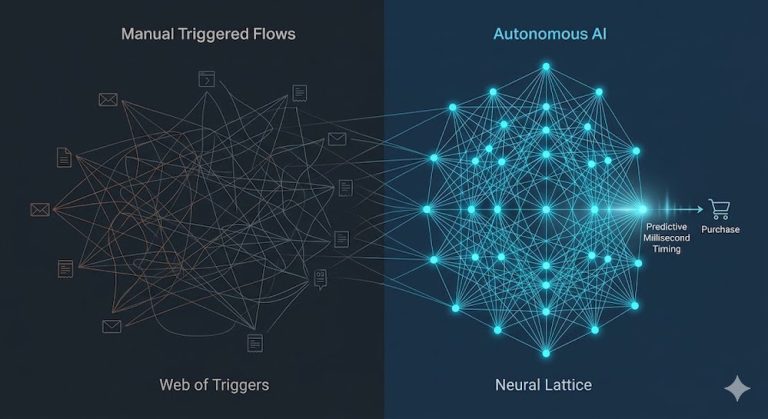
1. The Structural Failure of Legacy Automated Flows Traditional automated flows are fundamentally Reactive. They require a customer to perform an explicit, binary action—a click, a

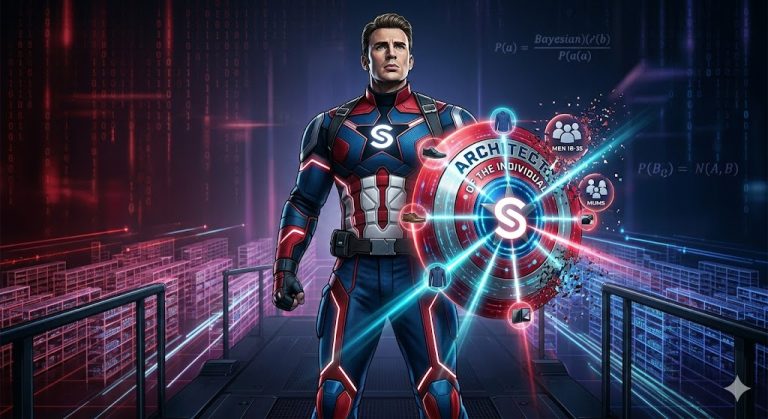
The Great Marketing Mirage For two decades, ecommerce and ecommerce directors have been sold a lie: that “Segmentation” is the pinnacle of customer relevance. We were told that if

Introduction: The Death of the “Average” Customer In the world of independent fashion and footwear, the “average” customer is a myth—a statistical ghost that doesn’t

Hyper-personalisation is when a brand or product doesn’t just treat you like “a segment” (like, female 25 to 34 in London who likes fitness). It

In the modern ecommerce stack, “Triggered Solution Marketing” (Klaviyo-style flows) and “Segmentation” (defining rules) have long been hailed as the gold standard. They were the

Agentic ecommerce changes how products are discovered and selected. If your entire 2026 ecommerce strategy relies on a customer clicking a link and visiting your

An expert analysis of The Measurement Problem for ecommerce customer behaviour, product relevance and measurable revenue growth.

Relevance can protect your margins: ecommerce discounting can produce short-term sales while quietly reducing contribution margin. When sales soften, a site-wide code may feel decisive,

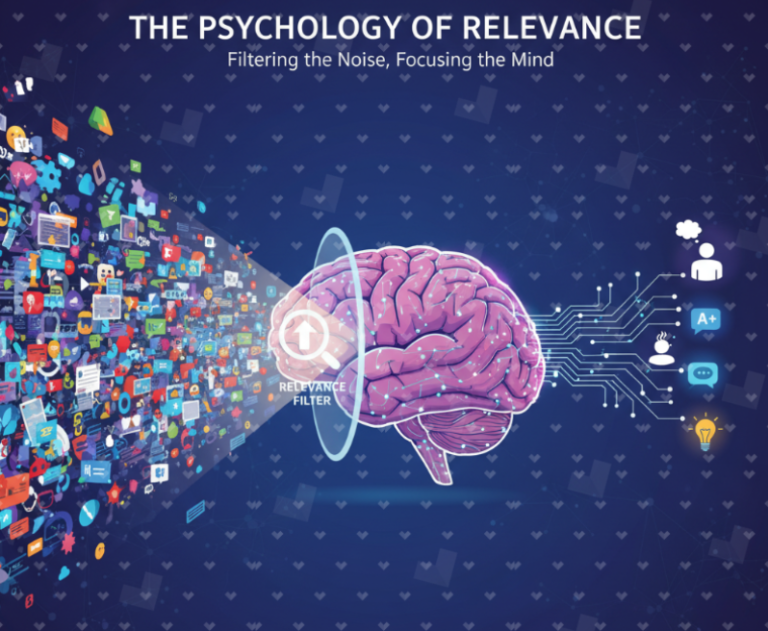
The psychology of relevance explains why an almost-right product recommendation can be worse than a shorter, genuinely useful selection. Ecommerce customers must ignore unsuitable products

Perpetual behavioural streams replace scheduled batch-and-blast campaigns with continuously recalculated product selections for each ecommerce customer. Instead of deciding what an audience segment should receive

An autonomous personalisation implementation roadmap should move from evidence and safeguards to controlled operation—not from a software purchase straight to full deployment. Ecommerce retailers need

Hyper-personalisation in fashion ecommerce addresses a demanding commercial problem: style, fit, price sensitivity and current intent differ sharply between individuals who may look identical inside