

Marketing technology: Digitally savvy brands invest in combinations of key tech solutions to ensure that their martech drives business value.
In a recession, many marketers cut back sharply on many expenses —except for their spending on technology. Investments in marketing technology still account for a sizable portion of marketing budgets. Yet brands utilize only 58% of their martech stack’s capabilities, according to Gartner research.
The disconnect between technology adoption and return on investment is a persistent challenge for digital marketing leaders. Taking cues from high-performing brands (Genius brands) can help drive greater martech utilisation. Genius brands rank highest on the Gartner Digital IQ Index (DIQ), which scores more than 2,000 brands on four digital competency dimensions: Site, digital marketing channels, social media and path to purchase. Based on its score, each brand is classified as Genius, Gifted, Average, Challenged or Feeble.
As digital marketing strategies grow and mature, leading brands rely on a mix of products. “Leverage product combinations the way Genius brands often do,” says Benjamin Bloom, Senior Director Analyst, at Gartner. “Establish which combinations are most relevant to your business and align complementary technologies to maximise capabilities and minimise waste.”
Marketing technology: Complement integrated-suite technology with point solutions
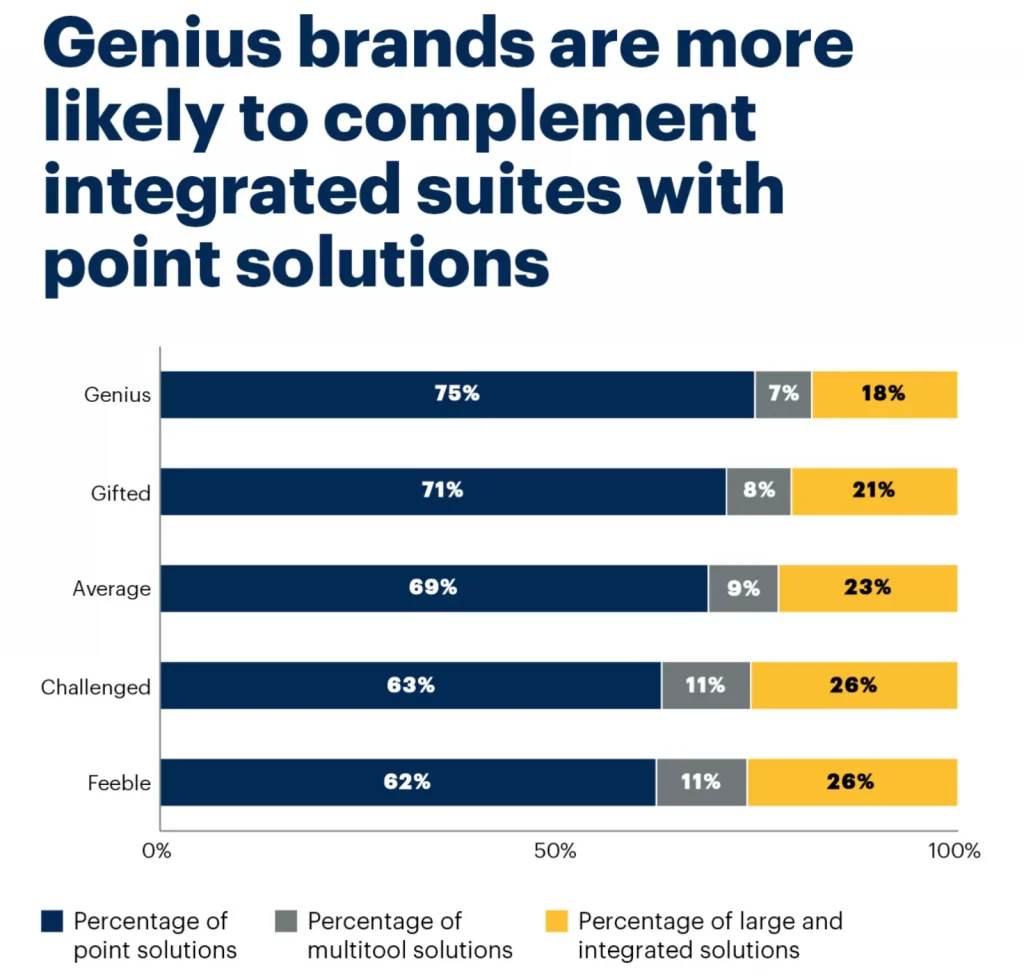
Many large vendors offer integrated solutions to meet a multitude of marketing capabilities. Genius brands do leverage these products, but point solutions — software designed to solve specific business problems — account for nearly three-quarters of their martech stacks. By comparison, less digitally proficient brands install more integrated products from large vendors at a higher rate. Acquiring all of the essential components of a Martech stack from a single vendor is uncommon: Just 29% of brands have more than one product from a single vendor.
Manage martech complexity for optimal performance
Gartner’s research finds no correlation between the amount of marketing technology investment and its effectiveness. Not every brand achieves its outcomes in ways that the number of technology solutions alone can explain. For example, about 20% of brands in the Gartner study have swelled in martech complexity yet failed to add sufficient ROI. Just 18% of brands display business performance that correlates with their stacks’ complexity.
To overcome the risk of martech complexity, build competencies around technology, content and workflow that enable technology to efficiently support marketing strategy. Assess capabilities to determine if sufficient depth in talent, training and organization is available to utilise the products in your stack.
Combine marketing technologies to extend capabilities
Genius brands extend their technology with complementary tools and build capabilities that advance their maturity. This combination of tools and work processes may explain the improved returns of brands with greater digital intelligence. High-performing brands are more likely to invest in technologies such as analytics and business intelligence, data science, mobile marketing platforms, demand-side platforms and digital asset management.
No single technology product is a key to top-performing martech. Instead, brands with high digital intelligence and complex martech stacks combine several linchpin technologies for analytics, data management, advertising, hyper-personalisation and multichannel marketing.
Further reading: how SwiftERM works.
Marketing technology: the current operational framework
Marketing technology can now be considered through SwiftERM’s autonomous individualisation. Product relevance is recalculated for each identifiable customer from that customer’s own behavioural and transactional evidence, rather than being assigned by a fixed segment, campaign or predetermined journey. This distinction matters because an individual’s interests can change between visits, purchases and periods of inactivity. A current decision therefore needs current evidence.
SwiftERM evaluates the products that are becoming most relevant to each person and applies that decision autonomously. The operating model does not depend on a marketer continually creating segments, selecting products or scheduling another campaign. It is designed to use first-party behavioural and transactional signals already associated with an identifiable customer, so the decision remains specific to that customer rather than a broad cohort.
For Marketing technology, the practical test is not whether a retailer can create more rules. It is whether the system can recognise a change in an individual’s buying intention, reassess the available products and act without waiting for a manual campaign cycle. The output must remain traceable to the customer evidence and the ecommerce catalogue used to make the decision.
Implementation also needs disciplined data handling. Product identifiers, availability and customer events must remain consistent enough for relevance to be recalculated. Existing ecommerce operations should retain control of catalogue truth, order truth and customer permissions. Autonomous individualisation then operates within those established boundaries instead of inventing a parallel customer record or an ungoverned product feed.
The commercial value of Marketing technology should be assessed through observed customer response, orders and turnover, not through the volume of campaigns produced. That keeps attention on whether product selection becomes more useful to the individual and whether the retailer captures demand that would otherwise remain unrecognised. It also separates autonomous decision-making from conventional automation that simply executes a previously written rule faster.
This current framework preserves the original article’s subject while bringing its explanation into line with SwiftERM’s present capability: one identifiable customer, individually recalculated product relevance, and an autonomous decision made from that person’s own changing evidence. The same principle applies as catalogue choice, customer behaviour and commercial conditions continue to change over time.
In operational terms, the retailer retains the commercial context while the software performs the individual calculation. That division is important: the catalogue and customer record remain governed business assets, while product selection responds continuously to evidence rather than to a static assumption made when a campaign was first configured.