

No marketing method has the highest return for every ecommerce retailer. Return depends on margin, incrementality, attribution window, audience, creative, catalogue and the costs included in the calculation. Channel benchmarks can help form a hypothesis, but the retailer’s own contribution profit and controlled evidence must decide where money is invested.
This article retains an older Nielsen comparison as historical context. It should not be read as a current universal ranking. Its useful purpose is to explain how different methods should be compared and why owned customer communication deserves separate scrutiny from paid acquisition.
- Paid online advertising
- Promotions/Price Discounts
- Magazines
- TV advertising
- Outdoor ads
- Newspapers
The chart below lists the major marketing methods that the vast majority of businesses will consider utilizing. We have also added the following mediums to review:
- Search engine optimisation
- Email marketing
- Direct mail marketing
- Trade shows
- LinkedIn Ad
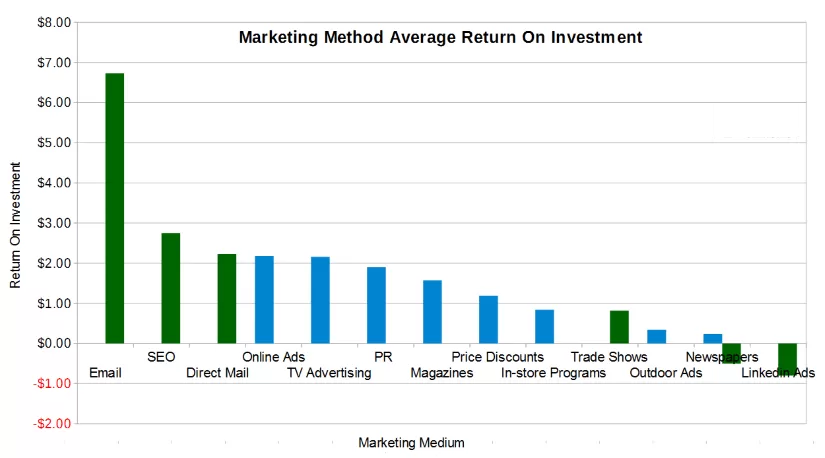
Comparing Marketing Methods
The linked Nielsen research is dated and compared selected advertising methods under its own methodology. It does not establish a permanent channel hierarchy, and SEO was not included in the comparison.
For a useful comparison, calculate incremental contribution profit—not simply attributed revenue—and include media, discount, production, technology, agency and internal operating costs. Results should be separated by channel and tested against what would probably have happened without the activity.
How to Measure the ROI of Your Marketing Activities
The first step to calculating the ROI of your marketing activities is to start attributing a marketing method to each sale. This can be done by giving customers a choice of marketing methods at the checkout page or if you don’t sell online it can be done by asking the customer how they found you and why they decided to buy at the time of purchase. Once you have this information you can calculate the sales and contribution margin attributed to each marketing method and calculate the return on investment for each method. To complete this calculation, you can use the formula below.
Marketing ROI = (Additional Profit From Marketing – Cost of Marketing)/Cost Of Marketing
Where Additional profit From marketing = Revenue from marketing – Variable costs of that marketing
And where Variable costs of that marketing = Revenue x Contribution Margin or Revenue – variable costs
For example:
If we assume that £10,000 in sales were brought from magazine advertising and that the company has contribution margins of 40%, that gives an ROI of [(10,000 x 40%)-500]/500 = 700% (Every £1 spent returned 7 pounds in profit after the cost of the marketing).
Different marketing methods excel in different campaign lengths. Some methods will take a few months to reach peak effectiveness while others will hit a peak immediately. Ensure you run and measure the campaigns for the right length of time, erroring on the side of measuring for too long a period.
Increasing the ROI of Existing Plans
The same Nielsen report found that marketing effectiveness could be increased by 30-40% by taking a closer look at the specifics of each marketing method and adapting the strategy to focus on strengths and minimize weaknesses. Their guiding principles for maximizing ROI are:
- Consider both the short and long-term impact of a marketing campaign
Different marketing methods excel in different campaign lengths. Some methods will take a few months to reach peak effectiveness while others will hit a peak immediately. Ensure you run and measure the campaigns for the right length of time, erroring on the side of measuring for too long a period. - Choose the right portals and campaigns for online success
Understand your target market on the web and focus on creating content and advertising to attract that specific demographic to your site. - Influence target groups with magazine advertising
Magazines have a segmented target group (unlike newspapers, which are read by a wide range of readers). If a magazine’s target group overlaps with your business’s target group consider advertising with that magazine. - Focus on campaigns that generate the greatest halo effect
Marketing methods that increase sales are what matter at the end of the day. Focus on methods that increase sales the most across the highest number of product lines. - Drive brand loyalty with TV advertising
TV/video ads are the best way to communicate brand information and build brand loyalty. For small or very targeted budgets try Youtube video ads. - Create synergies across media to produce additional uplift
The messages that your marketing is deploying must be consistent across all mediums. Implementing multiple media at the same time can cause a higher ROI. - Create brand awareness through in-store advertisements
An excess of discounts and promotions erodes a brand’s quality over time. Focus on advertising your brand within your store or website to continue to grow brand awareness instead of using discounts to drive sales - Invest in your customers with premium gift packs
Investing in your most valued customers has a short-term cost but can have a long-term gain. Increasing the perceived value of your services to your long-term customers is essential to keeping those customers. This can be done easily by offering additional services for free with a purchase or just giving them a small gift like a box of chocolates just to say thanks for being a customer.
Why first-party customer communication can produce strong returns
Email uses an audience the retailer has already acquired, so it can avoid repeatedly paying to reach the same customer. That structural advantage does not make every email profitable. Broad newsletters, fixed segments and triggered flows still differ materially in relevance, timing, margin and incremental effect.
SwiftERM uses first-party behavioural and transaction data to rank the products each identifiable customer is most likely to buy next and determine when that individual selection should be sent. The retailer keeps its existing email delivery platform; SwiftERM supplies autonomous individual product selection and timing.
The appropriate test is the additional contribution profit produced after SwiftERM’s cost, measured against a defensible baseline. That is more meaningful than applying a generic channel-average percentage to every retailer.
An index to all SwiftERM articles is available here.