
Your customers are telling you what they want. You’re just not listening.
There is an extraordinary amount of intelligence hidden in the ordinary behaviour of an ecommerce customer. The problem is not that retailers cannot see it.


There is an extraordinary amount of intelligence hidden in the ordinary behaviour of an ecommerce customer. The problem is not that retailers cannot see it.

For an independent specialist retailer, the current digital landscape feels remarkably conflicted. On one hand, you have spent years curation-perfecting your inventory, understanding why a

Ecommerce automation is the fundamental dividing line between a scalable architecture and a mathematical tragedy. In a £3 million FMCG brand, manual intervention is often misidentified

The pursuit of growth in the modern ecommerce landscape is often framed as a battle of volume: more traffic, more clicks, more transactions. However, the

In the high-SKU enterprise retail sector, the disconnect between inventory availability and consumer intent is the primary cause of lost margin. Traditional e-commerce models function

The Case for Autonomous Individualisation in High-SKU Retail In the high-SKU ecommerce landscape of 2026, the greatest threat to net margin isn’t competition—it is Technical Friction. Traditional “marketing

Marketing Stack Audit Proven to Stop 20% Ecommerce Turnover Leak To protect your gross margin, you must audit your marketing stack for the diminishing returns of the

The global ecommerce landscape has reached a point of systemic failure. For the enterprise managing £1.5M – £500M in turnover, the current model—built on manual “Flows,” agency

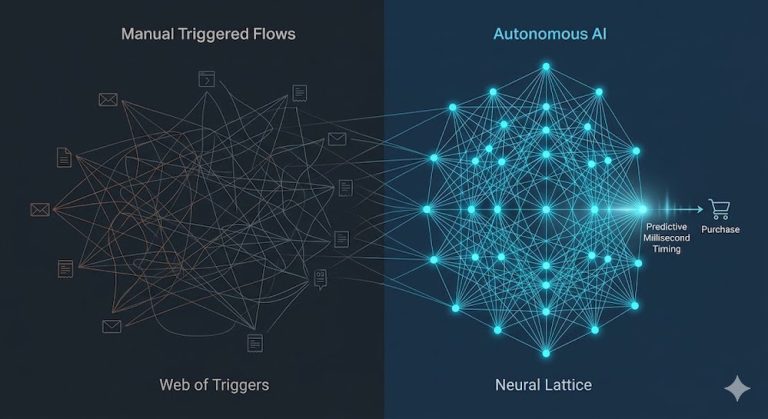
1. The Structural Failure of Legacy Automated Flows Traditional automated flows are fundamentally Reactive. They require a customer to perform an explicit, binary action—a click, a

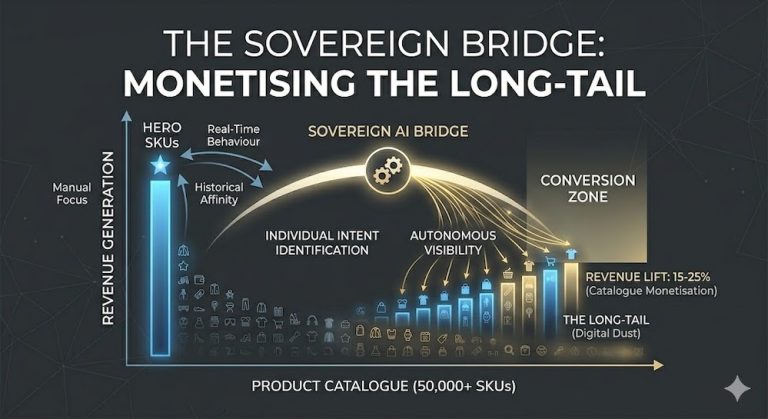
In the high-SKU ecommerce, retailers are haunted by a mathematical inefficiency: the Power Law of Inventory. Typically, 80% of revenue is generated by just 20% of

The Great Marketing Mirage For two decades, ecommerce and ecommerce directors have been sold a lie: that “Segmentation” is the pinnacle of customer relevance. We were told that if

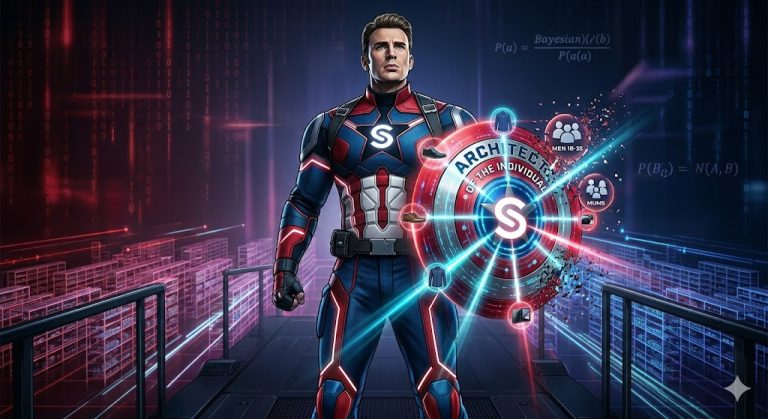
Introduction: The Death of the “Average” Customer In the world of independent fashion and footwear, the “average” customer is a myth—a statistical ghost that doesn’t

Hyper-personalisation is when a brand or product doesn’t just treat you like “a segment” (like, female 25 to 34 in London who likes fitness). It

In the modern e-commerce stack, “Triggered Solution Marketing” (Klaviyo-style flows) and “Segmentation” (defining rules) have long been hailed as the gold standard. They were the

If your entire 2026 ecommerce strategy relies on a customer clicking a link and visiting your beautiful, responsive website, your business is already a zombie.

Why traditional marketing metrics fail — and what should replace them For more than two decades, email marketing performance has been measured using campaign-centric metrics

Introduction: The Death of the “Average” Customer In the traditional ecommerce stack, the “customer” is a static data point. They are categorised into broad segments:

In the boardrooms of most ecommerce brands, the website is treated as the sun around which the customer orbits. Millions are poured into on-page optimisation,