
Product visibility in the AI-slop era depends on relevance and evidence
More generated content does not create more customer attention. When indistinguishable copy and imagery multiply, retailers need accurate product information, a recognisable point of view and distribution decisions grounded in what a particular customer is likely to value—not another layer of generic volume.
SwiftERM does not generate a campaign and hope it fits. It learns from each identifiable customer’s first-party behaviour and transactions, ranks the relevant SKUs and determines when to communicate them through the retailer’s existing email platform.
For an independent specialist retailer, the current digital landscape feels remarkably conflicted. On one hand, you have spent years curation-perfecting your inventory, understanding why a specific vintage, a particular textile weave, or a specialised pet nutrient is superior. You know your products, and you know the people who buy them. On the other hand, the internet is rapidly filling with automated content, generic product descriptions, and algorithmic noise often referred to as “AI slop.” When the internet is flooded with automated content, the traditional methods of getting products noticed fail because generic algorithms favour volume over true quality.
The real challenge for a specialist operating in the £1.5 million to £3 million turnover range isn’t competing on price; it is ensuring that your deep product expertise isn’t buried by generic, mass-produced digital noise. As search habits shift, the way consumers discover independent brands is changing. Shoppers are increasingly fatigued by generic recommendations, yet the platforms they use to find you rely more heavily than ever on automated sorting. To survive, independent retailers must learn how to make their authentic expertise machine-readable without losing the human warmth that defines their brand.
The Rise of the Discerning Shopper
British consumers are becoming significantly more selective. Recent retail data highlights that shoppers are actively resisting purely automated, detached shopping experiences, with nearly half of UK consumers stating they reject the use of fully autonomous AI tools to make personal style, clothing, or taste-based retail decisions for them. Instead, there is a distinct return to brand loyalty, where consumers prefer to initiate their shopping journeys directly on the websites and apps of trusted, independent specialists rather than scrolling through mass-market online marketplaces. Moving away from blunt search phrases means that getting products noticed now depends entirely on how effectively your platform maps unique item characteristics to highly specific customer intent.
This presents a massive structural advantage for boutique owners and passionate retailers. When a customer lands on your site, they are looking for identity, precise curation, and a sense of relationship. If your digital storefront treats them like a generic data point—showing them mass-market recommendations that ignore their specific taste profile—the illusion of the independent, personal touch breaks instantly. True personalisation for a specialist retailer isn’t about shouting louder with marketing campaigns; it is about reflecting the customer’s exact intent back to them through the inventory displayed on their screen.
Getting Products Noticed via Machine-Readable Curation
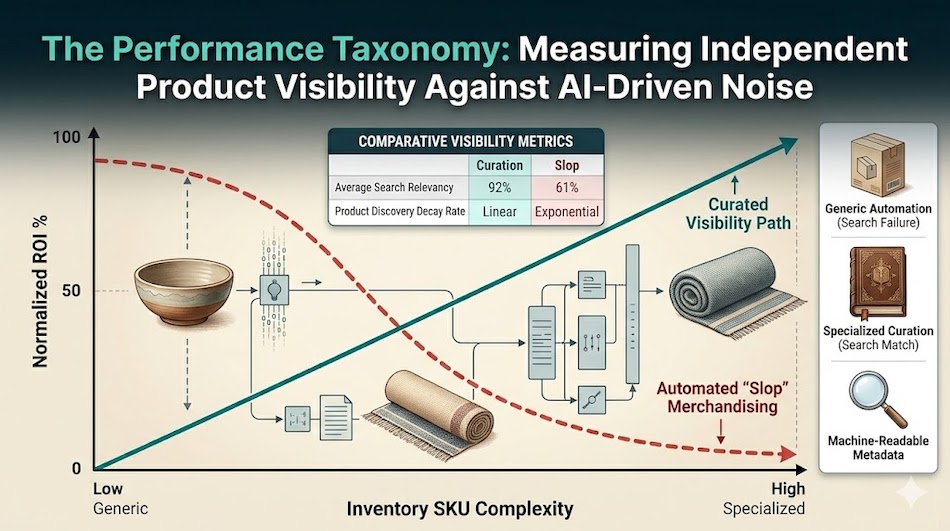
The pivot toward adaptive authority means keeping your elite product intelligence entirely intact while making your platform vastly more responsive. Large marketplace platforms rely on blunt keywords and mass categories. A specialist boutique thrives on the nuance between products. Customers are moving away from basic search phrases like “pink trainers” and are inputting highly complex, intent-driven queries regarding material origin, sustainability credentials, and hyper-specific technical standards.
To bridge the gap between your physical knowledge and digital execution, your data architecture must be flawless. If an online shop carries thousands of distinct stock-keeping units (SKUs) but relies on static navigation menus, the site is effectively hiding its own wealth. Artificial intelligence is quietly reshaping how customers discover products via conversational chatbots, meaning consumers are turned off instantly by “AI slop” and automated generic text. The independent businesses that thrive are those that let automation handle the background inventory tracking while keeping their unique voice, creativity, and product depth front and centre.
The Infrastructure Gap in Autonomous Commerce
For years, the retail sector has been lecturing businesses about omnichannel frameworks, often presenting them as expensive enterprise-level luxuries reserved for multi-million-pound conglomerates. In reality, the modern operational requirement is simply unified, real-time data. A severe vulnerability is emerging across UK ecommerce where autonomous shopping agents and machine-driven tools carry out transactions on retail platforms, yet backend structures lack the transaction visibility or liability controls to handle them smoothly. Over 58% of online merchants report that AI-initiated transactions are already hitting their stores.
Silently aligning deep inventory with real-time visitor behaviour is only half the battle, as 98% of a consumer’s life is spent away from a retail website. True visibility relies on monitoring intent proximity—ensuring that curated products are delivered exactly when an individual is identified as most likely to buy, via automated email dispatched at precisely the moment their purchase intent peaks.
The Opportunity Cost
Every hour high-SKU inventory sits hidden behind clunky navigation or generic, delayed automation is an hour of lost revenue. While mass-market tools guess based on static web traffic, predictive email intelligence actively identifies the exact moment a buyer is ready to convert—delivering precise products directly to the inbox. Leaving product visibility to chance doesn’t just lose a click; it leaks high-margin specialist sales to broad marketplaces.
Conclusion
The ultimate vulnerability for an independent specialist retailer is hidden inventory. When you carry thousands of highly specific SKUs, it is mathematically impossible for a human team to know exactly which product to display to which visitor at any given millisecond. Relying on static email campaigns or generic “best seller” banners means your most profitable, unique items remain buried in the warehouse. Every hour your digital storefront spends displaying irrelevant products to an expert consumer is a direct luxury tax paid to your larger competitors. True autonomous individualisation ensures that your entire inventory is working for you, automatically matching the exact depth of your stock to the precise intent of the buyer, turning passive browsing into immediate relationship-driven revenue.
References and Sources
- SCAYLE: Fashion Retail 2026: Strategies for Winning in a World of AI, Algorithms, and Tariffs. Available at: SCAYLE Trends Library
- Journal of Retailing and Consumer Services: Hyper-personalisation in Digital Retail: Evaluating the Shift from Segment-Based to Individualised Marketing Models. [Data Architecture Study]
- Modern Retail: The Independent Retail Report: Navigating Digital Noise and the Evolution of Specialist Physical and Online Storefronts. Available at: Modern Retail Analysis
- Journal of Consumer Research: The Paradox of Choice Revisited: Mitigating Cognitive Overload and Choice Paralysis in High-SKU Environments. [Cognitive Load Analysis]
- Retail Gazette: Retail Technology Trends 2026: Building Smarter, More Connected Stores. Available at: Retail Gazette Trend Reports
- International Journal of Information Management: Predictive Analytics in Email Architecture: Real-Time Intent Tracking and Consumer Purchase Proximity. [Data Infrastructure Review]