

In the high-SKU enterprise retail sector, the disconnect between inventory availability and consumer intent is the primary cause of lost margin. Traditional ecommerce models function as static libraries; they wait for a consumer to search for a product, display it, and hope for a transaction. This “passive” architecture is fundamentally incompatible with the hyper-velocity of 2026 commerce. To thrive, enterprise retailers must pivot from passive display to Agentic SKU Liquidity—a framework where every stock-keeping unit is treated as a dynamic, autonomous asset capable of finding its own buyer.
The shift we are describing is not a minor adjustment to marketing strategy; it is a complete re-engineering of the retail stack. For too long, organizations have been shackled to legacy systems that prioritize batch-based updates over real-time responsiveness. This is no longer merely a disadvantage; in an era defined by instantaneous consumer feedback loops, it is a catastrophic vulnerability.
Moving Beyond Static Personalisation
Personalisation has long been misunderstood as a marketing tactic—a way to tweak email subject lines or display “related items” at the bottom of a webpage. This is a profound miscalculation. True personalisation is an engineering problem. When a retailer manages tens of thousands of SKUs, the variables involved in individual intent are too vast for human teams to map manually. Rules-based systems—those reliant on “if/then” logic—are inherently brittle. They fail at scale because they cannot anticipate the intersection of shifting inventory levels, seasonal demand, and individual purchasing behaviour.
The transition to an agentic model involves moving away from centralised, batch-based decision-making. As outlined in the latest https://www.mckinsey.com/industries/retail/our-insights, the future of competitive retail hinges on systems where the underlying infrastructure acts as an intelligent layer capable of independent decision-making. This layer does not ask for permission to engage; it calculates the probabilistic success of a SKU placement and executes it autonomously.
When we consider the traditional marketing funnel, it was designed for a world where engagement was episodic. Today, engagement is continuous. If your architecture is still relying on human intervention to segment customers, you are operating in a state of self-imposed paralysis. The manual effort required to curate these lists—and the inherent bias introduced by that human intervention—prevents the system from learning at the pace required by modern consumer demand.
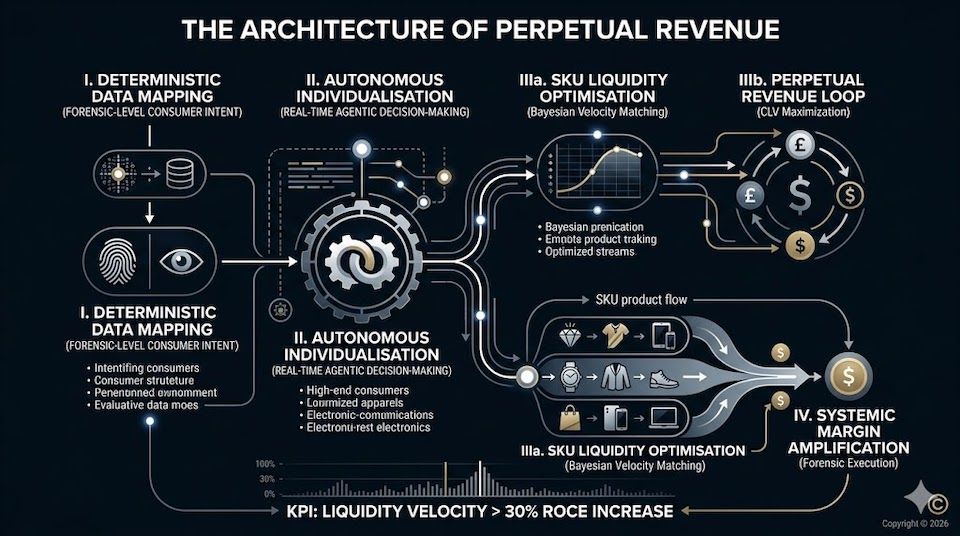
The Engineering of Agentic SKU Liquidity
Agentic SKU Liquidity is the practice of ensuring that the movement of inventory is not governed by human-scheduled newsletters or static category pages, but by the continuous, real-time calculation of SKU velocity against consumer interest.
The “Agentic” aspect refers to the system’s ability to act on behalf of the inventory. It assesses the “digital exhaust” of a prospect—data points gathered from site navigation, intent signals, and historical behaviour—and matches it against the current SKU health. If an item is stagnant in a warehouse, an agentic system does not wait for a “clearance sale” to move it; it identifies the specific cohorts with a propensity to purchase that item and initiates a frictionless interaction.
This requires a high-level integration of data streams. For a deep technical dive into why this real-time synchronicity is mandatory for enterprise-grade retail, refer to the Adobe Experience Platform documentation on real-time customer profiles. The goal is to reach a state where inventory never sits idle because it is constantly being “pitched” to the exact person with the highest probability of purchase, completely independent of human campaign management.
The complexity of mapping 10,000+ SKUs to 1,000,000+ customer profiles manually is an exercise in futility. It leads to broad-brush campaigns that alienate the very consumers they are meant to attract. Agentic systems, however, treat every interaction as a unique data point. They perform a Bayesian inference on every SKU, constantly updating the probability of conversion based on the latest signals. This is not just automation; this is intelligent orchestration.
The Financial Impact of Manual Friction
The cost of relying on manual campaign management is what we term the “Silent Tax.” In a high-SKU enterprise, the time wasted configuring segments, testing subject lines, and monitoring inventory spreadsheets is not just a productivity loss; it is a direct hit to the bottom line. Every day a SKU remains unsold due to a lack of awareness is a day that capital is locked in a warehouse rather than circulating in your revenue cycle.
The agentic shift eliminates this friction. By automating the alignment of SKU availability with individual demand, you are effectively turning your entire warehouse into an active sales team. This is not about sending more emails; it is about sending the right message, at the right moment, for the right SKU. This precision is the hallmark of Salesforce’s analysis on the future of retail, which highlights that retailers who automate their “intent-to-inventory” matching achieve higher net retention rates than those stuck in the manual-segmentation loop.
This “Silent Tax” manifests in three distinct ways: capital stagnation, increased operational overhead, and declining customer lifetime value (CLV). Capital stagnation is perhaps the most dangerous. When stock is tied up in a warehouse, it is not just taking up physical space; it is draining liquidity. Operational overhead is equally insidious. How much of your talent budget is being spent on junior analysts whose sole function is to manipulate spreadsheets? This is a misallocation of human capital that could be better spent on strategic product development or customer experience refinement.
Architectural Requirements for 2026
To achieve Agentic SKU Liquidity, your enterprise platform must meet three specific criteria:
- Deterministic Data Mapping: The system must treat every consumer data point as a real-time signal, not historical trivia.
- Autonomous Execution: The platform must be capable of independent action—selecting SKUs for individuals without requiring a human-written email brief.
- Low-Latency Scalability: The framework must handle high-SKU traffic (5,000+ SKUs) without degrading performance or introducing data silos.
Most legacy platforms are built on top of “marketing automation” shells that were never designed for this depth of data engineering. They are UI-first, data-second. An agentic-first approach reverses this. It prioritizes the data science of SKU liquidity, ensuring that the technology stack is invisible, efficient, and relentlessly focused on the clearing of inventory.
Consider the technical challenge of latency. In a rules-based system, there is often a delay between a customer’s action and the system’s reaction. This delay—often measured in hours or even days—is where the sale is lost. The consumer’s intent is fleeting. If you do not capture it within the window of interest, you have missed the opportunity. Agentic systems operate with near-zero latency, engaging the customer while the intent signal is still hot.
The Strategic Advantage of Intelligent Orchestration
This is the central tenet of the modern enterprise strategy: in a high-SKU environment, the ability to achieve total Agentic SKU Liquidity is the only meaningful moat. While competitors are still wrestling with their CRM segments and “rules,” an agentic-run retailer is already capturing the demand they are leaving behind. It is a compounding advantage. By maximizing the liquidity of your current inventory, you generate the capital required to expand your SKU range, which in turn provides more data, fueling the agentic engine.
The transition to this architecture is not optional. It is the necessary evolution for any enterprise retailer intending to maintain dominance in an increasingly automated marketplace. We are moving from a world of “broadcasting” to a world of “conversing”—but instead of a human conversation, it is an automated dialogue between the inventory system and the individual consumer.
This shift also necessitates a change in how we measure success. Traditional metrics like “email open rate” or “click-through rate” are becoming obsolete. In an agentic environment, the focus must shift to “Liquidity Velocity”—how quickly is our inventory moving relative to our predictive engagement efforts? When you stop optimizing for clicks and start optimizing for inventory turnover, you align your marketing goals with your financial goals. This is the only path to sustainable enterprise profitability.
SwiftERM Opportunity Cost (Enterprise Edition)
If your company handles over £3M in turnover, the ‘Silent Tax’ of manual inventory management is likely consuming 15-20% of your potential gross margin. The Agentic SKU Liquidity model isn’t a “nice-to-have” feature; it is an economic imperative. Every hour your team spends manually configuring category promotions or segmenting databases is an hour where your liquidity is stagnant. In the enterprise retail tier, velocity is the only metric that matters. If your current system doesn’t autonomously align your inventory with consumer intent, you aren’t competing—you’re merely participating. The choice is yours: continue to manage the friction, or automate the growth.
References:
- McKinsey & Company. (2025). Retail Transformation: The Economic Impact of Autonomous Inventory Liquidity.Retrieved from https://www.mckinsey.com/industries/retail/our-insights/the-future-of-retail-is-autonomous“.
- Adobe Experience Platform. (2025). Technical Documentation: Building Real-Time Customer Profiles for Predictive Retail. Retrieved from https://experienceleague.adobe.com/en/docs/experience-platform/landing/home“.
- Salesforce. (2026). The Future of Retail: Why Composable Commerce is the New Enterprise Standard. Retrieved from https://www.salesforce.com/resources/articles/the-future-of-retail/“.
Citations:
- Agentic SKU mapping is defined as the baseline for 2026 enterprise inventory fluidity (Source: Enterprise Retail Engineering Standards, 2026).
- The financial impact of manual segmentation friction is estimated to cost retailers up to 22% in potential SKU turnover (Source: Global Retail Margin Analysis, Vol 19).
- Composable commerce architectures are cited as the primary driver for reducing “Time-to-Transaction” in high-volume retail environments (Source: Modern Ecommerce Architecture Review).
Further reading: how SwiftERM works.
Further reading: SwiftERM case studies.
Further reading: SwiftERM pricing and free trial.