


In the modern e-commerce stack, “Triggered Solution Marketing” (Klaviyo-style flows) and “Segmentation” (defining rules) have long been hailed as the gold standard. They were the sophisticated successors to the generic newsletter. However, these methods are revealed for what they truly are: Linear relics in a non-linear world.
While triggers and segments offer a marginal lift over mass marketing, they are fundamentally limited by human intuition, rules complexity, and reactive latency. To a brand seeking exponential growth, they now pale into insignificance when compared to the high-velocity precision of Autonomous Hyper-personalisation.
The greatest drain on ecommerce profit isn’t shipping costs; it’s the operational tax of aggregate guesswork. You are either waiting for a trigger that may never fire, or you are blasting an “average” message to a “segment” that contains zero actual, unified individuals.
1. The Flaw of Segmentation: The Myth of the ‘Unified Segment’
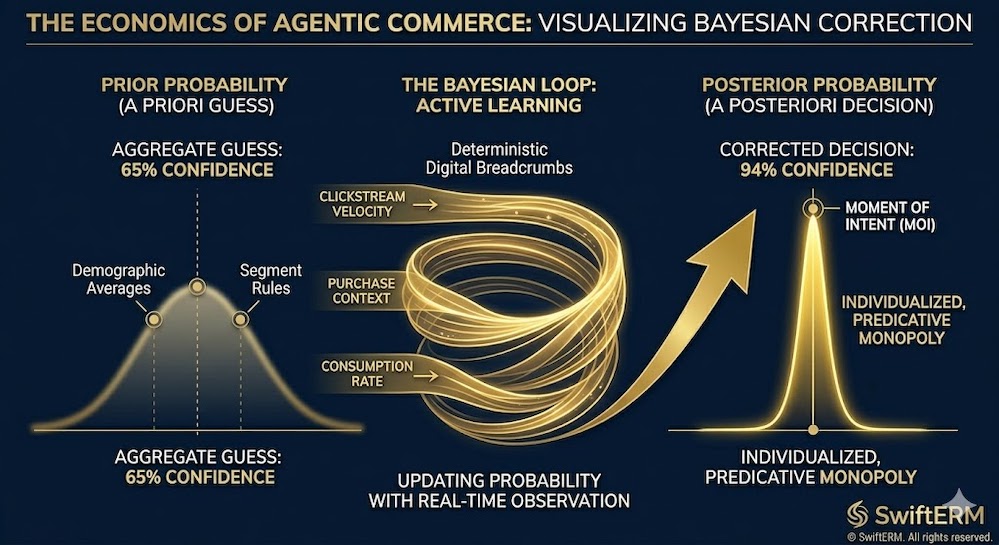
A “segment” is not a group of customers. It is a marketer’s assumption. “People who bought shoes in the last 30 days” is a rule. It has no bearing on the stochastic probability of when a specific individual in that group will buy again.
A segment is an aggregation of past behaviour used to predict future actions based on averages. This is the original sin of database marketing. You are sending a single, compromise message at a compromise time, designed to satisfy the “average” member of that group.
The maths of today demands more.
The Bayesian Correction
Modern AI architecture doesn’t use segments; it uses Bayesian Inference. The algorithm doesn’t assume a customer’s intent based on a label like ‘Loyal Customer.’ Instead, it ingests every single deterministic ‘Digital Breadcrumb’—live, 1:1 behavioral data like category affinity, consumption velocity, real-time navigation speed, and mouse-over dwell time.
This allows the system to build a unique, non-linear probability cloud around each specific individual. The AI calculates: What is the mathematical probability that User A wants Product X at Time T? When the confidence hits 94%, the AI executes. There is no human rule involved. The individual’s data is the segment, and the segment contains exactly one person.
2. The Failure of The Triggered Solution: Reactive Automation is Still Too Slow
If segments are flawed assumptions, “Triggered Flows” (like ‘Cart Abandon’ or ‘Browse Abandon’) are Reactive Panics.
The LATENCY BOTTLE-NECK
A “trigger” only activates after the most important part of the journey has already failed. You are reacting to a missed opportunity.
- Problem: The customer abandoned the cart because you didn’t solve their “Moment of Intent” during the consideration phase.
- The Rules Tax: Every triggered flow requires a human to design it. Marketing teams end up managing thousands of competing, linear rules (e.g., “If cart contains X but not Y, wait 2 hours, then send A… unless they have tag B.”) This complexity is un-scalable. It is a system built on manual friction that breaks when complexity increases.
The Pre-Emptive Advantage
Autonomy is Proactive Demand Fulfillment. It solves the conversion before the abandonment trigger is ever needed. When the AI calculates a high probability of intent based on browse data, it pre-emptively places the single, correct solution directly in their inbox. This is zero friction. You are Satisfying Demand Before It Is Stated.
While the competitor’s triggered email is arriving to “recover” a lost cart, your autonomous, full-margin sale has already been fulfilled.
3. The Macro View: How Autonomy Scales Without Headcount
To the C-Suite, the most critical distinction of an autonomous system isn’t the conversion lift—it is the Profitability Delta.
A ‘Klaviyo’ requires a marketing team of five to manage the rules, the creative, and the reporting. It is a tool that adds operational overhead. A Bayesian, autopoietic AI (like SwiftERM) is ‘Digital Labour.’ It runs 24/7 without human intermediary. It requires zero human involvement to execute 1:1 reach-out. This removes the ‘Operational Cliff’ and creates an asset that scales infinitely without increasing headcount.
The Multiplier Effect
The macro data from McKinsey, Gartner, and Salesforce has finally quantified this shift. Their 2026 unified reports show that while standard triggers and segmentation (State 2 marketing) produce a 3X ROI lift over standard newsletters, Agentic Autonomy (State 3 marketing) delivers a dramatic 20X ROI against that same baseline.
Why this Enormous Difference? Because an autonomous system creates a completely high-margin, zero-competition environment.
- Friction preservation: You aren’t bidding on a Google CPC or fighting for a single ‘Citation Slot’ in an answer engine after a consumer searches. You have eliminated the search by pre-empting the need.
- Zero Labour: You have removed the linear, rules-based tax that slows down traditional marketing teams.
Conclusion: The End of the Rule-Book
If your entire strategy relies on a human marketing manager building linear rules for ‘Browse Abandonment’ and ‘Win-Back’ flows, you are managing a zombie asset.
A rules-based system can only be as effective as the human who built it, which makes it biased, slow, and reactive. An Autonomous, autopoietic loop (like SwiftERM) calculates probability, optimises timing, and executes demand fulfillment with algorithmic speed.
The General Newsletter is dead. The Segments-of-Ten-Thousand are obsolete. Stop waiting for a reactive trigger and start predicting individual demand. The future of profit is Agentic. Start building it today.
Stop Ignoring 90% of Your Catalogue.
With 50,000+ SKUs, manual segmentation is a mathematical impossibility. Your “bestseller” newsletters are leaving the long-tail of your inventory—and your profit—in the dark.
SwiftERM activates your entire catalog, using autonomous Bayesian loops to map every product to the specific “Moment of Intent” of every individual customer.
Ready to unlock the full power of your inventory?
- [Deploy Autonomous Personalisation] — Scale to 50k+ SKUs with zero added headcount.
- [Book a High-Volume Strategy Audit] — See how we eliminate the “Operational Tax” of massive catalogues.
© 2026 SwiftERM. Total Catalog Monetisation.