

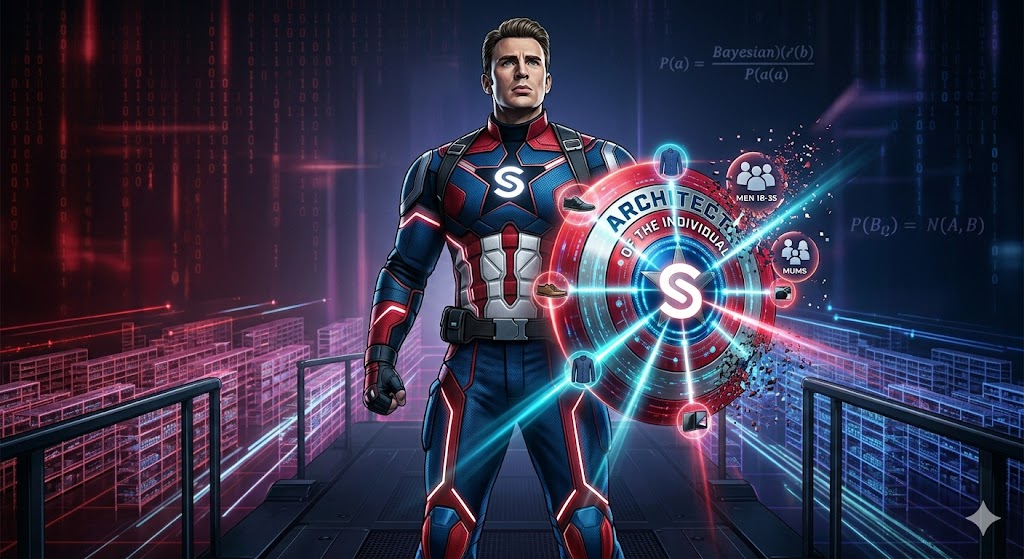
The Great Marketing Mirage
For two decades, ecommerce and ecommerce directors have been sold a lie: that “Segmentation” is the pinnacle of customer relevance. We were told that if we could just group our customers into neat little buckets—”Active High-Spenders,” “Churn Risks,” or “Discount Seekers”—we would unlock the secret to loyalty.
But in a high-SKU retail environment, the “Segment” is a blunt instrument. It is a generalisation masquerading as an insight. While your team is busy building a persona for “Sarah, the 35-year-old Yoga Enthusiast,” Sarah has already moved on. She isn’t a persona; she is a dynamic stream of intent. By grouping her with 5,000 other “Sarahs,” you aren’t personalising—you are averaging. And in the race for SKU yield, averages are where profit goes to die.
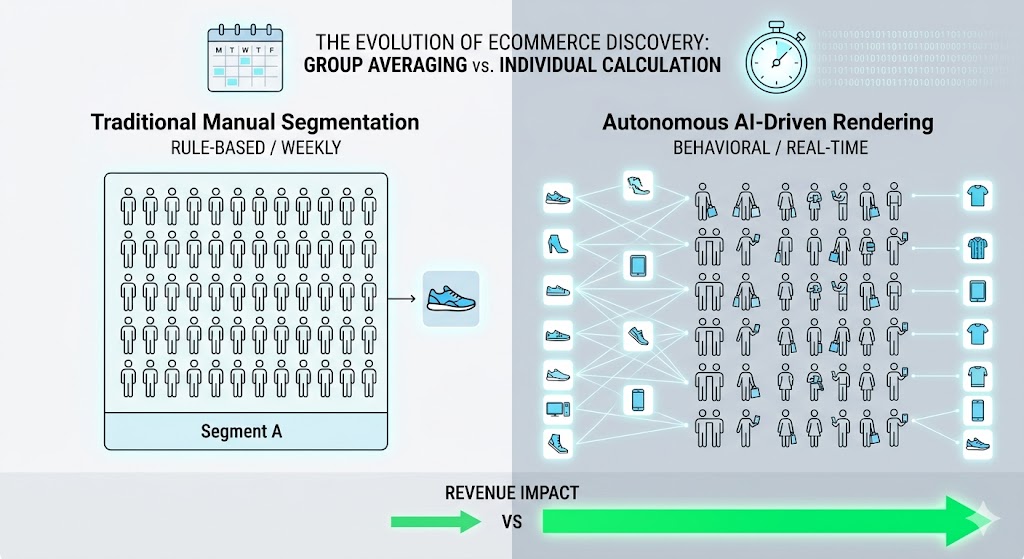
The “Frequentist” Failure
Traditional segmentation is built on “Frequentist” statistics—looking at what a group did in the past to predict what an individual might do in the future. This is the Strategic Friction that holds back £1.5M – £500M brands.
When you segment, you are looking in the rearview mirror. You are sending a “Yoga Mat” email to Sarah because she bought one six months ago. You are ignoring the fact that for the last three days, her “Digital Breadcrumbs” show a sudden, intense interest in high-end supplements and weight-lifting gear. By the time your manual segment updates, her “Window of Intent” has slammed shut.
The Shift to Bayesian Inference
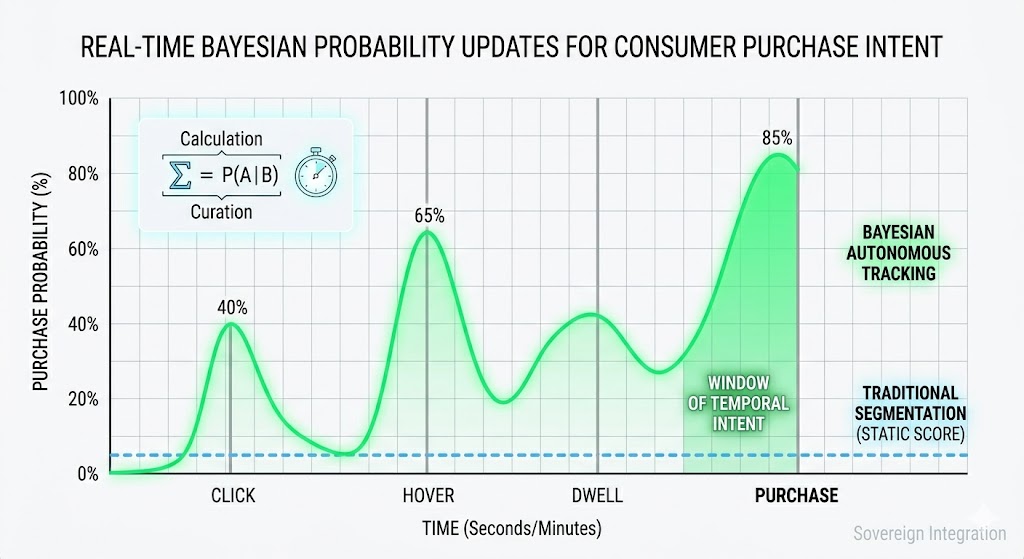
The alternative is not “better” segments; it is the total eradication of the segment. We are moving toward the Mathematics Of Intent: Why Bayesian Inference Is The Future.
Unlike traditional rule-based triggers, Bayesian models update their probability of “the next purchase” with every single click, hover, and dwell-time event. It doesn’t care who “Sarah” is supposed to be; it only cares what Sarah is doing right now. This is the shift from Curation (human guessing) to Calculation (machine certainty).
The 1-to-1 Reality: The Segment of One
When we speak of “Personalisation at Scale,” we are talking about a unique rendered experience for every individual in your database. If you have 100,000 customers, you should be sending 100,000 different emails—not 5 variations of a “Weekly Newsletter.”
This level of granularity is physically impossible for a human team to manage. This is where the Fall Of The Rule-Book Triggered Solution And Segmentation becomes apparent. Human-written “If/Then” rules cannot scale to meet the complexity of a 10,000 SKU catalogue. You cannot write enough rules to cover every permutation of human desire.
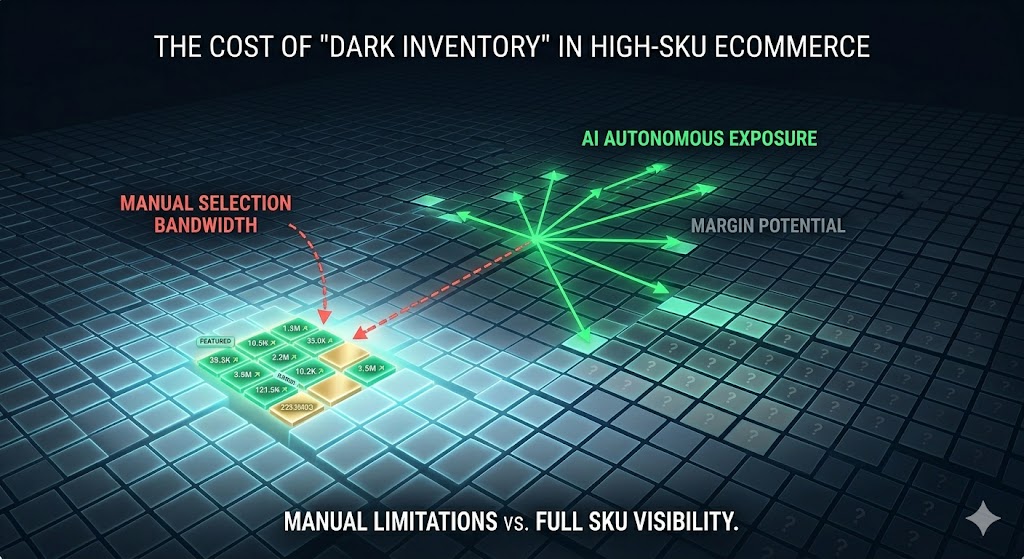
The Economic Reality of “Dark Inventory”
The most dangerous byproduct of the “Segment” is the creation of “Dark Inventory.” Because a human marketer can only conceive of a few segments at a time, they naturally gravitate toward “Hero Products” that appeal to the broadest group.
This results in a cycle where 5% of your products get 95% of the exposure. Your “Long Tail” SKUs—the high-margin, niche products that drive real profitability—stay hidden in the warehouse. They are “Invisible” to your customers because they don’t fit into a broad-market persona. According to McKinsey & Company, companies that master this level of 1-to-1 intimacy derive 40 per cent more of their revenue from personalisation than their slower-growing counterparts.
The “Zero-Input” Imperative
The future of ecommerce isn’t about giving your marketers better tools to segment; it’s about removing the need for them to segment at all. True autonomy is “Zero-Input.” It means the system ingests the data, calculates the probability, and renders the content without a single human meeting.
This is not a future concept; it is a current necessity. As highlighted in the Autonomous Hyper-Personalisation In Email: A Cost Analysis, the operational overhead of manual segmentation is a “Silent Tax” on your growth. You are paying for human hours to produce sub-optimal results.
Institutional Validation: The Global Shift
The world’s leading research firms are already flagging this transition. Gartner identifies that by 2026, over 40% of leading enterprises will have adopted hybrid computing paradigm architectures to manage this exact type of autonomous decision-making. They recognise that the human brain is no longer the most efficient engine for retail discovery.
Furthermore, the Baymard Institute has consistently shown that the primary reason for user drop-off is a failure in “Product Discovery.” If the user has to work to find what they want, they leave. Segments force the user to work; 1-to-1 autonomy brings the product to the user.
The Architect’s Conclusion: Reclaim Your Visual Authority
The “Segment” was a useful tool for the era of broadcast media. In the era of autonomous ecommerce, it is a relic. If you are still defining your customers by “Groups,” you are missing the Individual.
You have the inventory. You have the data. It is time to stop “grouping” your potential and start calculating your success. The Death of the Segment isn’t a tragedy—it is the birth of the most profitable era in your brand’s history.
Conclusion: The Sovereign Transition
The era of the “Segment” was a necessary stepping stone in the history of retail, but for the high-SKU architect, it has become a ceiling. Every minute your team spends manually sorting customers into buckets is a minute lost to your competitors, who have already embraced the Sovereign model of total autonomy.
The death of the segment isn’t merely a technical update; it is an executive liberation. It frees your marketing talent from the “drudgery of the spreadsheet” and allows your entire product catalogue to breathe. By moving to a 1-to-1 calculation, you are no longer shouting at a crowd—you are whispering exactly what each customer wants, at the precise moment they want it.
In the high-SKU retail game, the winner isn’t the one with the most segments; it’s the one who has successfully eradicated the need for them. The inventory is in your warehouse. The data is in your platform. The only thing missing is the autonomous engine to bridge the two.
Technical & Institutional Citations
SwiftERM Technical Whitepaper (2026) – The Mathematics of Intent: Eradicating Manual Friction in High-SKU Environments.
McKinsey & Company (2021) – The Value of Getting Personalization Right—or Wrong—is Everything. Link
Gartner (2025) – Top Strategic Technology Trends for 2026: The Rise of Autonomous Agents. Link
Baymard Institute (2024) – E-Commerce Product List UX: 36% of Sites Have Severe Discovery Issues. Link
Harvard Business Review (2022) – The Algorithmic CEO: How AI is Redefining Executive Decision Making.
Journal of Marketing Research (2023) – Bayesian Inference in Real-Time Consumer Choice Models.
Deloitte Digital (2023) – The Hyper-Personalization Opportunity: Moving Beyond Traditional Segments.
Forrester Research (2024) – The End of the Persona: Why Behavioral Data Trumps Demographic Modeling.
MIT Sloan Management Review (2023) – Scaling Personalization with Machine Learning: A Retail Perspective.
Journal of Retailing and Consumer Services (2025) – Long-Tail SKU Optimization through Autonomous Recommendation Engines.
The Royal Statistical Society (2022) – Applications of Bayesian Networks in Predictive Consumer Analytics.
Accenture Interactive (2021) – The Personalization Pulse Check: Why Consumers Crave 1-to-1 Relevance.