

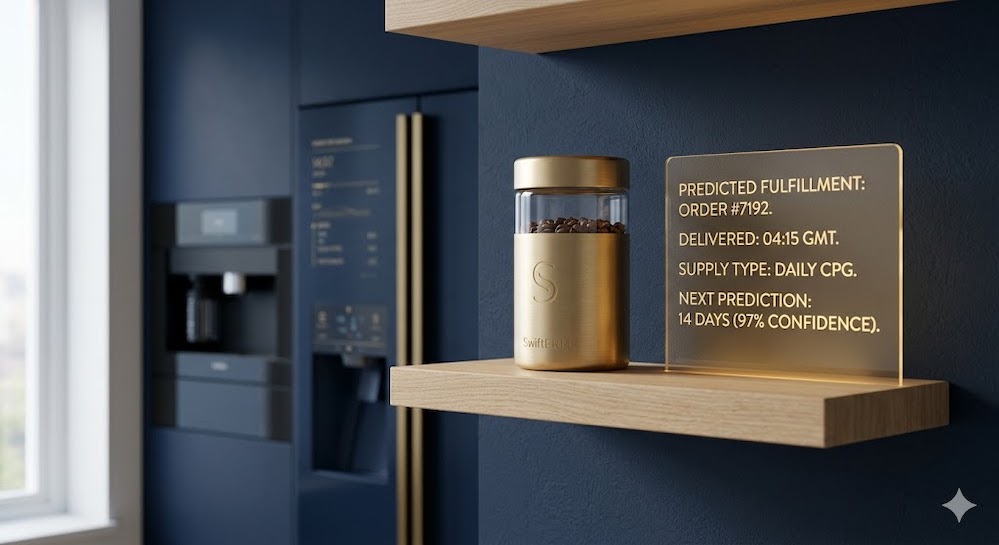
If your entire 2026 ecommerce strategy relies on a customer clicking a link and visiting your beautiful, responsive website, your business is already a zombie. You just haven’t fallen over yet.
For twenty years, the “Visit” has been the golden metric of retail. Get them to the site, show them a banner, trigger a pop-up, and hope for a 3% conversion rate. It was the “If you build it, they will come” model of commerce.
That model is dead. It didn’t just die; it was executed by the sheer force of computational speed and the rise of Autonomous Agents. We are now in the era of Agentic Commerce, where the fundamental unit of value is no longer the “Click,” but the Machine-Readable Prediction.
The End of ‘Browsing’: Why 2026 is the Year of the Shopping Agent
We saw the first tremors in 2024. Consumers started asking ChatGPT for product comparisons instead of Google. “Best noise-cancelling headphones for commuting” replaced a direct search for “Bose vs. Sony.”
By 2026, those foundational queries have evolved into Delegated Actions. According to the latest data from Salesforce, 31% of Gen Z shoppers are now comfortable letting an AI agent (like their Gemini-powered assistant or OpenAI’s Sora Commerce plugin) research, compare, and even execute a purchase on their behalf.
The consumer isn’t “browsing” your site; they are “tasking” their agent.
The Implications are Catastrophic for Traditional Retail
This is a tectonic shift. It means your:
- $1M ‘Experience’ Site: Completely irrelevant to a machine agent.
- On-Page Personalisation (Nosto, etc.): Wasted on a visitor that never arrives.
- Triggered Cart Abandonment (Klaviyo, etc.): Reactive, slow, and too late.
If the consumer isn’t visiting, how does your brand survive? By switching from a “Waiting for the Visitor” mentality to a “Meet the Demand Before It is Stated” strategy. This is Agentic Demand Fulfilment.
The Predictive Reality: Why Averages are the Enemy of Profit
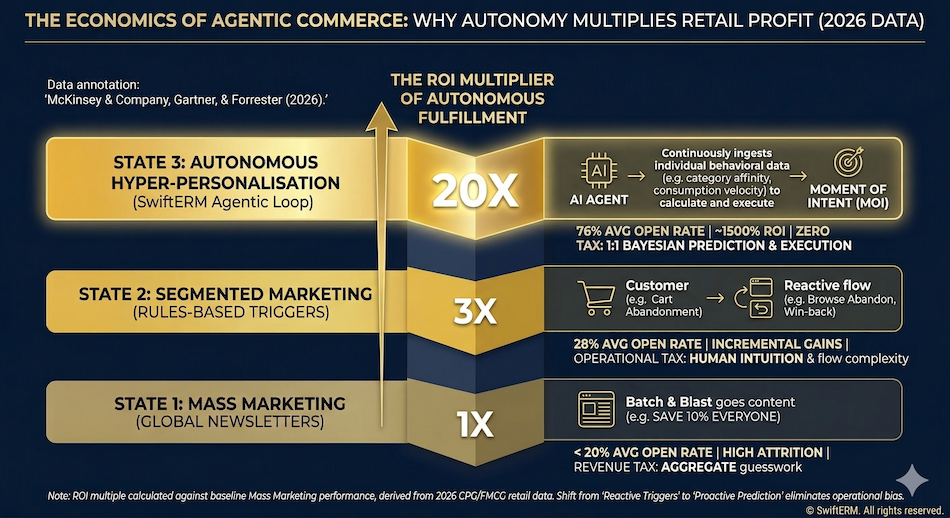
The most significant bottleneck in traditional ecommerce has always been human intuition. A marketing team builds a segment: “People who bought shoes in the last 30 days.” They define a rule. They generate a list. They send a “Batch and Blast” message at 10:00 AM on a Tuesday, based on an “average” send-time study.
This is a mathematical guarantee of wasted impressions and lost profit. It is Reactive Marketing, and it is too slow to compete in 2026.
The Math of Autonomy
The alternative is Proactive, Bayesian-Led Fulfilment. This isn’t just about sending a better email; it’s about shifting from a “reporting” model to a “predictive” model. It asks: What is the mathematical probability that User A will buy Product X at Time T?
Consider a high-frequency CPG category like premium coffee pods.
- The Traditional Approach (Segmented): Send an email on day 30, when the consumer has already bought from a competitor on Amazon.
- The Autonomous Approach (Predicted): AI calculates the individual’s consumption rate. On day 27, when their stock is low, an AI hyper-personalised, 1:1 email lands in their inbox with a one-click re-order of their specific roast. Zero friction. Zero decision fatigue. Just demand, met.
This is the power of a “Zero-Segment” architecture. The individual’s data dictates the action, not a marketer’s assumption.
The Macro View: Corroborating the Agentic Ecommerce Shift
Don’t take our word for it. Look at the data provided by the “Big Three” consultancies:
1. Gartner’s Search Cliff Prediction
Gartner predicted a 25% drop in organic search traffic as consumers moved away from traditional search and toward AI-powered Agents (SGE and ChatGPT). This “Search Cliff” means your SEO strategy is no longer a growth lever; it is a retention play. New customer acquisition now requires Proactive, Algorithmic Outreach.
2. McKinsey’s $7 Trillion Shift
McKinsey & Company reports that the total value unlocked by Generative AI and Agentic Commerce will exceed $7 Trillion annually across the global value chain. They found that companies that grow faster drive 40% more of their revenue from autonomous ML hyper-personalisation than their slow-growing counterparts. For the top-tier players, this doesn’t mean a 10% lift; it is a 20x return on marketing spend.
3. Forrester’s Maturity Model
Forrester noted that “Individualisation” is the true successor to “Segmentation.” Their research shows that individualised, automated product recommendations can increase Average Order Value (AOV) by up to 25% by effectively managing dense catalogues.
The Technical Moat: The SaaS Distinction of Autonomy
For the CTO, this shift requires a new architectural standard. Traditional personalization requires “Model Training.” It’s an “Integration Tax” that slows down the storefront and requires constant human tuning.
Modern, agentic systems use an API-First, Decoupled Architecture. They ingest raw event streams (clicks, views, purchases) via a lightweight JS snippet. The heavy lifting—the Stochastic and Bayesian calculations—is done in the cloud, in the “shadow” of the storefront transaction, without adding latency.
Zero Human Involvement as a Feature
The critical distinction of an Agentic System (like SwiftERM) is the elimination of human intermediaries. This removes the “Bottleneck of Intuition” and, importantly, removes cognitive bias. The AI has no “emotional bias” against recommending an “old season” SKU if the data shows that is what the individual is mathematically most likely to buy next.
Conclusion: The New Era of Customer Maximisation
The data from McKinsey, Gartner, and Forrester all points to the same mathematical reality: The general newsletter is a relic. The rules-based triggered flow is too slow.
In 2026, the retail race is won by the brands that can shift from Customer Acquisition (high cost/low margin) to Customer Maximization (low cost/high margin).
You are no longer building a “store.” You are building a Predictive Revenue Engine. The goal isn’t to get them to the site; it’s to place the solution directly in their lap at the exact millisecond their need arises.
The question isn’t whether your team can manually execute this; they can’t. The question is: Are you going to wait for your customers to delegate their shopping to an AI agent, or are you going to deploy an autonomous agent to predict their demand first?
The future of profit is Agentic. Start building it today.