
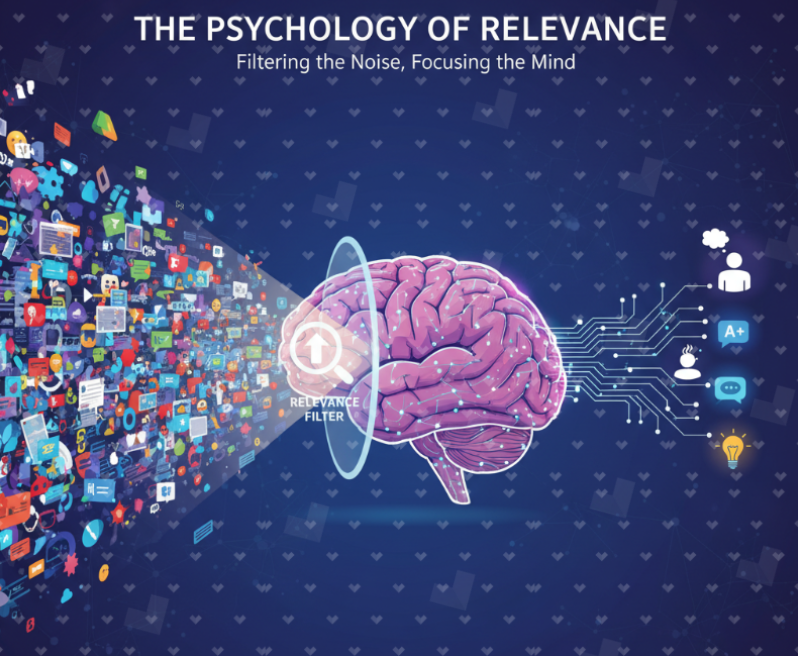
The psychology of relevance explains why an almost-right product recommendation can be worse than a shorter, genuinely useful selection. Ecommerce customers must ignore unsuitable products before they can consider the one that fits their present intent.
Many retailers still rely on broad segments, seasonal triggers and “people who bought this also bought that” recommendations. Those methods can help discovery, but they do not establish what one individual is most likely to buy next.
However, there is a silent drain on your bottom line. “Good enough” is no longer a neutral state; it is a source of friction. When a customer opens an email from your brand and finds products that are almost right, but not quite, you aren’t just missing a sale. You are actively training their brain to ignore your next notification.
This article examines the psychology of relevance, the effort imposed by excessive choice, and the evidence retailers should require before calling a recommendation effective.
1. The Paradox of Choice and Cognitive Load in the Psychology of Relevance
Choice overload is real in some settings, but it is not a universal rule. A controlled experiment found that very large assortments can reduce satisfaction even when they do not reduce the number of choices made. The practical lesson is to test whether a selection helps customers decide, rather than assuming that more or fewer products always wins. Read the choice-satisfaction experiment.
When an ecommerce brand sends a weekly newsletter featuring “Our Top 10 Picks,” they are forcing the customer to perform Cognitive Labour. The customer must:
- Filter out items they already own.
- Filter out items that don’t fit their current style.
- Filter out items that are outside their current budget.
- Decide if any of the remaining items are worth the effort of a click.
Every unsuitable item adds work: the customer must recognise it, reject it and continue searching. Repeated irrelevance can therefore make a message easier to ignore, even though the exact effect should be measured rather than assumed.
The Autonomous Solution: Hyper-personalisation removes the “Filter” phase of the customer journey. By using predictive modelling to present only the items with the highest probability of purchase, you bypass the Paradox of Choice. You aren’t offering a “Top 10” list; you are offering a “Only For You” selection.
2. Decision Fatigue vs. The Digital Concierge
Decision fatigue is often used to describe declining decision quality after sustained mental effort. In ecommerce, the safer operational conclusion is simple: do not ask a customer to browse unnecessarily when behavioural evidence can narrow the selection.
If your email asks them to make more decisions—to browse, to compare, to hunt—you have already lost.
This is where the concept of the Digital Concierge comes in. In a luxury hotel, a concierge doesn’t hand you a 500-page book of every restaurant in London. They ask two questions, observe your demeanor, and hand you one reservation card.
Autonomous AI, like SwiftERM, functions as this concierge. It doesn’t just look at what the customer bought in the past (historical data); it looks at the velocity of their intent.
- Did they look at red dresses three times in the last 48 hours?
- Do they typically buy on payday?
- Is their average session duration increasing or decreasing?
By synthesising these signals, the AI presents a solution, not a choice.
3. Measure the Relevance Premium
There is no universal percentage uplift from relevance. Performance depends on catalogue, customer behaviour, data quality and the comparison used. The defensible measure is incremental revenue from a controlled holdout group, not revenue merely attributed by the sending platform.
A useful recommender should be assessed from the customer’s perspective as well as by prediction accuracy. Research on user-centric evaluation shows why experience, trust and decision support belong beside technical metrics. See the user-centric recommender evaluation study.
Recommendation quality should be tested against what the customer actually does next. Utility-based recommender research also demonstrates that the value of a recommendation cannot be reduced to similarity alone. Review the utility-based recommender research.
It is not magic; it is the mathematical elimination of irrelevant options.
4. The “Implicit Signal” Algorithm: How the AI “Feels” Intent
Most retailers rely on Explicit Signals: A purchase, a “Favourite” click, or a Newsletter sign-up. These are rare. The true goldmine is in Implicit Signals. These are the “micro-behaviours” that a human marketer could never track, let alone act upon, for 50,000 customers simultaneously.
- Dwell Time: How many seconds did they spend looking at a specific image?
- Scroll Depth: Did they reach the bottom of the “Technical Specs” or stop at the “Lifestyle Photos”?
- Navigation Path: Did they go from “Men’s Shoes” to “Hiking Boots,” or from “Sale” to “Hiking Boots”?
An autonomous system takes these thousands of data points and builds a Preference Map. While a manual marketer is still trying to figure out which subject line will get more opens, the AI has already recalculated the product grid for User #4829 based on the fact that they just clicked a link from a specific Instagram influencer 30 seconds ago.
5. Moving From “Automated” to “Autonomous”
The biggest hurdle for ecommerce CEOs is understanding the difference between Automated Marketing and Autonomous Marketing.
- Automated Marketing is a machine following a human’s rules. (e.g., “If they buy a printer, wait 30 days and send an email for ink.”) This is better than nothing, but it is rigid. What if the user bought the ink elsewhere? Or what if they are a heavy user and need ink in 10 days?
- Autonomous Marketing is the machine creating its own rules based on real-time data. It observes that User A uses ink faster than User B and adjusts the “Send Time” and “Product Selection” accordingly.
Human-written rules cannot account for every change in individual behaviour. An autonomous system can recalculate product selection and timing as new evidence arrives, while the retailer verifies the commercial effect through a controlled comparison.
6. Illustrative Example: Changing Product Affinity
Consider a coffee customer whose recent browsing shifts from a usual blend towards new dark roasts. An autonomous system can respond by ranking different products rather than sending a fixed reorder reminder.
This is an illustration, not a case study or performance claim. The retailer should measure whether the changed selection produces incremental orders and contribution through a controlled comparison.
10-Point Relevance Audit for Your Store
- Do 100% of your subscribers receive the same Tuesday newsletter? (If yes, you are losing money).
- Is your “Send Time” based on your office hours or your customer’s behaviour?
- Does your email software automatically suppress products a customer has already bought?
- Can your system distinguish between a “Gift Purchase” and a “Personal Purchase”?
- What incremental revenue and contribution does each email generate against a holdout group?
- How many manual hours are spent per week selecting products for emails?
- Do you have a “Cold Start” strategy for first-time visitors?
- Are you using “Implicit Signals” (hover time, scroll depth) in your data model?
- Is your “Unsubscribe Rate” increasing as your list grows?
- If you turned off your manual campaigns tomorrow, would your “Autonomous Revenue” keep the lights on?
Further reading: how SwiftERM works.