

What this means for ecommerce retailers
The subject matters commercially when it changes a real customer decision. The strongest application connects reliable evidence to a specific product, recipient and moment, then measures the incremental result.
SwiftERM applies that principle to first-party behavioural and transaction evidence. It continually ranks relevant SKUs for each identifiable customer, determines likely next-purchase timing and supplies the selection through the retailer’s existing ecommerce and email systems. The result is judged by additional attributable turnover, not by the volume of messages sent.
A useful commercial reading separates the underlying development from the claims that surround it. Retailers need to know what evidence is available, which customer decision it can improve, whether the improvement can operate across the whole catalogue and how the incremental result will be established. Without those tests, an interesting trend may remain operationally irrelevant. With them, it can become a repeatable source of better product relevance and additional purchasing.
That distinction also protects measurement. Opens, clicks, sessions and attributed orders can describe activity, but none independently proves that a sale would not otherwise have happened. A credible assessment compares like with like, keeps the commercial objective visible and considers margin, availability, customer history and timing alongside headline conversion. It should also recognise uncertainty rather than turning a market average into a promise for one retailer.
For established ecommerce businesses, the practical opportunity lies in using evidence already created by customer behaviour. Product views, purchases, recency, frequency, sequence and changing affinities can indicate what is becoming relevant to each person. Autonomous individualisation makes those signals useful without requiring another campaign calendar or a growing team of operators. The work is continuous because customers, catalogues and circumstances continue to change.
The appropriate next step is therefore a bounded test against the retailer’s own trading reality. A free trial can reveal whether the approach produces genuinely additional turnover while allowing the business to examine implementation, attribution and operational demands directly. That is more dependable than treating a general forecast, technical label or isolated benchmark as evidence of the result a particular company will achieve.
Core web vitals are Google’s group of UX-related ranking factors, which take into account metrics around page stability and the load speed of key elements. Core web vitals are a set of metrics which Google sees as key to the user experience. Ostensibly, this is an effort by Google to improve the UX of the sites it ranks and make for a better user experience.
Much UX measurement is drawn from user testing – seeing how real people use your website and benchmarking performance, but Google has selected elements that it can measure more precisely.
According to Google:
Each of the Core Web Vitals represents a distinct facet of the user experience, is measurable in the field, and reflects the real-world experience of a critical user-centric outcome.
These new metrics will be added to Google’s existing UX-related metrics, which cover mobile friendliness, use of HTTPS and intrusive interstitials.
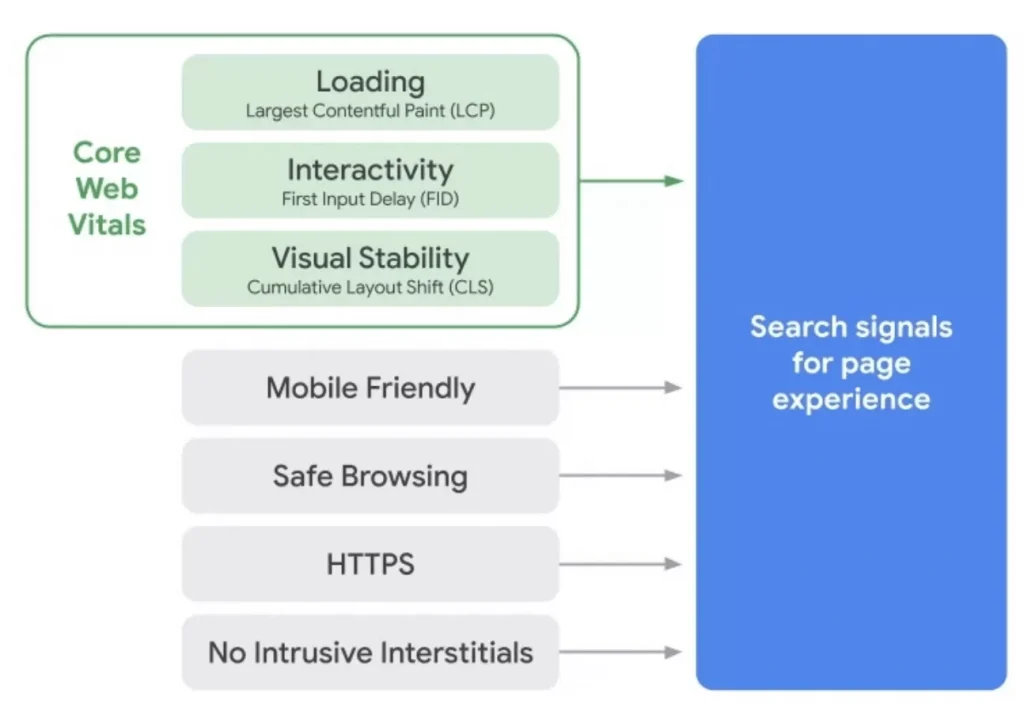
These new metrics measure factors which affect the user experience when a visitor lands on a page:
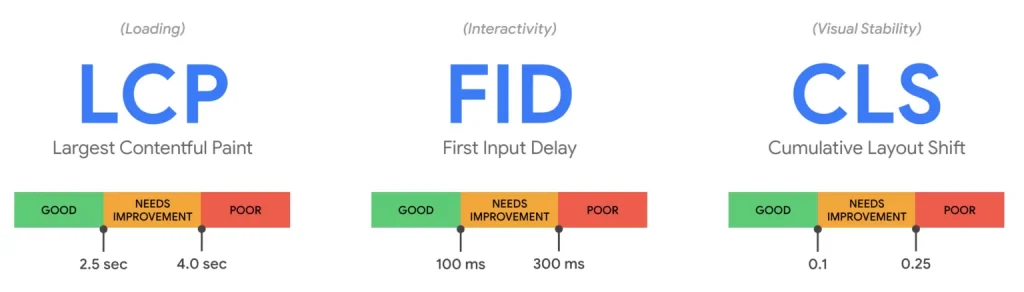
- Largest Contentful Paint (LCP). This is a measure of the time it takes for the largest piece of content on a web page to be visible. For publishers, this may be the text of an article. or perhaps a product image on a retailer’s site. For a ‘good’ classification from Google, this content should load within 2.5 seconds.
- First Input Delay (FID). This is a measure of the time before the visitor can interact with a page. On some sites, you may notice that you can’t click on a link or add text to a form field until various page elements have finished loading. For a ‘good’ classification from Google, this delay before interaction should be less than 100ms.
- Cumulative Layout Shift (CLS). This metric relates to the visual stability of a page. Moving or unstable elements as page loads can lead to users clicking incorrect links and can be a frustrating experience. For a ‘good’ classification, Google wants to see a CLS of less than 0.1.
Measuring Your Site’s Core Web Vitals
You can measure your site against Google’s performance criteria using several Google tools. Google recommends using Search Console to identify pages which fail to meet its standards and therefore need attention. These metrics are now used in Google’s ranking algorithm.
Essentially, though the exact weighting given to these core web vitals compared to other ranking factors is unclear, a site’s performance against these metrics affects its search rankings. It seems that many sites may have work to do to pass Google’s criteria. A study by Reddico into core web vitals benchmarked the speed performance of 500 top retail brands.
It found that just 35% achieved a ‘good’ score for Largest Contentful Paint, and 32% achieved the same for Cumulative Layout Shift. First Input Delay was the only one of the three vitals where most brands passed the test, with 83% achieving a ‘good’ score.
In Summary
Exactly how important core web vitals will be to ecommerce search performance remains to be seen, but this is certainly an area brands need to keep an eye on. More broadly, good UX matters to ecommerce performance. Sites with a better user experience, from loading speed to ease of navigation and smooth checkout are more likely to convert visitors. UX is an area sites should be focusing on anyway, but if this becomes a significant ranking factor, then some sites may need to pay more attention.
Further reading: how SwiftERM works.
Further reading: SwiftERM case studies.
Further reading: SwiftERM pricing and free trial.