


Why traditional marketing metrics fail — and what should replace them
For more than two decades, email marketing performance has been measured using campaign-centric metrics such as open rates, click-through rates and conversions.
These measures emerged during the era of batch marketing campaigns, where marketers designed messages for segments of customers and evaluated success based on engagement with those messages.
However, ecommerce marketing is increasingly shifting toward autonomous hyper-personalisation solutions that continuously analyse customer behaviour and deliver individually optimised product recommendations.
This shift creates a fundamental problem:
Most organisations are still evaluating autonomous systems using measurement frameworks designed for campaigns.
The result is that the true economic impact of personalisation is often misunderstood.
The Limits of Engagement Metrics
Open rates and click-through rates measure interaction with a message, but they do not necessarily reflect commercial outcomes.
Several limitations make them problematic as primary performance indicators:
Engagement does not equal revenue
A highly engaging email may generate little incremental revenue if customers would have purchased anyway.
Attribution inflation
Standard attribution models often assign credit for purchases that would have occurred without marketing intervention.
Segment bias
Traditional campaigns frequently target already-engaged customers, creating inflated performance metrics while neglecting less active customers.
Because of these issues, engagement metrics frequently fail to capture the true economic contribution of marketing activity.
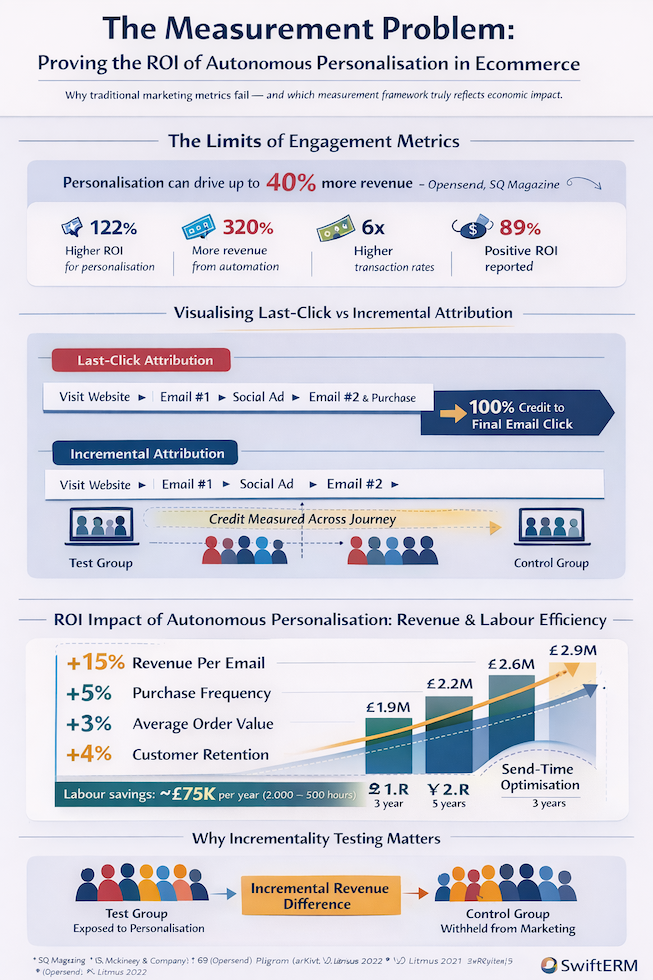
Research across ecommerce marketing indicates that organisations implementing comprehensive personalisation strategies can generate up to 40% more revenue than average competitors (McKinsey & Company, 2021).
Similarly, surveys of marketers suggest that 89% report positive ROI from personalisation initiatives, while nearly all retailers implementing personalisation observe increases in average order value (Gartner, 2023).
The Attribution Problem
A second challenge in measuring marketing performance arises from the widespread use of last-click attribution models.
Many marketing platforms assign revenue credit to email when a purchase occurs within a fixed time window following an open or click. However, this approach does not determine whether the marketing activity caused the purchase.
Incrementality testing provides a more reliable method.
This involves comparing the purchasing behaviour of:
- a group of customers exposed to marketing messages
- a control group deliberately withheld from those messages
Only the difference between the two groups represents the true incremental impact of the marketing intervention.
Last-click attribution assigns 100% of the credit for a purchase to the final marketing interaction immediately preceding the transaction.
Research into digital marketing attribution shows that traditional last-touch models frequently overestimate marketing impact by 20–40% when compared with controlled experiments (Lewis and Rao, 2015).
For example:
- A customer browses products on an ecommerce site.
- Later they receive several marketing emails or ads.
- They click a promotional email and complete the purchase.
Under a last-click attribution model, the entire revenue from the order is attributed to that final email click, even if the customer had already decided to buy or had previously interacted with multiple marketing channels.
This approach creates several distortions.
1. It ignores earlier influences
Customer purchase decisions are typically influenced by multiple interactions — including website visits, previous emails, product recommendations and advertising.
Last-click attribution disregards all earlier interactions and assigns full credit to the final touchpoint.
2. It overstates marketing impact
If a customer had already decided to purchase, the final marketing interaction may simply coincide with the purchase rather than cause it.
Research into digital advertising measurement has demonstrated that traditional attribution models can significantly overestimate marketing effectiveness when compared with controlled experiments (Lewis and Rao, 2015).
3. It biases marketing strategy
Because last-click attribution rewards the final interaction before purchase, it encourages marketers to prioritise short-term conversion tactics rather than activities that build long-term customer value.
Diagram Concept: Last-Click vs Incremental Attribution
Title: How Attribution Models Can Misrepresent Marketing Impact
| Step | Customer Journey | Last-Click Attribution | Incremental Attribution |
|---|---|---|---|
| 1 | Visits website, browses products | No credit | No credit |
| 2 | Receives email #1, opens, clicks | No credit | Partial credit (influence measured via control group) |
| 3 | Receives ad on social media, clicks | No credit | Partial credit |
| 4 | Receives email #2, clicks, completes purchase | 100% credit to email #2 | Credit distributed across interactions, or measured as incremental lift compared to control group |
Why Incrementality Testing Matters
To determine whether marketing activity truly causes purchases, organisations must measure incremental impact.
Incrementality testing involves comparing two groups of customers:
- Treatment group – exposed to marketing messages
- Control group – deliberately withheld from those messages
The difference in purchasing behaviour between these groups represents the true causal impact of the marketing intervention.
This method removes the distortion created by attribution models and provides a more reliable measure of economic value.
In environments where autonomous personalisation systems continuously optimise customer communications, incrementality testing becomes particularly important. It allows organisations to measure whether algorithmically generated recommendations genuinely increase purchasing behaviour rather than simply capturing credit for transactions that would have occurred anyway.imate marketing impact by 20–40% when compared with controlled experiments (Lewis and Rao, 2015).
Metrics That Reflect Economic Impact
If the objective of marketing is to maximise commercial performance, then the measurement framework must focus on metrics that capture economic value rather than engagement.
The most relevant indicators include:
Revenue Per Email (RPE)
Revenue per email integrates conversion rate and average order value into a single commercial metric.
Customer Lifetime Value (CLV)
Customer lifetime value represents the total revenue expected from a customer relationship.
Personalised marketing systems can increase CLV by encouraging repeat purchasing and strengthening customer loyalty (Kumar and Reinartz, 2016).
Average Order Value (AOV)
Personalised product recommendations can increase basket size by presenting relevant products at the moment of decision.
Purchase Frequency
Increased purchasing frequency indicates that personalisation is strengthening the relationship between customer and retailer.
Contribution Margin
Evaluating marketing performance using contribution margin ensures that optimisation is aligned with profitability rather than simply top-line sales.
Together, these metrics measure the long-term economic effects of personalisation.
The Strategic Importance of Customer Lifetime Value
Among these indicators, CLV may be the most strategically important.
Marketing strategies that focus on short-term conversions may overlook the cumulative value generated by repeat customers.
Research in relationship marketing has shown that increasing customer retention by 5% can increase profits by between 25% and 95%, depending on the industry (Reichheld and Sasser, 1990).
Autonomous personalisation systems aim to influence these long-term outcomes by continuously adapting communications to customer behaviour.
By delivering relevant product recommendations and reducing search friction, such systems can strengthen habitual purchasing behaviour over time.
Quantitative Example: Measuring ROI Over Time
The economic impact of autonomous personalisation often emerges gradually.
Consider a simplified example involving an ecommerce retailer with the following baseline metrics:
| Metric | Baseline |
|---|---|
| Active customers | 500,000 |
| Average order value | £60 |
| Average purchases per year | 2.0 |
| Annual revenue | £60 million |
Suppose the introduction of an autonomous personalisation system leads to:
- a 5% increase in purchase frequency
- a 3% increase in average order value
- a 4% improvement in customer retention
The resulting revenue effects compound over time.
Year 1
Revenue increases to approximately £63.9 million.
Year 2
Improved retention expands the active customer base, raising revenue to £67–69 million.
Year 3
Continued compounding increases annual revenue to approximately £72–75 million.
In this simplified model, a modest improvement in customer behaviour produces £12–15 million in additional annual revenue within three years.
Because autonomous systems continuously learn from behavioural data, the performance improvement may increase further as the algorithm gathers more information about customer preferences.
Research into algorithmic recommendation systems similarly demonstrates that improvements in relevance can have significant cumulative effects on ecommerce performance (Ricci, Rokach and Shapira, 2015).
Autonomous Personalisation in Practice
Autonomous personalisation, known as hyper-personalisation, systems differ fundamentally from traditional marketing tools.
Rather than relying on manually created segments and scheduled campaigns, they continuously analyse behavioural data — including browsing activity, purchasing history and interaction signals — to determine which products or messages should be presented to each individual customer.
Platforms such as SwiftERM have explored this approach by applying machine-learning algorithms to customer behaviour in order to generate individualised product recommendations and email communications.
This transforms marketing from a sequence of campaigns into a continuously optimised recommendation system.
As the system learns more about each customer’s preferences, the relevance of communications improves, producing compounding economic effects.
A New Measurement Framework for Ecommerce Marketing
To capture these effects, organisations need a measurement framework based on causal analysis and customer economics rather than campaign engagement.
A robust framework typically includes:
| Metric | Measurement Method |
|---|---|
| Incremental revenue | Controlled holdout testing |
| Revenue per email | Total revenue divided by email volume |
| Customer lifetime value | Cohort-based modelling |
| Contribution margin | Revenue weighted by product margin |
| Purchase frequency | Longitudinal customer behaviour analysis |
This approach shifts the focus from message performance to customer value creation.
Operational Efficiency and Labour Savings
Autonomous personalisation systems not only drive higher revenue — they reduce labour costs and increase operational speed, which is often overlooked in ROI calculations.
Key benefits:
- Reduced manual intervention:
Traditional segmented campaigns require marketers to manually create segments, design content, schedule sends, and analyse results. Autonomous systems automate these tasks, freeing teams to focus on strategy rather than repetitive execution. Industry estimates suggest automation can reduce email campaign labour costs by 30–50% (Litmus, 2022). - Real-time optimisation:
Systems continuously learn from customer behaviour, enabling features such as send-time optimisation, product recommendation updates, and adaptive frequency adjustments. This immediacy ensures communications are always relevant without manual recalculation or intervention. - Scalable personalisation:
Labour-intensive A/B tests and manual personalisation become impractical at scale. Autonomous systems dynamically personalise emails for millions of customers, maintaining accuracy and relevance with minimal human input.
Example: Labour vs Revenue ROI
Consider the earlier 5 million emails per year example:
| Metric | Manual Campaign | Autonomous System |
|---|---|---|
| Labour hours per year | 2,000 | 500 |
| Cost of labour (£50/hour) | £100,000 | £25,000 |
| Revenue | £1.9M | £2.2M |
Here, labour savings alone add £75,000 to net ROI, on top of revenue gains. Combined with compounding improvements from send-time optimisation and continual learning, autonomous personalisation delivers both financial and operational advantages.
Conclusion
Autonomous personalisation represents a structural shift in ecommerce marketing.
Yet many organisations continue to evaluate it using metrics designed for the campaign era.
Open rates and click-through rates may indicate engagement, but they do not measure the economic impact of marketing activity.
To understand the true value of personalisation, organisations must adopt measurement frameworks centred on incremental revenue, customer lifetime value and long-term profitability.
In the emerging landscape of algorithmic commerce, the companies that measure marketing most effectively may ultimately gain the greatest competitive advantage.
To appreciate the potential impact, we offer a FREE, 30-day trial to establish viability. Book a call with us now.
References
Gartner (2023) Marketing Personalization Survey Results. Gartner Research.
Kumar, V. and Reinartz, W. (2016) Creating Enduring Customer Value. Journal of Marketing, 80(6), pp. 36–68.
Lewis, R.A. and Rao, J.M. (2015) The Unfavorable Economics of Measuring the Returns to Advertising. Quarterly Journal of Economics, 130(4), pp. 1941–1973.
McKinsey & Company (2021) The Value of Getting Personalization Right — or Wrong. Available at: https://www.mckinsey.com
Reichheld, F. and Sasser, W. (1990) Zero Defections: Quality Comes to Services. Harvard Business Review.
Ricci, F., Rokach, L. and Shapira, B. (2015) Recommender Systems Handbook. Springer.