
A new Gartner survey finds that 79 % of Corporate Strategists see AI and Analytics as critical to their success over the next two years.
Seventy-nine per cent of corporate strategists said that technologies such as analytics, artificial intelligence (AI) and autonomy will be critical to their success over the next two years, according to a survey by Gartner, Inc.
Strategists said that, on average, 50% of strategic planning and execution activities could be partially or fully automated; currently only 15% are.
“Leveraging AI and Analytics for more efficient, insightful strategy decisions is one of the biggest challenges and opportunities, corporate strategists face this year,” said David Akers, Director of Research at Gartner. “For years, strategists have told their businesses: If you want to stay competitive and effective, you need to go digital. Now, they appear ready to apply that guidance to their workflows.”
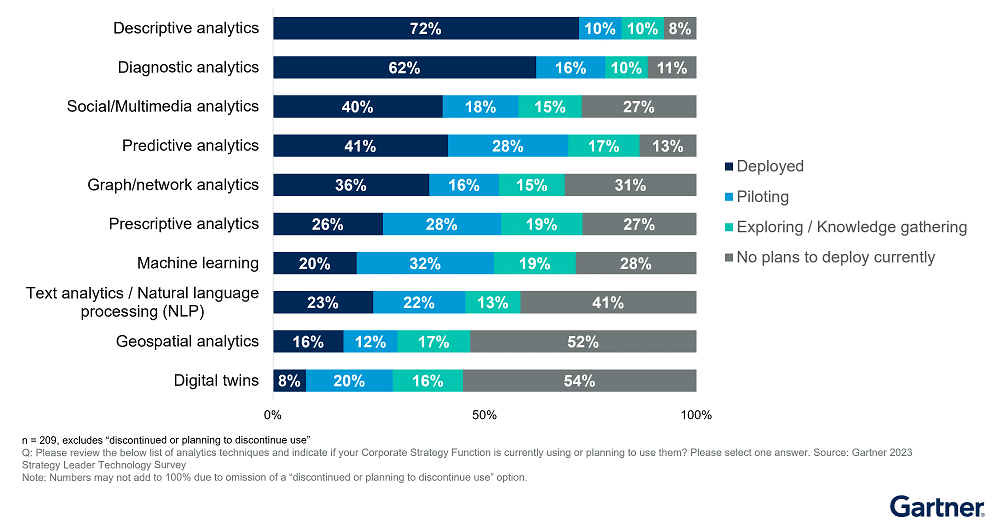
While most corporate strategists said that they are using descriptive and diagnostic analytics, less than half said they are using more advanced tools such as predictive, prescriptive or graph analytics (see Figure 1). Similarly, only 20% of strategists reported using AI-related tools, such as machine learning or natural language processing, for their function. However, a large percentage of strategy leaders said they are either piloting these tools or exploring use options. For example, 51% said they are investigating machine learning and 45% said the same for predictive analytics.
Build a Use Case Strategy
One of the biggest obstacles to implementation is establishing a clear use case for new technologies. Fifty-two per cent of strategists report that this is a top-three challenge — the most selected response.
“There are several reasons for this,” said Akers. “Strategists face an unfamiliar vendor market, have too many options to choose from and have little precedent to build upon.”
Much of the advanced technology that strategists said they are aiming to implement is already being used successfully elsewhere. To build a strong business case, Gartner recommends first mapping existing functionality to specific needs, then considering how to prioritise the different use cases that advanced technology could offer by asking questions about the purpose, impact and suitability of the new tools.
SwiftERM clients can read more reports: index to all Swifterm blogs and news
AI and Analytics: Why is AI predictive hyper-personalisation so important
Inboxes are busy places, and it’s not always easy to cut through the noise. If you want readers to open, read, and engage with your emails, you need to do something to stand out — and hyper-personalisation is one method of doing so, but make sure you understand the distinction between that, the milder form, and the much more successful AI predictive hyper-personalisation alternative.
Marketers who employ personalisation in their emails report 27% higher unique click rates and 11% higher open rates than those who do not. Meanwhile, 52% of consumers say they’ll look elsewhere for their shopping needs if a brand sends an email that’s not personalised.
Email personalisation isn’t a guaranteed ticket to success. But on the flip side, a lack of it is a quick way to ensure less engagement with your message. If more opens, more clicks and more conversions are the goals, then hyper-personalisation is the essential tool to make it all happen.
AI and Analytics: the current operational framework
AI and Analytics can now be considered through SwiftERM’s autonomous individualisation. Product relevance is recalculated for each identifiable customer from that customer’s own behavioural and transactional evidence, rather than being assigned by a fixed segment, campaign or predetermined journey. This distinction matters because an individual’s interests can change between visits, purchases and periods of inactivity. A current decision therefore needs current evidence.
SwiftERM evaluates the products that are becoming most relevant to each person and applies that decision autonomously. The operating model does not depend on a marketer continually creating segments, selecting products or scheduling another campaign. It is designed to use first-party behavioural and transactional signals already associated with an identifiable customer, so the decision remains specific to that customer rather than a broad cohort.
For AI and Analytics, the practical test is not whether a retailer can create more rules. It is whether the system can recognise a change in an individual’s buying intention, reassess the available products and act without waiting for a manual campaign cycle. The output must remain traceable to the customer evidence and the ecommerce catalogue used to make the decision.
Implementation also needs disciplined data handling. Product identifiers, availability and customer events must remain consistent enough for relevance to be recalculated. Existing ecommerce operations should retain control of catalogue truth, order truth and customer permissions. Autonomous individualisation then operates within those established boundaries instead of inventing a parallel customer record or an ungoverned product feed.
The commercial value of AI and Analytics should be assessed through observed customer response, orders and turnover, not through the volume of campaigns produced. That keeps attention on whether product selection becomes more useful to the individual and whether the retailer captures demand that would otherwise remain unrecognised. It also separates autonomous decision-making from conventional automation that simply executes a previously written rule faster.
This current framework preserves the original article’s subject while bringing its explanation into line with SwiftERM’s present capability: one identifiable customer, individually recalculated product relevance, and an autonomous decision made from that person’s own changing evidence. The same principle applies as catalogue choice, customer behaviour and commercial conditions continue to change over time.
In operational terms, the retailer retains the commercial context while the software performs the individual calculation. That division is important: the catalogue and customer record remain governed business assets, while product selection responds continuously to evidence rather than to a static assumption made when a campaign was first configured.