

What makes people “add to cart”? So what influences shoppers to buy online? Google did a study of a couple of large international markets to shed light on the state of ecommerce and what most influences shoppers when deciding to buy online.
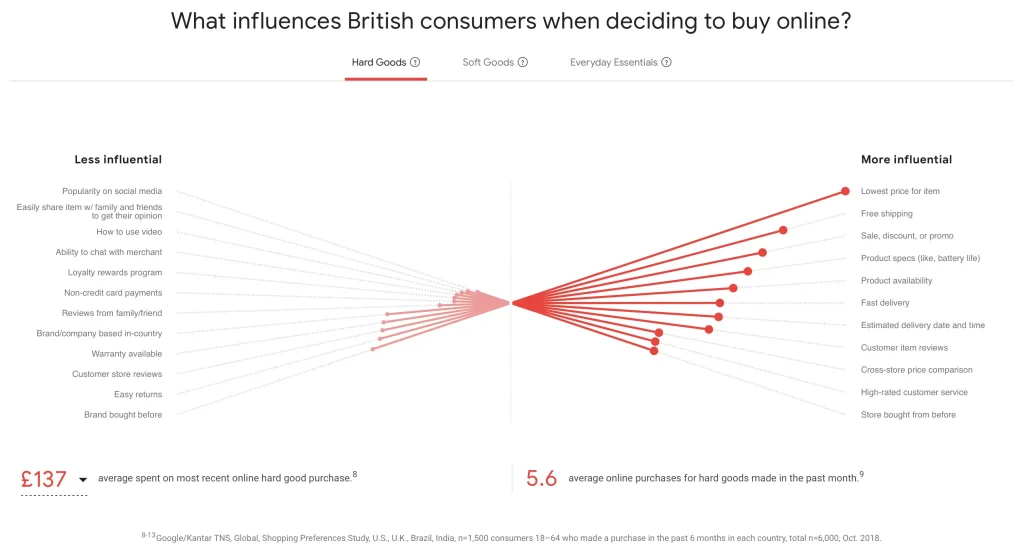
i. United Kingdom. With a robust infrastructure and high consumer confidence, the UK boasts the third-largest ecommerce market in the world. UK shoppers tend to mirror US shoppers with low prices considered very important. UK shoppers pay much attention to import charges, taxes and delivery, which might affect the ranking of their values.
After price, UK consumers prioritise fast and affordable delivery. Incentivise repeat visits with offers and incentives, and most of all keep your relationship with each consumer personal, no one wants to know what someone else is interested in. (Google/Kantar TNS, Global, Shopping Preferences Study, U.S., U.K., Brazil, India, n=1,500 consumers 18–64 who purchased in the past 6 months in each country, total n=6,000.)
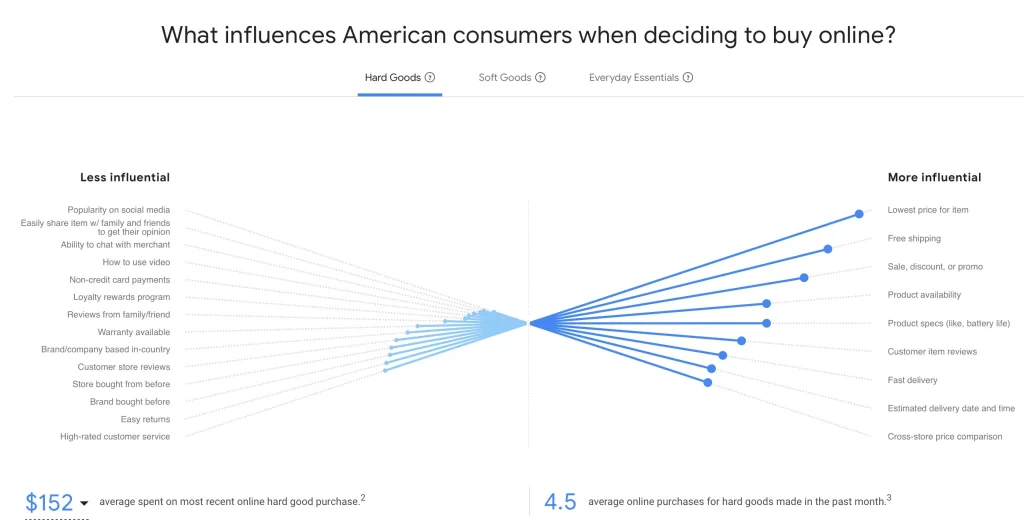
ii. United States, a model of mature ecommerce. American consumers are probably the largest and most developed and their values may be a reflection of a highly saturated market, and many trusted options. Price point is probably the most important purchase consideration with free shipping right behind it.
Google recommend we take note that this is a prime example of considerations for saturated markets, wherever they appear. When you can beat the competition make sure you show it. Keep an eye on markets for products you can undercut. US shoppers are more interested in fast shopping times than in-store pick-ups.
Putting add to cart insights into practice.
Whether you’re looking to improve your site or looking to launch in new markets it pays to keep these insights in mind. Google stress the importance of keeping your site up to date, with insights into products they care about and relevant to the market you’re targeting. You should prioritise local values, and design your site with those in mind. Use a list of values to stand out and differentiate to underline the distinction.
Further reading: how SwiftERM works.
Further reading: SwiftERM case studies.
Further evidence and related SwiftERM analysis
Add to Cart: the current operational framework
Add to Cart can now be considered through SwiftERM’s autonomous individualisation. Product relevance is recalculated for each identifiable customer from that customer’s own behavioural and transactional evidence, rather than being assigned by a fixed segment, campaign or predetermined journey. This distinction matters because an individual’s interests can change between visits, purchases and periods of inactivity. A current decision therefore needs current evidence.
SwiftERM evaluates the products that are becoming most relevant to each person and applies that decision autonomously. The operating model does not depend on a marketer continually creating segments, selecting products or scheduling another campaign. It is designed to use first-party behavioural and transactional signals already associated with an identifiable customer, so the decision remains specific to that customer rather than a broad cohort.
For Add to Cart, the practical test is not whether a retailer can create more rules. It is whether the system can recognise a change in an individual’s buying intention, reassess the available products and act without waiting for a manual campaign cycle. The output must remain traceable to the customer evidence and the ecommerce catalogue used to make the decision.
Implementation also needs disciplined data handling. Product identifiers, availability and customer events must remain consistent enough for relevance to be recalculated. Existing ecommerce operations should retain control of catalogue truth, order truth and customer permissions. Autonomous individualisation then operates within those established boundaries instead of inventing a parallel customer record or an ungoverned product feed.
The commercial value of Add to Cart should be assessed through observed customer response, orders and turnover, not through the volume of campaigns produced. That keeps attention on whether product selection becomes more useful to the individual and whether the retailer captures demand that would otherwise remain unrecognised. It also separates autonomous decision-making from conventional automation that simply executes a previously written rule faster.
This current framework preserves the original article’s subject while bringing its explanation into line with SwiftERM’s present capability: one identifiable customer, individually recalculated product relevance, and an autonomous decision made from that person’s own changing evidence. The same principle applies as catalogue choice, customer behaviour and commercial conditions continue to change over time.
In operational terms, the retailer retains the commercial context while the software performs the individual calculation. That division is important: the catalogue and customer record remain governed business assets, while product selection responds continuously to evidence rather than to a static assumption made when a campaign was first configured.