

What this means for applied ecommerce intelligence
The value of an AI or data method is not its technical label. It is whether trustworthy evidence can be converted into a better commercial decision repeatedly, at catalogue and customer scale, without asking staff to interpret every case.
SwiftERM applies that principle to first-party behavioural and transaction evidence. It continually ranks relevant SKUs for each identifiable customer, determines likely next-purchase timing and supplies the selection through the retailer’s existing ecommerce and email systems. The result is judged by additional attributable turnover, not by the volume of messages sent.
The pursuit of growth in the modern ecommerce landscape is often framed as a battle of volume: more traffic, more clicks, more transactions. However, the most successful retailers have long since realised that volume is a secondary concern. The primary objective is clarity. In an environment saturated with noise, your ability to extract meaning from the chaos—your data maturity—is the single greatest predictor of your long-term success. Yet, many businesses remain trapped in the infancy of data collection, hoarding massive, unstructured datasets while failing to translate that information into the engine of autonomous individualisation.
Data maturity is not merely about how much data you hold; it is about how effectively you operationalise it. A business that collects vast amounts of information but relies on manual interpretation is not data-mature; it is simply data-heavy. True maturity is the ability to move from descriptive insights—what happened yesterday—to prescriptive, autonomous action—what should happen right now, for this specific customer, without human intervention. This shift is where the operational efficiency and profitability gaps are widened between the market leaders and the rest of the pack. To compete today, you must prioritise the mechanics of your data as rigorously as you prioritise your supply chain or your financial accounting.
The Data-Driven Fallacy
The industry is rife with companies that claim to be “data-driven.” However, when you look beneath the surface, you often find a reliance on historical reporting and human-led decision-making. The transition to becoming truly data-driven companies requires a fundamental change in the organisational culture, not just an upgrade in software. Most retailers treat data as an archive—a record of transactions that occurred—rather than as a live, pulsing asset that dictates the future of their business.
If you are still looking at monthly reports to decide your promotional strategy, you have missed the point of the digital era. By the time that report hits your desk, the data is cold, and the opportunity is gone. Data maturity is defined by your ability to move the decision-making loop as close to the point of customer interaction as possible. In a high-maturity environment, the data does not just “inform” your strategy; it executes it. You must ask yourself whether your team is analysing the data, or if the data is analysing the customer and making the decision for you.
Defining Your Maturity Index
To achieve autonomous individualisation, you must first assess where you stand. It categorises retailers into stages: from initial data capture (where you are simply recording the fact that a sale happened) to advanced, intelligent deployment (where your data is automatically triggering the next best action for every individual user).
Many mid-sized retailers get stuck in the middle. They have robust analytics, but they lack the integration necessary to turn those analytics into a customer experience. They know who bought what, but they cannot autonomously predict what the customer is going to want next, nor can they trigger that interaction at the perfect moment. This is the maturity gap. It is the difference between having a map and having a self-driving car.
If you find that your team is spending their days managing segments, manually A/B testing, or fixing broken tracking codes, you are in the lower tiers of the index. Your data is working for your developers, not for your customers. The goal of any serious ecommerce operation must be to move the intelligence layer closer to the customer, so the system itself becomes the engine of growth. You are not trying to be a technology company; you are trying to be a retailer that leverages technology to eliminate the friction that causes customers to leave your site.
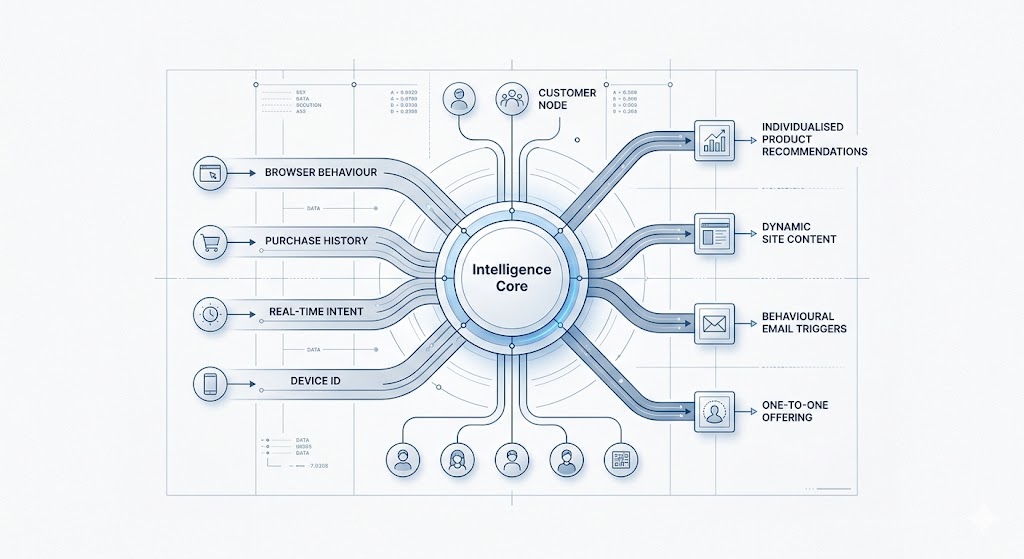
Why Autonomous Individualisation is the Ultimate Goal
Autonomous individualisation is the practical application of high-level data maturity. It is what happens when your data infrastructure is mature enough to sustain a self-learning environment. When your systems can process browsing behaviour, past purchase history, and real-time intent, they can construct a highly personalised reality for every single visitor.
This process is not about segmenting. It is about individualising. Segmentation is a blunt instrument; individualisation is a surgical one. In an autonomous state, the storefront becomes a reflection of the customer’s intent. If a customer is clearly in the research phase, the system provides depth and technical detail. If they are in the buying phase, the system clears the path, simplifies the checkout, and reinforces the urgency. All of this happens without a human ever defining a segment or rule.
The mechanical advantage here is the reduction of latency. In the manual world, there is always a gap between intent and response. In the autonomous world, the response is instantaneous. This is the only way to compete in an ecommerce ecosystem where customer patience is near zero. If you are not responding to the intent, your competitor will, and they will likely do so with a system that has already learned how to close the deal.
Operationalising Your Insights
Building a data architecture strategy that supports this level of autonomy requires a departure from legacy thinking. You cannot bolt this capability onto a broken foundation. Your data must be clean, it must be unified across all channels, and it must be accessible in real-time to your intelligence engine.
The biggest hurdle for most retailers is not the technology; it is the data silos. If your email data is in one place, your web analytics in another, and your inventory data in a third, you are effectively handicapping your ability to individualise. Autonomous systems rely on the single source of truth. If the system does not have a complete picture of the customer across all touchpoints, its decisions will be flawed.
The maturity process requires you to integrate these silos into a singular, unified intelligence layer. This is why we focus so heavily on the technical infrastructure of your business. When the underlying architecture is sound, the intelligence layer can do its job. When it is fragmented, the intelligence layer is essentially trying to read a book where half the pages are torn out. You cannot individualise what you do not understand. You must prioritise the clean, connected flow of data over the adoption of flashy, standalone tools.
The Cost of Immature Data
We have to be candid about what it costs you to maintain an immature data environment. It is not just about missed opportunities; it is about the opportunity cost of precision. Every single visitor that leaves your site without converting is a signal you have failed to read. An immature system sees this as a lost visitor. A mature system sees this as a diagnostic indicator of why the experience failed and autonomously adjusts the next interaction to correct the path.
When you do not have this feedback loop, you are essentially burning your customer acquisition budget to stay in the same place. You are paying for traffic that your site is not capable of converting. This is the hidden tax on your profit margins. Retailers who are data-mature operate with significantly lower customer acquisition costs because their traffic converts at a much higher rate. They are not chasing the market; they are capturing it.
The operational discipline required to fix this is significant. It requires a relentless focus on the quality of your data, the speed of your infrastructure, and the capability of your tools. But the return on this investment is the most reliable profit driver in the retail industry. It turns your business from a volatile collection of random transactions into a predictable, scalable engine of growth. You are building an asset that appreciates in value the more data it consumes.
The Path to Maturity
As we continue to navigate the specifics of autonomous individualisation, the focus will remain on the structural requirements of your stack. We are not just talking about theory; we are talking about the mechanics of how you turn your ecommerce site into an automated revenue driver. The next phase of this series will delve into the specific integration of these intelligence layers.
For now, start by evaluating your own data maturity. Ask yourself: if your best customer walked onto your site right now, does your system know who they are? Does it know what they are looking for? And does it have the capacity to act on that information without a human telling it what to do? If the answer is “no,” you have identified your primary bottleneck.
Do not be discouraged by the scale of the task. The shift to a mature, autonomous operation is the most important transition your business will ever make. It is the transition from a retailer that hopes for growth to a retailer that engineers it. By prioritising the mechanics of your data today, you are laying the foundation for the profitability of tomorrow. Every step you take to refine your data strategy is a step toward a leaner, faster, and more profitable enterprise. The noise of the manual era is fading; the era of autonomous precision has begun.
References and Citations
- Data-driven companies are more productive: Harvard Business Review. An analysis of the direct correlation between fragmented executive attention and operational decision-making latency. Read the full analysis [https://hbr.org/2014/10/data-driven-companies-are-more-productive] (opens in a separate window).
- Outcomes drive your data architecture strategy: Forrester Research. A comprehensive industry report on how high-frequency, low-relevance outreach degrades domain authority and long-term brand equity. Access report [https://www.forrester.com/blogs/outcomes-drive-your-data-architecture-strategy/] (opens in a separate window).