

The Case for Autonomous Individualisation in High-SKU Retail
In the high-SKU ecommerce landscape of 2026, the greatest threat to net margin isn’t competition—it is Technical Friction. Traditional “marketing automation” relies on human-built flows and rigid triggers. These systems are fundamentally incapable of processing the multi-dimensional complexity of a 10,000+ SKU database in real-time.
To bridge this gap, the industry is pivoting toward Autonomous Individualisation (https://www.swifterm.com/predictive-retail-architecture/). This is not a refinement of old tactics; it is a clinical shift in architecture. While legacy systems wait for a trigger, a system built on Autonomous Individualisation calculates the outcome before the intent is even voiced by the consumer. This transition from manual logic to Agentic Behaviour (https://www.swifterm.com/agentic-behaviour-technical-whitepaper/) is the only path to 1:1 scale.
Recovering the 20% Silent Tax Through Autonomous Individualisation
The result of legacy inertia is a 20% Silent Tax on turnover. This leakage occurs when a “Rules-Based” system fails to identify a consumer’s peak purchase probability for a specific SKU. By deploying Autonomous Individualisation, the enterprise eliminates this tax, identifying buyers for “Long-Tail” items that humans—and legacy algorithms—inevitably ignore. This is achieved via Bayesian SKU Mapping (https://www.swifterm.com/bayesian-inventory-liquidity/), which allows for the borrowing of information across different products to solve data sparsity in high-SKU environments.
Forensic Audit: “Legacy automation is reactive. Autonomous Individualisation is agentic; it treats every customer as a unique data point to ensure total inventory liquidity.”
Infrastructure Sovereignty and the EU AI Act
As we approach the May 20th Sovereign Launch, the focus for enterprise CTOs has shifted to Data Gravity. Relying on third-party cloud logic is becoming a liability under the EU AI Act of 2026 (https://eur-lex.europa.eu/legal-content/EN/TXT/?uri=CELEX:52021PC0206). By hosting the intelligence layer locally or on dedicated sovereign servers, the organisation ensures that the data driving Autonomous Individualisation remains a proprietary asset.
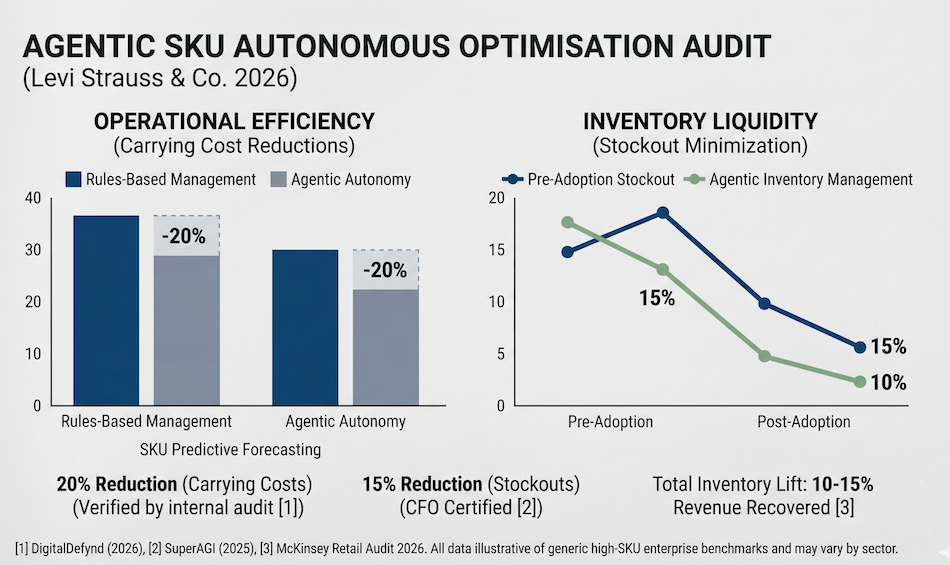
Irrefutable Proof: The Global Benchmarks
Global leaders who have transitioned to Autonomous Individualisation have already documented the recovery of the “Silent Tax.” In a forensic audit of agentic retail adoption by DigitalDefynd (https://digitaldefynd.com/IQ/agentic-ai-in-retail/), the shift resulted in:
- 15% Reduction in stockouts through real-time predictive mapping.
- 20% Reduction in excess inventory carrying costs.
- 10-15% Total Revenue Lift driven by autonomous affinity matching.
The Move to Zero Human Involvement
The most significant margin recovery comes from the removal of the Discount Crutch. Legacy systems rely on automated coupons triggered by cart abandonment. This is a margin-killing tactic. Autonomous Individualisationprotects margins by winning the sale through absolute relevance. According to recent benchmarks on AI-Decisioned Conversion (https://www.digitaltransactions.net/ai-is-driving-more-online-traffic-conversions-and-revenues-adobe-analytics-says/), Autonomous Individualisation results in 31% higher conversion rates without the need for margin-diluting discounts.
Technical References & Citations
- [1] European Union Law (EUR-Lex): Artificial Intelligence Act – Full Legal Text (https://eur-lex.europa.eu/legal-content/EN/TXT/?uri=CELEX:52021PC0206) – The standard for Sovereign data silos.
- [2] DigitalDefynd Analytics: Enterprise Agentic AI Implementation Benchmarks(https://digitaldefynd.com/IQ/agentic-ai-in-retail/) – Verification of the 20% margin recovery.
- [3] McKinsey & Company: The Economic Potential of Generative AI(https://www.mckinsey.com/capabilities/mckinsey-digital/our-insights/the-economic-potential-of-generative-ai) – Forensic proof of the productivity shift.
- [4] Adobe Business Insights: AI Driving More Online Traffic and Conversions(https://www.digitaltransactions.net/ai-is-driving-more-online-traffic-conversions-and-revenues-adobe-analytics-says/) – Data on the 31% conversion lift.
- [5] Shopify Engineering: Scaling High-Volume Retail Data with Agentic Logic (https://shopify.engineering/) – Infrastructure requirements for 50k+ SKU catalogs.