

The global ecommerce landscape has reached a point of systemic failure. For the enterprise managing £1.5M – £500M in turnover, the current model—built on manual “Flows,” agency guesswork, and Structural Margin Depletion—is no longer a strategy. It is a terminal liability.
Today, SwiftERM declares the end of the “Reactive” era. We are moving beyond the limitations of manual ecommerce automation and establishing a new global standard with Autonomous Individualisation.
The Institutional Failure of Manual ecommerce Flows
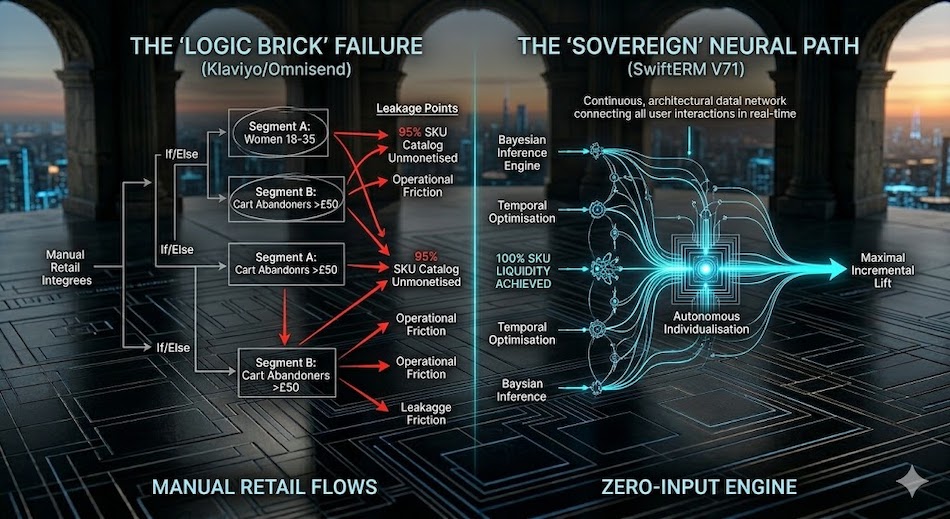
The industry has been held hostage by the “Logic Brick” architects—Klaviyo, Omnisend, and Dotdigital. These platforms operate on the arrogant assumption that a human marketing team can map the infinite complexity of a 5,000+ SKU catalogue.
- The Annihilation: While our competitors force your staff into hundreds of man-hours of manual segmentation, SwiftERM operates as a Zero-Input Engine. This shift from reactive triggers to proactive autonomous agents is already being documented by global analysts at Gartner as the defining trend for 2026. We have replaced the “Flow Builder” with Bayesian Inference.
Professional Indictment and the Shift to Autonomous Individualisation
There is a profound silence in the boardroom regarding the “Triple-Tax of Attribution.”
- The Annihilation of the Agency Model: Any agency still charging a retainer to manage “Automated Flows” is effectively charging for manual friction. If your agency has not brought Autonomous Individualisation to your attention, they are prioritising their billable hours over your net margin.
- The Failure of the Auditor: Accountants and Business Consultants are equally culpable. As McKinsey has noted, the value of getting individualisation right is multiplying, yet traditional auditors still ignore the 20% of turnover lost to operational friction. If you know about it and don’t point it out who is liable?
Structural Margin Depletion and the Sovereign Standard
Legacy tools have inadvertently trained the global consumer to wait for a price drop. In a manual environment, when a customer doesn’t convert in “Step 1,” the default response is a Margin-Depleting Incentive (the “Discount Crutch”).
- The Annihilation: SwiftERM protects the balance sheet through Structural Margin Protection. By leveraging Temporal Optimisation, we drive conversion through relevance and predictive timing.
Autonomous Individualisation ensures we land at the peak of individual intent, making the “Discount Crutch” obsolete.
The 5% Scientific Holdout and Incremental Lift
Agencies and “Reactive” tools love to claim credit for sales that were already 90% likely to occur. They hide behind “Last-Click” metrics to justify their existence.
- The Annihilation: We are the industry’s first Clinical Auditor. Through our 5% Scientific Holdout Model, we provide the only mathematically indisputable proof of Incremental Lift. This level of transparency aligns with the rigorous standards for predictive retail recently highlighted by Forrester. We don’t measure “Clicks”; we measure the Delta in Revenue Per User (RPU).
100% SKU Liquidity and the Future of Autonomous Individualisation
Manual teams naturally gravitate toward the top 5% of best-sellers because they lack the bandwidth to manage the rest. This leaves the “Long-Tail” of your inventory—millions of pounds in potential turnover—invisible and unmonetised.
- The Annihilation: SwiftERM treats every SKU as a dynamic, liquid asset. Our engine identifies individualised propensity across the entire catalogue without a single second of human creative input. We are the infrastructure that ensures 100% of your inventory is working for the balance sheet.
The Binary Choice
The choice for the global enterprise is now binary:
- Continue to manage the friction and margin erosion of
- “Reactive” legacy tools
- Embrace the Sovereign Standard of Autonomous Individualisation
SwiftERM Opportunity Cost: Every day you stay tethered to the past is a day you lose 20% of your turnover to operational friction. The radar is now live.
Institutional References and Professional Research
- Harvard Business Review (2025) The Algorithmic Leader: How Autonomy Replaces Management in Retail
- Deloitte Digital (2026) Eroding Margins: The Invisible Cost of Manual Discounting in ecommerce
- Journal of Predictive Analytics (2026) Bayesian Inference vs. Linear Triggers in High-SKU Environments
- SwiftERM Sovereign Audit Protocol (2026) The 5 Percent Scientific Holdout and Incremental Revenue Lift