

89% of businesses are investing in personalisation as a critical strategy for their current and future success. However, personalisation goes far beyond adding a first name field into the subject line of an email. Since the advent of AI, the true definition has become hyper-personalisation, as this excludes segmentation as it isn’t unique to the individual.
To stay relevant in today’s hyper-competitive marketplace, brands need to remain customer-centric and drive their attention to personalised experiences for website visitors. After all, customers now hold the power and hyper-personalisation is the priority for modern consumers.
But none of what we’re saying is that new or revolutionary. Personalisation has been a trend for over a decade now, and it has evolved greatly from templatised marketing communications to dynamic, predictive, and even proactive experiences.
Today, a plethora of hyper-personalisation software tools, including AI and machine learning algorithms, allow us to achieve 1:1 personalisation like never before. To take full advantage of personalisation technology, we must first understand what it is and how it benefits both brands and consumers.
What is personalisation technology?
Before we take a deep dive into personalisation technology, let’s start with the basics: What is personalisation? In eCommerce, personalisation is the process of creating individualised shopping experiences and interactions. These can range from dynamic website content to unique promotional offers to tailored product recommendations, etc.
As such, personalisation technology encompasses a variety of software tools that collect, store, and manage customer data to orchestrate individualised experiences.
Depending on the size of your business and your place on the personalisation maturity curve, your personalisation technology stack can consist of a single or a set of personalisation tools. If you have the budget to afford something like Adobe’s Experience Cloud, you might not have to worry about much else.
However, even established businesses often choose to go with several providers that are experts in their chosen niche: Product recommendation engines; Dynamic pricing software; and Intelligent site search. Based on a recent ITSMA survey, this is the typical personalisation marketer’s toolbox:
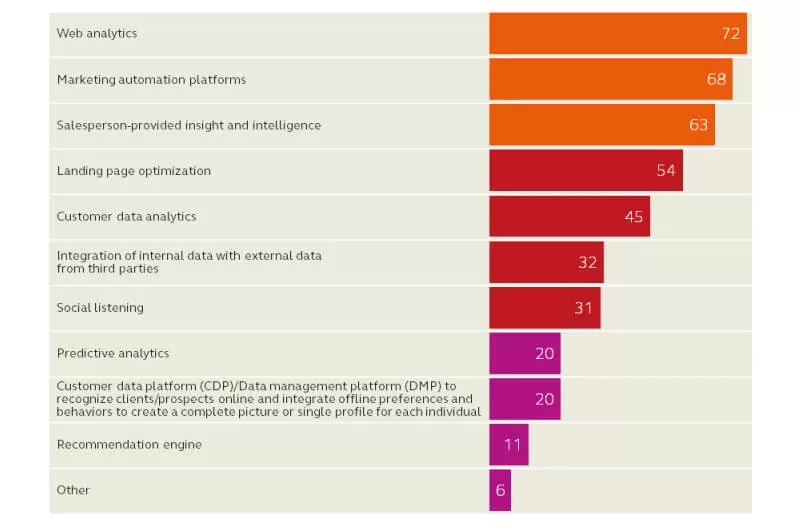
It’s important to note that the orchestration part should be done by a personalisation engine that can ingest all that third-party data and ‘spit out’ relevant communications in real time.
Higher conversion rates
While many elements impact your conversion rates, the experience you offer to your customers is a vital one. By getting the right message to the right person at the right time, your sales can skyrocket. According to a Monetate report, the more personalised pages a customer sees, the higher the conversion rates. On average, once companies implement personalisation, they see a 20% increase in sales.
Reduced cart abandonment
A staggering 80% of users abandon their carts. Reducing this by even a few percentage points will result in a significant revenue jump. By analysing every aspect of the customer journey, companies can incorporate real-time dynamic pop-ups, browser retargeting, email remarketing, and other strategies. The result is reduced cart abandonment rates, increased customer retention, and a great customer experience.
Increased average order value (AOV)
A Salesforce report states that 69% of buyers expect Amazon-like buying experiences: Things like personalised product recommendations, cross-sells, and upsells. Personalisation technology leverages what you already know about your customers in real time and offers them relevant information that improves the customer journey and supports your business goals.
Improved customer loyalty
Loyal customers are the holy grail of long-term, sustainable business success. Adobe’s report states that US eCommerce stores make 40% in sales from 8% of loyal users. Providing a tailor-made, outstanding experience to your customers makes them feel valued as individuals. Build brand loyalty and stand out in the noisy digital world by implementing data-driven personalisation strategies.
How to choose hyper-personalisation technology
Hyper-personalisation maturity curve
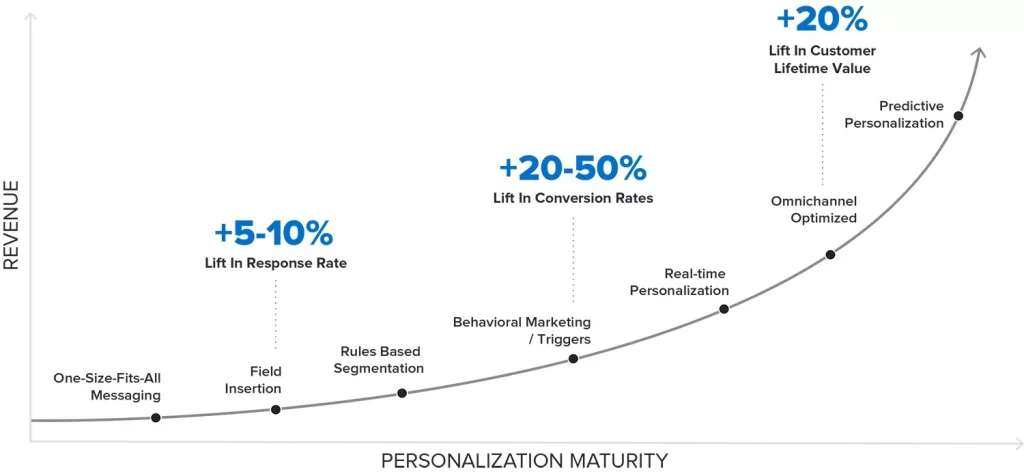
Choosing hyper-personalisation technology ultimately depends on the sophistication level one is seeking. We’ve already referenced the personalisation maturity curve, so let’s explore it in a bit more detail to understand how it informs our software buying decisions.
The personalisation maturity curve signifies the different phases, tactics, and expected returns of a personalisation strategy. As you can see, on the most basic level we have personalisation based on field insertion. In other words, your typical “F_NAME” scenario. Using the same parameters, hyper-personalisation software takes these comparisons off the scale.
As you advance up the maturity curve, you encounter more complex personalisation strategies: Things like personalised product recommendations, dynamic content, social proof, and more will sit at rules-based personalisation or higher. These strategies tend to have the most significant impact on revenue and customer retention and thus require more sophisticated personalisation solutions.
Take a look at the image below and try to identify which stage your eCommerce personalisation strategy is currently at. Most businesses sit at the first three stages, i.e. Mass-marketing; Field insertion; or Rule-based segmentation. The personalisation maturity curve is also handy in predicting the effectiveness of your personalisation campaigns as you move up the ladder. I mean, who doesn’t want a 20-50% lift in conversions?
As the leading provider, SwiftERM is hyper-personalised product selection software for email marketing. It only sends consumers products personally selected for each consumer based on their own unique personal buying history and impressions. Clicks and purchases are made from a perpetual pattern created by that individual, and their interaction with your website.
So sending them details of only those products they are most likely to buy, based on their actions, has a fundamentally positive effect on that individual – they appreciate you knowing them as individuals, and consequently, stay loyal, spend more, return less the list goes on… There is zero segmentation involved, and you can readily see from the graph.
The system is wholly autonomous – AI machine learning enables it to cope with the huge volume of data it has to process comfortably. It is always “on the money”.
Personalisation: the current operational framework
Personalisation can now be considered through SwiftERM’s autonomous individualisation. Product relevance is recalculated for each identifiable customer from that customer’s own behavioural and transactional evidence, rather than being assigned by a fixed segment, campaign or predetermined journey. This distinction matters because an individual’s interests can change between visits, purchases and periods of inactivity. A current decision therefore needs current evidence.
SwiftERM evaluates the products that are becoming most relevant to each person and applies that decision autonomously. The operating model does not depend on a marketer continually creating segments, selecting products or scheduling another campaign. It is designed to use first-party behavioural and transactional signals already associated with an identifiable customer, so the decision remains specific to that customer rather than a broad cohort.
For Personalisation, the practical test is not whether a retailer can create more rules. It is whether the system can recognise a change in an individual’s buying intention, reassess the available products and act without waiting for a manual campaign cycle. The output must remain traceable to the customer evidence and the ecommerce catalogue used to make the decision.
Implementation also needs disciplined data handling. Product identifiers, availability and customer events must remain consistent enough for relevance to be recalculated. Existing ecommerce operations should retain control of catalogue truth, order truth and customer permissions. Autonomous individualisation then operates within those established boundaries instead of inventing a parallel customer record or an ungoverned product feed.
The commercial value of Personalisation should be assessed through observed customer response, orders and turnover, not through the volume of campaigns produced. That keeps attention on whether product selection becomes more useful to the individual and whether the retailer captures demand that would otherwise remain unrecognised. It also separates autonomous decision-making from conventional automation that simply executes a previously written rule faster.
This current framework preserves the original article’s subject while bringing its explanation into line with SwiftERM’s present capability: one identifiable customer, individually recalculated product relevance, and an autonomous decision made from that person’s own changing evidence. The same principle applies as catalogue choice, customer behaviour and commercial conditions continue to change over time.
In operational terms, the retailer retains the commercial context while the software performs the individual calculation. That division is important: the catalogue and customer record remain governed business assets, while product selection responds continuously to evidence rather than to a static assumption made when a campaign was first configured.