
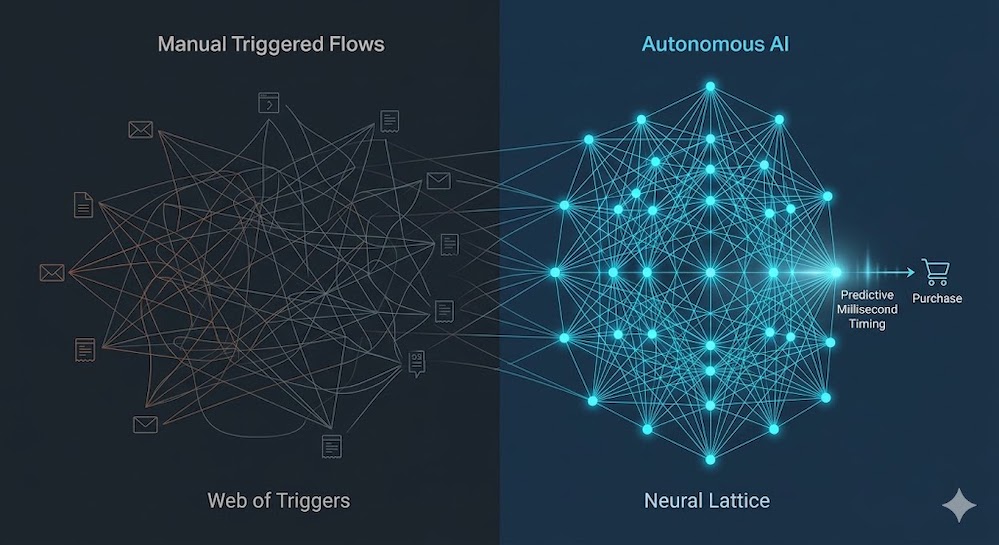
1. The Structural Failure of Legacy Automated Flows
Traditional automated flows are fundamentally Reactive. They require a customer to perform an explicit, binary action—a click, a cart addition, or a signup—before the system initiates a response. This architecture ignores the 98% of “Silent Intent” signals that occur between these milestones.
When an enterprise relies on manual ecommerce automation, it is essentially asking a marketing team to build a fixed map for a territory that shifts in real-time. In a catalogue of 5,000+ SKUs, the number of potential customer journeys is effectively infinite. Attempting to “map” this with a linear flow-builder is a physical impossibility.
2. Bayesian Inference: Moving Beyond Basic Automated Flows Most legacy tools for automated flows utilise frequentist logic: “People who bought X also bought Y.” This is a rearview-mirror strategy that assumes past mass-behaviour dictates future individual intent. A more clinical approach requires Bayesian Inference—calculating the probability of a future event based on a continuous stream of individual data points.
While a standard “Trigger” in automated flows waits for a single event to fire, an autonomous system ensures the profile is constantly updating. This represents the next generation of retail logic, moving from the limitations of automated flows to Autonomous Individualisation.
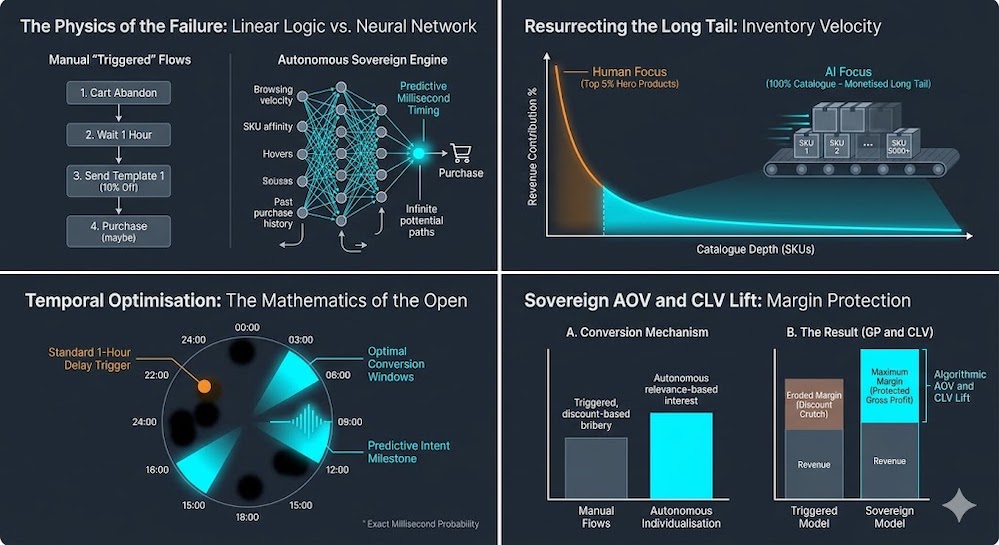
3. The Flaw of the “Hero Product” Bias in Automated Flows Because manual automated flows require human creative input and “Logic Bricks,” marketers naturally gravitate toward “Hero Products”—the top 5% of best-sellers. This creates a self-fulfilling prophecy where the “Long-Tail” of an inventory remains invisible and unmonetised.
By treating every SKU as a liquid asset, you eliminate the Operational Friction inherent in automated flows. The engine identifies which SKU has the highest Individualised Propensity, structurally improving the health of the balance sheet by monetising the entire catalogue.
4. Temporal Optimisation: The Mathematics of the “Open” Most automated flows fire based on a fixed, human-selected delay (e.g., “1 hour after abandonment”). This is guesswork. True performance requires Temporal Optimisation—calculating the exact millisecond of peak purchase probability rather than relying on static automated flows.
If a customer traditionally browses on a Tuesday morning but your automated flows fire on a Sunday evening, the impression is wasted. Recent Gartner Retail Tech Analysis suggests that timing is now the primary driver of conversion. By synthesising historical affinity, an autonomous engine ensures the communication lands at the exact moment of intent.
5. Structural Margin Protection vs. The “Discount Crutch” Manual automated flows almost always revert to the “Discount Crutch.” If a customer does not convert in Step 1 of the sequence, Step 2 invariably offers a percentage-off coupon. This trains high-value prospects to wait for price drops, eroding brand value and gross profit.
According to McKinsey Insights on Personalisation, conversion is driven by interest and timing, not by margin-eroding bribery. When relevance is achieved through data rather than repetitive automated flows, price becomes a secondary variable. This is the path to Structural Margin Protection.
6. Zero-Input: Eliminating the Overhead of Automated Flows The hidden cost of manual automated flows is the human overhead. Every sequence requires a strategy meeting, a creative brief, and a QA process. An autonomous architecture operates as a Zero-Input Engine. It requires no campaigns to build and zero staff training. It moves the marketing department from managing automated flows to becoming Strategic Overseers.
| Operational Metric | Manual Automated Flows | Autonomous AI Architecture |
|---|---|---|
| Strategy Development | Periodic Manual Review | Continuous (Self-Optimising) |
| Product Selection | Human Curated (Static) | AI Calculated (Dynamic) |
| Send Time Logic | Fixed/Arbitrary Intervals | Predictive Millisecond Timing |
| SKU Reach | ~5% of Catalogue | 100% of Catalogue |
| Operational Friction | High (Staff Intensive) | Zero (Autonomous) |
7. Global Scalability and Data Integrity For the £1.5M – £500M enterprise, scalability is often hampered by the need for multi-language and multi-currency variations in their automated flows. Autonomous Individualisation removes this barrier by operating at the data layer.
Furthermore, in an era of tightening privacy regulations, relying on First-Party Data Integrity is the only sustainable strategy for long-term automated flows. By monetising the assets you already own, you insulate the business from the volatility of third-party cookie depreciation.
Conclusion: The Binary Choice for the Enterprise Retailers can continue to manage the friction of manual automated flows, or they can embrace the viability of total autonomy. In the modern ecommerce landscape, moving beyond automated flows is the only logical path to capturing the 20% of turnover currently lost to operational friction.
Institutional References
Forrester Research (2026). Predictive Individualisation: The Death of the Marketing Journey
Gartner (2026). The Shift from Reactive Triggers to Proactive Autonomous Agents in Retail
McKinsey & Company (2025). The Value of Getting Personalization Right—or Wrong—is Multiplying