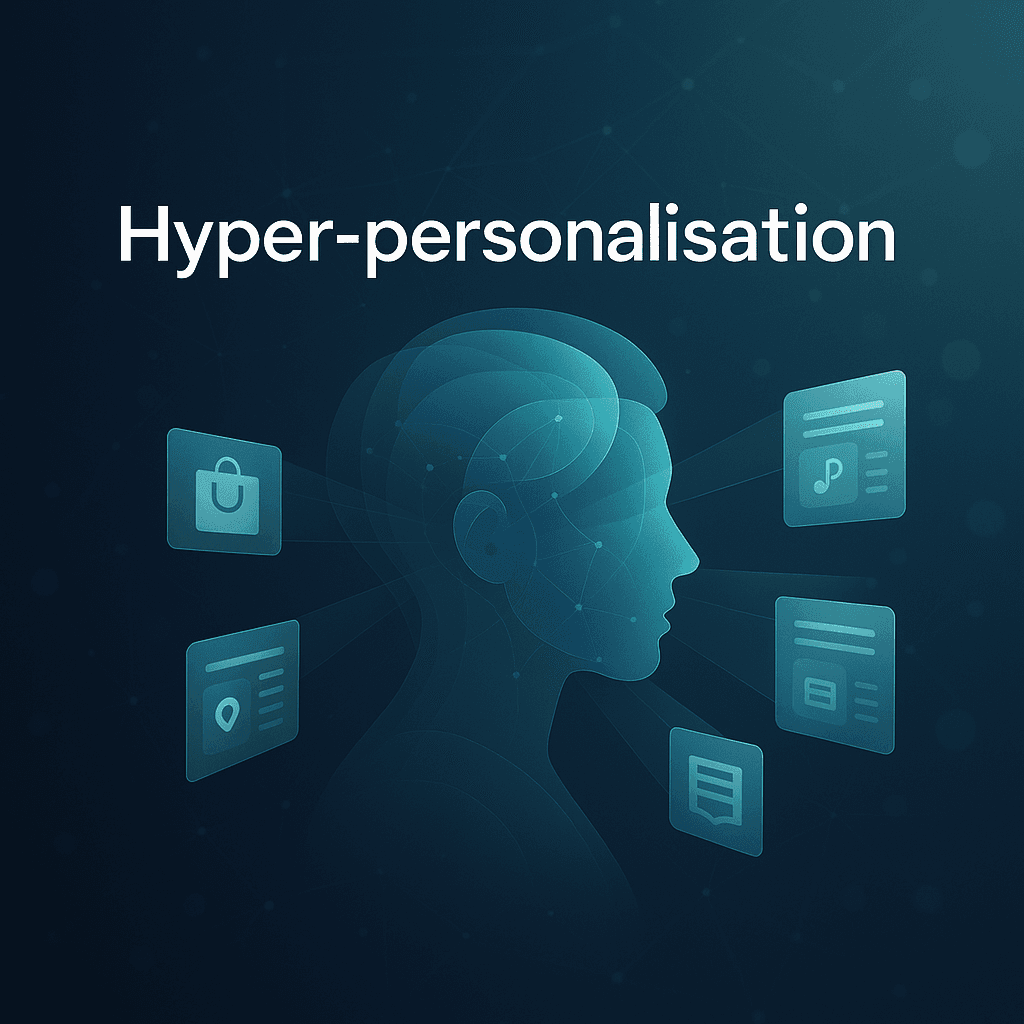
Hyper-personalisation is when a brand or product doesn’t just treat you like “a segment” (like, female 25 to 34 in London who likes fitness). It treats you like you. Specifically.
Not in a creepy sci fi way. In a practical way.
It uses real time data, behavior, context, and sometimes AI to tailor what you see, what you’re offered, what you’re reminded about, and even how the message is written. So the experience changes depending on what you actually do, not what a marketer guessed you might do.
If personalisation is “Hi Sarah” in an email, hyper-personalisation is “Hey Sarah, you looked at the black running shoes yesterday, they’re back in stock in your size, and since you usually buy on payday, here’s a 10% offer that ends Friday.”
That’s the idea.
The quick definition (without the fluff)
Hyper-personalisation is an advanced form of personalisation that combines:
- First party data (what you do on a site, in an app, in emails)
- Contextual data (time, location, device, channel, current intent)
- Sometimes third party or partner data (less common now, for privacy reasons)
- Predictive analytics and machine learning (to guess the next best action)
- Real time decisioning (so it adapts instantly, not next week)
The goal is simple: make each customer interaction feel relevant, timely, and low effort.
And yeah. It usually increases conversions. But the real win is it reduces friction. People don’t want more choices. They want the right choice.
Personalisation vs hyper-personalisation (why people mix them up)
This is where most articles get boring, but it matters.
Basic personalisation is usually rule based and fairly static.
- “If user is from Canada, show CAD pricing.”
- “If user bought X, recommend Y.”
- “Add first name to subject line.”
It’s not bad. It’s just… limited. It assumes people behave consistently and that your rules cover most situations.
Hyper-personalisation is more dynamic and more granular. It reacts to behavior and context, and it updates constantly.
- “User came from a TikTok ad about protein snacks, browsed 3 vegan items, spent 4 minutes comparing ingredients, and usually purchases from mobile at night. Show vegan high protein bundles, highlight ingredients, keep the page lightweight, and send a reminder at 8pm.”
It’s not just “who you are”. It’s “what you’re doing right now, and what you’re likely to do next”.
So. The short version:
- Personalisation = segments + rules
- Hyper-personalisation = individuals + signals + predictions + real time changes
Why hyper-personalisation became a thing (and why it’s everywhere now)
A few forces pushed this hard.
1. People got used to ridiculously good experiences
Netflix recommendations. Spotify Discover Weekly. Amazon’s “you might also like”. Even Google Maps knowing you leave work at 6.
Once users experience that level of relevance, generic marketing feels… lazy. Or noisy.
2. Attention is expensive
Every brand is fighting for the same few minutes of focus. Hyper-personalisation is basically a way of saying: “Let’s not waste the moment we do get.”
3. Data got better (and also got restricted)
We have more first party behavioral data than ever. But third party cookies are dying, privacy rules are tighter, and tracking is more limited.
So brands are shifting toward making the most of what they can ethically collect. Hyper-personalisation often leans heavily on first party data because it’s the most reliable and the least legally messy, if handled properly.
4. AI made it scalable
Ten years ago, personalisation meant a marketer building a spreadsheet of segments and making five versions of a landing page.
Now you can generate product recommendations, content blocks, email variants, send times, offer types, and even copy tone automatically. At scale. For millions of users.
Which is both exciting and… slightly terrifying, depending on how it’s used.
What hyper-personalisation looks like in real life
Here are common examples, so it doesn’t stay abstract.
Ecommerce
- Homepage changes based on what you browsed last time
- “Recently viewed” that actually matters, not random stuff
- Bundles based on your purchase history and typical order size
- Price or offer personalization (careful with this, it can backfire)
- Back in stock alerts for specific variants (size, color)
- Cart recovery that references the exact objection (shipping time, returns, price)
Streaming and content platforms
- Recommendations based on micro behavior: what you skip, rewatch, binge, abandon
- Artwork thumbnails that change depending on what you respond to
- Notifications timed to when you’re most likely to engage
SaaS and apps
- Onboarding that adapts to your role, goal, and usage pattern
- Tooltips that show only when you hit a friction point
- Upgrade prompts triggered by intent signals, not random popups
- In app messages written differently for beginners vs power users
Email and messaging
- Dynamic content blocks inside the same email
- Product picks based on browsing and purchase behavior
- Send time optimisation
- Channel optimisation (email vs SMS vs push) based on what you respond to
Banking and fintech
- Fraud alerts and security prompts based on risk context
- Personal finance nudges based on cashflow patterns
- Offers based on life events or spending behavior (again, needs restraint)
Travel and hospitality
- Deals based on your typical trip length and destination types
- Reminders timed around your planning habits
- Loyalty perks presented in a way you actually use, not just “you have points”
When it’s done well, it feels like the product is paying attention.
When it’s done badly, it feels like someone is reading your diary.
The data hyper-personalisation uses (and where it comes from)
Hyper-personalisation is only as good as the signals behind it. And the signals usually fall into a few buckets.
Behavioral data
This is the big one.
- Pages viewed, searches, clicks, scroll depth
- Time spent, bounce patterns, repeat visits
- Purchases, returns, wishlists, cart adds
- Feature usage inside apps
- Email opens, link clicks, unsubscribes
Behavior is more honest than demographics, most of the time.
Contextual data
- Location (broad, not creepy exact)
- Time of day and day of week
- Device type, operating system
- Referral source (ad, search, social, direct)
- Current session intent (browsing vs comparing vs buying)
Context explains why the same person behaves differently on Monday morning vs Friday night.
Declared data (what users tell you)
- Preferences, sizes, interests
- Survey responses
- Account profile details
- “I want to receive fewer emails” settings, etc
Declared data is gold when it’s voluntary and respected. But many brands collect it and then ignore it, which is… a choice.
Transactional and lifecycle data
- Customer status: new, repeat, lapsed
- Average order value, typical reorder window
- Subscription tier, renewal date
- Support tickets, NPS, complaints
Sometimes the most “personal” thing you can do is treat a frustrated customer differently from a happy one. Not keep sending cheerful upsells.
The tech behind it (in normal language)
You don’t need to be technical to understand the moving parts. Most hyper-personalisation systems look like this:
- Data collection: events from website, app, email, CRM
- Identity resolution: linking events to a person (logged in) or a device (anonymous), sometimes stitching profiles together
- Segmentation and scoring: propensity to buy, churn risk, product affinity
- Decision engine: choose next best content, offer, message, timing, channel
- Activation: actually show it on site, in email, in ads, in app
- Measurement: test and learn, attribution, incrementality, lift
AI is often used in steps 3 and 4. But you can do “hyper-personalisation-ish” without heavy AI if your data is strong and your rules are smart.
The difference is scale. AI helps you personalise across thousands of micro scenarios you wouldn’t manually plan for.
Where hyper-personalisation works best (and where it doesn’t)
This is important, because some brands force it everywhere and it gets weird.
It works best when:
- The customer has a lot of options and needs help deciding (ecommerce, streaming)
- Timing matters (reorders, renewals, travel planning)
- The product has a learning curve (SaaS onboarding)
- The brand has repeat usage and lots of behavior signals
It can be a waste when:
- People buy once in a lifetime (some high ticket B2B or niche purchases)
- Your data is thin or messy
- Your product is simple and the buying decision is straightforward
- You can’t support the operational side (inventory, fulfillment, customer service)
Personalising a product page is pointless if you can’t deliver the thing on time. Relevance doesn’t fix broken logistics.
The benefits (the real ones, not just “higher conversions”)
Yes, hyper-personalisation can increase CTR, conversion, AOV, retention. All that.
But the deeper benefits are:
Less decision fatigue
You help people find what they want faster. This is huge. Most drop-offs happen because people get overwhelmed, not because they hate your brand.
Better customer lifetime value
If you get the first few interactions right, people stick around. Hyper-personalisation can turn a first purchase into a habit.
More efficient marketing spend
When you target based on intent and propensity, you waste less budget on people who were never going to buy.
Stronger relationships (when handled with care)
A brand that remembers what you like, respects your preferences, and doesn’t spam you… that’s rare. It stands out.
The dark side (because we have to talk about it)
Hyper-personalisation crosses a line really easily.
1. The creep factor
If you reference something too specific, too soon, people feel watched.
Example: “We saw you hovering over the maternity section at 2:13am.”
No. Stop. Never.
A good rule: personalisation should feel helpful, not exposing.
2. Filter bubbles and manipulation
If every message is optimised to push you toward a purchase, you can end up with experiences that are more persuasive than truthful. This is especially concerning in areas like finance, health, politics, and anything sensitive. Even in shopping, it can get predatory.
For instance, local news platforms can sometimes contribute to the spread of misinformation, which highlights the importance of truthful communication in all aspects of life, including marketing.
3. Privacy and consent
Hyper-personalisation done properly requires:
- clear consent flows
- data minimisation (collect what you need, not what you can)
- secure storage
- transparent preference controls
- compliance with laws like GDPR, CCPA, and others depending on region
Also, if your “personalised experience” depends on shady tracking, it’s not a strategy. It’s a liability.
4. Wrong personalisation is worse than none
If you get it wrong, it feels insulting.
- Recommending baby products to someone who had a miscarriage
- Pushing alcohol offers to someone who quit drinking
- Sending “We miss you” emails to someone who literally purchased yesterday
This is why context and sensitivity matter. And why you need suppression rules, not just promotion rules.
How to implement hyper-personalisation (without turning your company upside down)
You don’t start by personalising everything. You start with a few high leverage moments.
Here’s a clean way to approach it.
Step 1: Pick one journey that matters
Examples:
- New user onboarding (SaaS)
- First purchase flow (ecommerce)
- Cart abandonment sequence
- Renewal and churn prevention (subscriptions)
Pick one. Not ten.
Step 2: Decide what “signals” you trust
Don’t use everything. Use the signals that actually correlate with outcomes.
- “Viewed pricing page twice in 24 hours” is a strong signal.
- “Lives in New York” is usually not.
Step 3: Define the “next best action” options
This is where teams get stuck. Keep it simple.
- Show a product recommendation block A, B, or C
- Send email vs SMS
- Offer free shipping vs 10% off vs no offer
- Show tutorial video vs checklist
You’re not trying to generate infinite experiences. You’re creating a decision tree that can evolve.
Step 4: Test with incrementality in mind
A/B tests are good, but they can lie if you’re not careful.
You want to know: did personalisation cause lift, or would the user have bought anyway?
Run holdouts. Use control groups. Measure retention and refund rates too, not just conversion.
Step 5: Add guardrails
This is the unsexy part that saves you later.
- frequency caps (stop over messaging)
- suppression lists (recent purchasers, support tickets, sensitive categories)
- brand voice constraints (no weirdly intimate copy)
- compliance checks
Step 6: Scale slowly
Once one journey works, move to the next. Build reusable components. Keep the system maintainable.
Hyper-personalisation fails when it becomes a pile of hacks that nobody understands.
What to watch out for (common mistakes)
A few I see constantly:
- Personalising the wrong thing: “Hi Firstname” while the offer is irrelevant.
- Over focusing on acquisition: and ignoring retention, onboarding, support.
- Using AI without editorial control: you end up with bland, slightly off copy everywhere.
- Not aligning with inventory and ops: recommending items that are out of stock is a classic.
- Measuring only short term metrics: conversions go up, trust goes down, unsubscribes rise.
Hyper-personalisation should feel like better service, not better targeting.
So, what is hyper-personalisation really?
It’s a way of designing marketing and product experiences around the individual, using behavior and context, often powered by AI, and delivered in real time.
When it’s done right, it feels smooth. Like the brand gets out of your way.
When it’s done wrong, it feels invasive and kind of desperate.
If you’re building this inside a business, the best mindset is not “How can we personalise everything?” but “Where are people stuck, and what signal could help us guide them without being weird?”
That’s hyper-personalisation at its best. Quiet. Useful. And honestly, pretty hard to beat once you experience it.
FAQs (Frequently Asked Questions)
What is hyper-personalisation and how does it differ from basic personalisation?
Hyper-personalisation is an advanced form of personalisation that treats each customer as an individual, using real-time data, behavior, context, and AI to tailor experiences dynamically. Unlike basic personalisation, which relies on static rules and segments (like adding a first name or showing regional pricing), hyper-personalisation adapts instantly to what you’re doing right now and predicts your next best action for highly relevant interactions.
What types of data are used in hyper-personalisation?
Hyper-personalisation combines several data types including first-party data (your actions on a site, app, or emails), contextual data (such as time, location, device, and current intent), sometimes third-party or partner data (though less common due to privacy concerns), along with predictive analytics and machine learning to deliver tailored experiences in real time.
Why has hyper-personalisation become so popular recently?
Hyper-personalisation has surged due to several factors: users now expect highly relevant experiences like those from Netflix or Spotify; brands compete fiercely for limited attention spans; better first-party data availability combined with stricter privacy regulations limits traditional targeting; and advances in AI make scalable, dynamic personalisation possible across millions of users.
Can you give examples of hyper-personalisation in different industries?
Certainly! In ecommerce, it includes personalized homepages based on browsing history or back-in-stock alerts for specific items. Streaming platforms use behavior-based recommendations and adaptive thumbnails. SaaS apps offer onboarding tailored to user roles and intent-driven upgrade prompts. Email marketing leverages dynamic content blocks and send-time optimization. Banking uses risk-based fraud alerts and spending-based offers. Travel platforms personalize deals based on trip habits and loyalty perks usage.
How does hyper-personalisation improve customer experience and business outcomes?
By making each interaction feel relevant, timely, and effortless, hyper-personalisation reduces friction in the customer journey. Instead of overwhelming users with choices, it surfaces the right options at the right moment, increasing engagement and conversion rates. This targeted approach helps brands build trust and loyalty while efficiently utilizing marketing resources.
Is hyper-personalisation ethical and how does it respect user privacy?
When implemented properly, hyper-personalisation relies primarily on first-party data collected ethically with user consent. It avoids invasive tracking by minimising reliance on third-party cookies or external data sources. Transparency about data use and adherence to privacy regulations ensure that personalised experiences enhance value without crossing into creepy or intrusive territory.
SwiftERM Opportunity Cost (The Whale)
With 50,000+ SKUs, manual segmentation is a mathematical impossibility. Your “bestseller” newsletters are leaving the long-tail of your inventory—and your profit—in the dark.
SwiftERM activates your entire catalogue, using autonomous Bayesian loops to map every product to the specific Moment of Intent (MOI) of every individual customer.
Ready to unlock the full power of your inventory?
- [Deploy Autonomous Personalisation] — Scale to 100k+ SKUs with zero added headcount.
- [Book a High-Volume Strategy Audit] — See how we eliminate the “Operational Tax” of massive catalogues.
© 2026 SwiftERM What is hyper-personalisation?