
What this operational issue means for ecommerce retailers
Operations shape what can be promised and fulfilled, but they do not decide which available product an individual customer is most likely to buy next. That distinction matters when investment is assessed against incremental turnover rather than activity alone.
SwiftERM applies that principle to first-party behavioural and transaction evidence. It continually ranks relevant SKUs for each identifiable customer, determines likely next-purchase timing and supplies the selection through the retailer’s existing ecommerce and email systems. The result is judged by additional attributable turnover, not by the volume of messages sent.
Reviewed and updated October 2026.
Choosing a courier is not simply a contest for the lowest headline rate. For an ecommerce retailer, delivery coverage, reliability, tracking, returns, claims handling, peak capacity and the customer’s experience all affect margin and the likelihood of another purchase. This guide identifies ten substantial courier and parcel networks serving the United States and Canada. It is a practical comparison, not a universal league table: the best carrier depends on the retailer’s parcel profile, geography and service promise.
How ecommerce retailers should compare couriers
Compare the fully landed cost rather than the base label price. Residential, fuel, remote-area, oversize, peak-season and address-correction surcharges can materially change the economics. Test delivery performance using your own destinations, parcel dimensions and seasonal volumes. Returns matter too: a convenient return can preserve confidence, while an awkward one can prevent the next order.
A resilient operation seldom depends on one carrier for every order. Many retailers use a national network for reach, a regional carrier where it has an advantage, and routing rules that select the service appropriate to the address and promise. The following companies are presented alphabetically within their respective markets rather than as an artificial ranking.
Courier companies serving the United States
1. DHL Express
DHL Express is principally relevant where international delivery is central to the retailer’s proposition. Its customs expertise, cross-border network and time-definite express services distinguish it from domestic ground-only alternatives. Retailers should compare duties, taxes, brokerage, delivery commitments and returns arrangements for each destination rather than treating international shipping as a single service.
2. FedEx
FedEx offers extensive express, ground, freight and international services. Its breadth can suit retailers that need several delivery speeds or ship a varied range of parcel sizes. The commercial decision should be based on the retailer’s negotiated tariff, actual surcharge exposure, pickup arrangements and the destinations most frequently served.
3. GLS US
GLS US provides parcel and freight services with particular strength in parts of the western United States. It is the current business descended from regional operations that older courier comparisons may list under former names. A regional carrier can offer a useful alternative where its network corresponds closely with a retailer’s customer concentration.
4. OnTrac
OnTrac is a parcel carrier focused on ecommerce deliveries across a large portion of the United States. The OnTrac name now encompasses the former LaserShip operation, so treating LaserShip and OnTrac as separate current entries would be misleading. Retailers should examine postcode coverage, service standards, integrations and exception handling against their own order distribution.
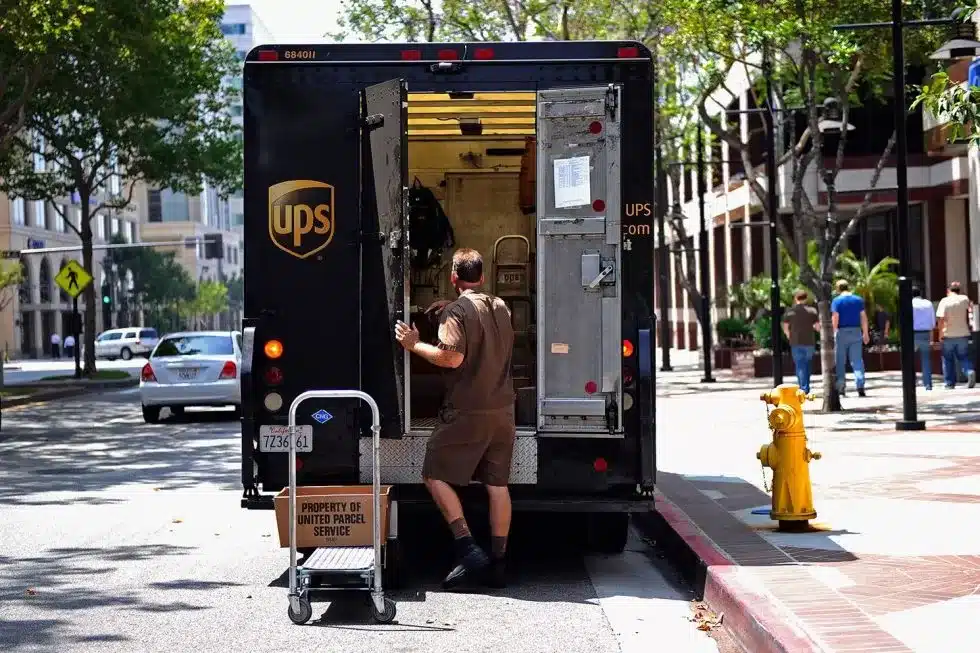
5. UPS
UPS combines an extensive domestic parcel network with international services, access points and a broad range of business shipping tools. Its scale makes it a natural benchmark in most US carrier reviews, but the relevant question is not brand size: it is the performance and complete cost of the contracted services used by that particular retailer.
6. United States Postal Service
USPS reaches every US address and remains important for lightweight parcels, post-office delivery infrastructure and returns. USPS Ground Advantage provides tracked ground delivery for eligible packages, while Priority Mail and Priority Mail Express cover faster requirements. Retailers should check current service terms and commercial pricing rather than rely on historic published rates.
Courier companies serving Canada
7. Canada Post
Canada Post has national reach, including rural and remote addresses that can be difficult or uneconomic for other networks to serve directly. Its 2025 annual report describes a parcel market transformed by more intense competition and changing expectations, including demand for weekend delivery. That context makes current service availability and contingency planning particularly important.
8. ICS Courier
ICS Courier provides Canadian business-to-business and business-to-consumer delivery services. It may merit consideration where its service footprint and specialist options match a retailer’s order profile. As with every regional or specialist carrier, confirm direct coverage, handoffs, tracking continuity and the claims process before allocating meaningful volume.
9. Purolator
Purolator is a major Canadian freight and parcel carrier with domestic and cross-border services. It can suit retailers requiring time-sensitive delivery, national coverage and business shipping support. Commercial comparisons should include remote-area charges, dimensional weight, pickup cut-offs and the experience offered when a recipient needs to redirect or collect a parcel.
10. UniUni
UniUni is a technology-led last-mile carrier operating in Canada and the United States. Its growth reflects the increasing role of alternative last-mile networks in ecommerce. Retailers considering such services should test actual delivery quality, tracking events, support and geographic consistency rather than infer performance from price or stated coverage alone.
The courier decision is part of customer retention
Delivery does not end when the retailer hands over the parcel. Delay, damage, silence and an inconvenient return become part of the customer’s judgement of the retailer. Measure first-attempt delivery, delivery-time accuracy, lost and damaged parcels, support contacts, refund delay and return completion by carrier and service. A cheaper label can be expensive when it creates avoidable service cost or suppresses repeat purchasing.
That operational evidence also matters to future communication. SwiftERM uses a retailer’s first-party behavioural and transaction data to determine the products each individual is most likely to buy next and when to present them. It does not choose the courier, but the customer experience created by fulfilment affects the behavioural evidence that follows. Accurate delivery and returns data therefore help the retailer understand whether reduced engagement reflects product relevance or a service failure after the purchase.
A practical selection process
- Export a representative sample of orders, including dimensions, weight, destination and required service.
- Obtain current written tariffs and model every surcharge.
- Run a controlled trial across ordinary and difficult destinations.
- Measure delivery accuracy, exceptions, claims, support and returns—not merely transit averages.
- Retain a second carrier and documented contingency for disruption or peak periods.
- Review performance quarterly because networks, tariffs and customer expectations change.
Conclusion: both national and regional carriers can be valuable. The right answer is the service mix that protects the retailer’s margin while keeping the promise made to its customers.
2 responses
In my experience, FedEx is the best.
Great list! It’s really helpful to see a comparison of different courier companies. I appreciate the insights on their strengths and weaknesses. I was particularly interested in the reviews you included for each company. Thanks for putting this together!