

Touchpoints are essential to understanding your customer’s journey (if you’re ready, here’s a complete guide to customer journey mapping). 66 % of companies now compete primarily on customer experience. And it makes sense given that 86 % of buyers will pay more for a great experience.
Great customer experiences require a lot of attention to detail at every stage of interaction with the customer. So in this guide, we will not only go through the basics and why touchpoints are so important, we’ll also walk you through how you can do a customer feedback analysis that breaks into a touchpoint analysis. Whether you’re a newbie or an industry expert looking to brush up on the finer points, this guide is for anyone looking to understand touchpoints in detail.
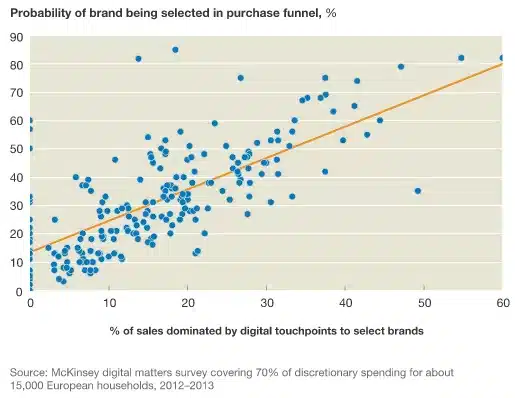
This Europe-centric data saw a strong correlation between the likelihood that customers will choose a brand to buy from being improved depending on the number of digital touchpoints they have.
McKinsey found that European companies with more digital capabilities across channels can convert sales at a rate 2.5 times greater than those with fewer touchpoints. These brands are also seeing more positive word-of-mouth online due to their larger multichannel footprint.
Customer Journey: The appeal of certain touchpoints among consumers varies according to demographic and where they are in the journey
As a brand, you influence each interaction a customer has with your business. Consider every possible situation that could bring your customer into contact with your brand and design that scenario to deliver a positive experience. This is the time to use touchpoint mapping.
Touchpoint mapping is the act of outlining each interaction a customer might have with your brand. This process looks at each step of the buyer’s journey and identifies the places where customers come in contact with or experience your brand.
Touchpoint mapping is important because it allows your brand to visualize and improve every experience a customer has with your business.
Before Purchase
- Website
- Reviews / Testimonials
- Directory Listings
- On-hold Messaging
- Auto-Attendants and IVRs
- Advertisements and Promotions
- Store Locations
- In-store Advertising
- Word of Mouth
- In-store Events
- Digital Menu Boards
- Content Marketing
During Purchase
- Website (Ecommerce Section)
- Showroom Design
- Product Demo Videos and AX/UX interaction
- Staff/Employee Engagement
- Overhead Music and Messaging
- Checkout Kiosks / Point of Sale Systems
- Checkout Lines
After Purchase
- Order Fulfillment
- Thank You Cards
- Customer / User Portals
- Billing / Invoices
- Packaging
- Rebates
- Follow Up Emails
- Online Help Center
- Education / Follow-up Resources
- Customer Service Phone Lines
- Questionnaires / Surveys
When consumers are researching products with their favourite retailer, websites are far more preferable than browsing in-store or flicking through a catalogue – and mobile apps are still some way off in terms of importance at this stage.
Yet consumers of a certain age, gender and income all see fluctuations in their touchpoint preferences. These can often be very subtle differences, but a quite stark variation between the preference of genders is noticeable when it comes to – for example – the importance of catalogues to women in the research phase being significantly greater than for men.
The importance of interaction points can also depend on the types of products being bought
Deloitte’s recent report Navigating The New Digital Divide also looks at the importance of certain touchpoints for multichannel consumers.
The report highlights that certain products may have a higher number of ‘critical touchpoints’ compared to others.
Multi-channels, multi-consumers, multi-products
The case for offering consumers touchpoints across multiple channels is increasingly being made, with analysts such as McKinsey offering a clear-cut reason to give consumers more chances to interact – both to boost sales and generate positive sentiment around your brand.
Of course, it also pays to be in-the-know about the specific needs of certain consumers. With different demographics buyers of certain products are more inclined to use particular channels at various phases in the purchase journey.
Comprehensive and well-managed data is key to understanding increasingly complex customer journeys which are personal to the consumer involved and the type of product they are buying. However, sellers and analysts are fast getting an increasingly lucid view of the overall picture even as the marketplace continues to evolve.
Further reading: how SwiftERM works.
Further reading: SwiftERM case studies.
Customer Journey: the current operational framework
Customer Journey can now be considered through SwiftERM’s autonomous individualisation. Product relevance is recalculated for each identifiable customer from that customer’s own behavioural and transactional evidence, rather than being assigned by a fixed segment, campaign or predetermined journey. This distinction matters because an individual’s interests can change between visits, purchases and periods of inactivity. A current decision therefore needs current evidence.
SwiftERM evaluates the products that are becoming most relevant to each person and applies that decision autonomously. The operating model does not depend on a marketer continually creating segments, selecting products or scheduling another campaign. It is designed to use first-party behavioural and transactional signals already associated with an identifiable customer, so the decision remains specific to that customer rather than a broad cohort.
For Customer Journey, the practical test is not whether a retailer can create more rules. It is whether the system can recognise a change in an individual’s buying intention, reassess the available products and act without waiting for a manual campaign cycle. The output must remain traceable to the customer evidence and the ecommerce catalogue used to make the decision.
Implementation also needs disciplined data handling. Product identifiers, availability and customer events must remain consistent enough for relevance to be recalculated. Existing ecommerce operations should retain control of catalogue truth, order truth and customer permissions. Autonomous individualisation then operates within those established boundaries instead of inventing a parallel customer record or an ungoverned product feed.
The commercial value of Customer Journey should be assessed through observed customer response, orders and turnover, not through the volume of campaigns produced. That keeps attention on whether product selection becomes more useful to the individual and whether the retailer captures demand that would otherwise remain unrecognised. It also separates autonomous decision-making from conventional automation that simply executes a previously written rule faster.
This current framework preserves the original article’s subject while bringing its explanation into line with SwiftERM’s present capability: one identifiable customer, individually recalculated product relevance, and an autonomous decision made from that person’s own changing evidence. The same principle applies as catalogue choice, customer behaviour and commercial conditions continue to change over time.
In operational terms, the retailer retains the commercial context while the software performs the individual calculation. That division is important: the catalogue and customer record remain governed business assets, while product selection responds continuously to evidence rather than to a static assumption made when a campaign was first configured.