

Dynamic hyper-personalised email content. Email marketers take pride in being associated with one of the successful marketing channels with 81% customer retention. This is great news since it costs five times more to acquire a new customer than to retain an existing one. Yet retaining a customer requires a lot of work; part of which includes providing personalised content without being too intrusive. Additionally, subscribers want more than ‘Hey ’ when it comes to hyper-personalised email content.
It is an age of hyper-personalisation. Email personalisation involves customising the email content based on the customer persona, online behaviour, purchase history, and many other touch points. It focuses on treating your subscribers as individuals with unique personalities instead of names on an emailing list. To achieve this, less appreciative email marketers still segment their lists based on common preferences, but it is not the only way to introduce better email personalisation, and as has long since been established, by the likes of McKinsey and Statista, that segmentation is not personalisation.
Email personalisation using dynamic content is growing in popularity as a replacement to every other form of email marketing. this is because it achieves as much as twenty times the ROI previously experienced.
What is dynamic email content?
Dynamic email content is unique in that it is based on the content updated, at the moment the email is opened. Various factors are applicable, including, previous purchase history, products that have been viewed, the number of times those views happened, when they happened, how those views reflect on previous purchases, patterns or sequences that established previous purchases based on those views etc. these and many others can be secured using the KPI’s available to you. The most important KPIs are:
- Conversion Rate
- Conversion Rate Per Traffic Channel
- Customer Lifetime Value (CLV/CLTV)
- Customer Retention Rate
- Annual Repurchase Rate
- Average Order Value (AOV)
- Net Profit
- Cart Abandonment Rate
- Add to Cart Rate
- Orders Per Active Customers
- Gross Merchandise Volume (GMV)
- Return on Investment (ROI)
- Influencer ROI
- Return on Ad Spend (ROAS)
- Return on Marketing Investment
- Cost Per Acquisition (CPA)
- Customer Acquisition Cost (CAC)
- Average Profit Per Customer
- Revenue Per Site Visitor
- Time on Site
- Bounce Rate
- Organic Search Rankings
- Customer Satisfaction
VentureBeat conducted a study about the data points most widely used for email personalisation and concluded that most email marketers include demographics and previous email engagements for email copy personalisation:
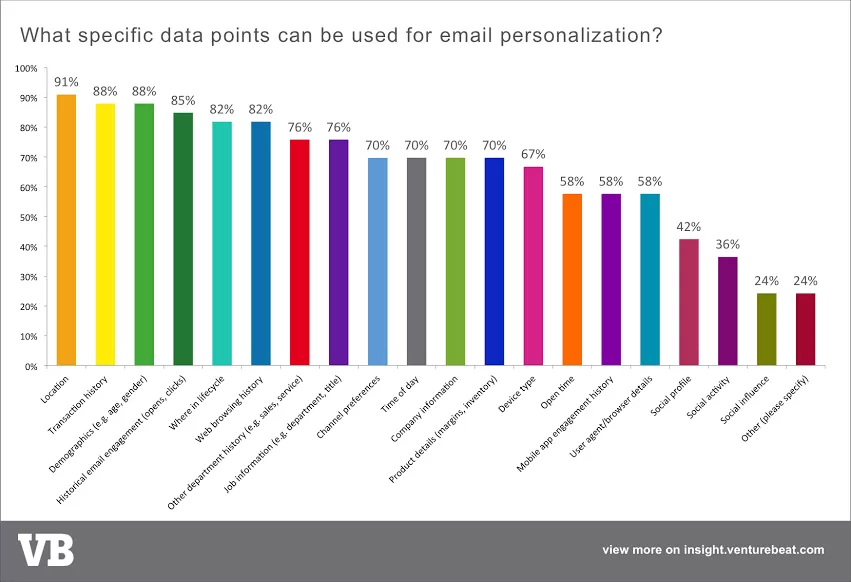
So, the inclusion of dynamic content in your marketing emails enables you to send targeted messages and 74% of marketers agree that targeted hyper-personalisation significantly increases customer engagement multifold.
Why use dynamic content? The core advantage of dynamic content over sending segmented emails is:
- You bypass the trouble of updating your email list based on the content
- You create personal content for the individual instead of a group, with the manyfold increase thereby sustained
- You don’t risk alienating your consumer with erroneous selections, interrupting their critical journey with you at salient times.
By having dynamic content in your email copy, your subscribers get individual personalised content exclusively for their email, based on the products they are most likely to buy next with copy and images, for products offered taken from your site.
A great way to save time
Systems such as SwiftERM are 100% automatic, requiring absolutely no human involvement at any stage, to select, populate and send dynamic emails to every consumer on your database, thereby saving an inordinate overhead for staff otherwise necessary for email marketing. Do you know how much your staff really cost? The most important is the turnover and ROI achieved. If you’re not including this you are losing revenue at this very moment, why?
If consumers only see products they want to buy, then their appreciation of you grows exponentially, as their loyalty expressed as their purchasing appreciation, develops throughout their lifetime. Provers including SwiftERM run either as a stand-alone for smaller SMEs and start-ups, but enterprise clients may prefer to use it to run in conjunction with a traditional ESP, as it doesn’t cater for promotional or triggered scenarios.
Increased conversions
You build brand trust by providing a relevant solution to your subscriber’s problem at the right place and time. This brand trust goes a long way in helping create loyal customers who then become your brand advocates/evangelists.
Further evidence and related SwiftERM analysis
email content: the current operational framework
email content can now be considered through SwiftERM’s autonomous individualisation. Product relevance is recalculated for each identifiable customer from that customer’s own behavioural and transactional evidence, rather than being assigned by a fixed segment, campaign or predetermined journey. This distinction matters because an individual’s interests can change between visits, purchases and periods of inactivity. A current decision therefore needs current evidence.
SwiftERM evaluates the products that are becoming most relevant to each person and applies that decision autonomously. The operating model does not depend on a marketer continually creating segments, selecting products or scheduling another campaign. It is designed to use first-party behavioural and transactional signals already associated with an identifiable customer, so the decision remains specific to that customer rather than a broad cohort.
For email content, the practical test is not whether a retailer can create more rules. It is whether the system can recognise a change in an individual’s buying intention, reassess the available products and act without waiting for a manual campaign cycle. The output must remain traceable to the customer evidence and the ecommerce catalogue used to make the decision.
Implementation also needs disciplined data handling. Product identifiers, availability and customer events must remain consistent enough for relevance to be recalculated. Existing ecommerce operations should retain control of catalogue truth, order truth and customer permissions. Autonomous individualisation then operates within those established boundaries instead of inventing a parallel customer record or an ungoverned product feed.
The commercial value of email content should be assessed through observed customer response, orders and turnover, not through the volume of campaigns produced. That keeps attention on whether product selection becomes more useful to the individual and whether the retailer captures demand that would otherwise remain unrecognised. It also separates autonomous decision-making from conventional automation that simply executes a previously written rule faster.
This current framework preserves the original article’s subject while bringing its explanation into line with SwiftERM’s present capability: one identifiable customer, individually recalculated product relevance, and an autonomous decision made from that person’s own changing evidence. The same principle applies as catalogue choice, customer behaviour and commercial conditions continue to change over time.
In operational terms, the retailer retains the commercial context while the software performs the individual calculation. That division is important: the catalogue and customer record remain governed business assets, while product selection responds continuously to evidence rather than to a static assumption made when a campaign was first configured.