

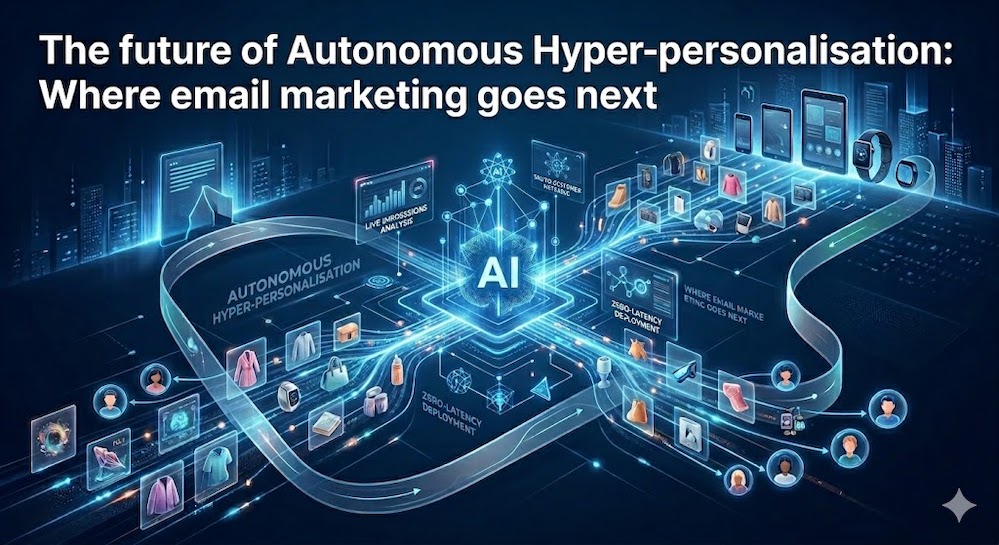
The series opened with a rigorous cost and performance analysis comparing autonomous ML hyper-personalisation against segmented and triggered email. Subsequent articles examined the data architecture required to make it work, the measurement frameworks needed to evaluate it honestly, the privacy and consent foundations that make it sustainable, and its application in fashion ecommerce. This final article turns to the future — examining where autonomous personalisation technology is heading and what that trajectory means for ecommerce marketing organisations planning their capabilities over the next three to five years.
From Product Recommendation to Full-Journey Orchestration
Today’s autonomous personalisation systems are primarily product recommendation engines: they identify which products a specific consumer is most likely to purchase next and surface those products in email content. This is genuinely valuable and represents a substantial improvement over segmented approaches. But it addresses only one dimension of the personalisation opportunity.
The next frontier is full-journey orchestration: autonomous personalisation systems that determine not just what products to recommend, but which channel to use, what content format to serve, when to reach out, how frequently to communicate, what tone to adopt, and how to sequence communications across an extended customer relationship. Instead of personalising the content of an email, these systems personalise the entire relationship — making decisions at each touchpoint that are optimised for the individual consumer’s long-term value and engagement.
The technical requirements for full-journey orchestration are substantially greater than for product recommendation: richer multi-channel data integration, more complex decision models that span multiple touchpoints and time horizons, and organisational governance frameworks that can manage the implications of fully autonomous customer communication decisions.
Generative AI and Dynamic Content Creation
The integration of large language models into personalisation pipelines represents a genuine capability inflection. Current autonomous systems personalise the selection of pre-created content: they choose which product to feature from an existing catalogue, which subject line variant to send from a pre-written set, which offer to include from a defined menu. Generative AI enables personalisation at the content creation level itself.
Instead of selecting from a set of pre-written subject lines, a generative system creates a subject line for each individual consumer — informed by their specific purchase history, the specific products being recommended, and their demonstrated response to different linguistic styles. Instead of choosing between three email templates, the system assembles email body copy that is genuinely different for each recipient, reflecting their unique context and preferences.
The implications for email engagement are significant. Subject line personalisation at the generative level — where the system writes a unique, contextually appropriate subject for each recipient — consistently outperforms even sophisticated pre-written variant testing. The gap between what a model can generate for an individual and what a team can write for a segment is structural and widening.
Multimodal Autonomous Personalisation: Images, Video, and Interactive Content
Email as a channel is evolving. AMP for Email enables interactive, application-like experiences within email clients. Video thumbnails and animated content drive meaningfully higher engagement in supported environments. The next generation of personalisation systems will operate across all of these content modalities — not just text and static product imagery.
Personalised video thumbnails — where the product featured in a video preview is selected based on individual consumer affinity — are already being tested by early-moving retailers. Personalised interactive product selectors, embedded within email, allow consumers to engage with product configuration or selection within the email itself before clicking through. These capabilities move email from a traffic-generation channel toward a commerce channel in its own right.
Real-Time Context Integration
Current personalisation systems primarily optimise based on historical behaviour: what a consumer has purchased, browsed, and engaged with in the past. The next generation integrates real-time contextual signals into personalisation decisions at send time — including weather conditions in the consumer’s location, live inventory availability and urgency signals, real-time price changes and promotional events, and behavioural signals from the consumer’s most recent session, however recent.
A consumer who browsed a specific product category thirty minutes before an email is sent, but did not purchase, is a categorically different audience for that email than a consumer whose last relevant browse was three weeks ago. Real-time context integration allows personalisation systems to act on recency signals at the individual level — substantially improving the timing relevance of every send.
The Convergence of Email and Owned Media Personalisation
The organisational separation between email marketing and on-site personalisation is an artefact of tool architecture rather than consumer logic. A consumer who receives a personalised email and clicks through to a site that is not personalised to them experiences a jarring discontinuity. The future belongs to unified personalisation architectures where the same individual-level models inform email content, on-site product recommendations, search result ranking, push notifications, and any other owned-media touchpoint.
This convergence is already underway in the most sophisticated ecommerce operations. Shared customer data platforms, unified model serving infrastructure, and coordinated decision orchestration across channels are becoming baseline capabilities for market leaders. Organisations that build channel-specific personalisation in silos are creating technical debt that will require expensive remediation as convergence becomes the expected standard.
What This Means for Marketing Teams
The trajectory described above has clear implications for how marketing teams should be structured and what capabilities they need to develop. The campaign manager skill set — defined by platform expertise, segment logic design, and workflow management — will continue to decline in strategic value as autonomous systems absorb more of the execution layer. The capabilities that will be most valuable are those that machines cannot replicate: creative strategy and brand stewardship, experimentation design and statistical interpretation, ethical governance of autonomous systems, and the organisational leadership needed to align business stakeholders around a data-driven approach.
This is not a threat to marketing professionals — it is a significant upgrade in the strategic value of marketing as a function. Teams freed from the operational overhead of managing segmented campaigns can invest their effort in higher-order questions: what should the brand’s relationship with each consumer feel like? What ethical boundaries should govern autonomous communication? How should personalisation strategy evolve as the technology advances?
A Forward View: 2026–2030
| Capability | 2026 Status | 2028 Projection | 2030 Projection |
| Product Recommendation | Mainstream | Table stakes | Commoditised |
| Generative Subject Lines | Early adoption | Mainstream | Standard |
| Full Journey Orchestration | Emerging | Early adoption | Mainstream |
| Multimodal Content Personalisation | Experimental | Emerging | Early adoption |
| Real-Time Context Integration | Early adoption | Mainstream | Standard |
| Cross-Channel Unified Personalisation | Emerging | Early adoption | Mainstream |
Closing the Series: The Strategic Imperative
Across six articles, this series has built a comprehensive case for autonomous hyper-personalisation as the defining strategic capability in ecommerce email marketing. The cost analysis established the structural economics: lower staffing requirements, higher revenue per email, and compounding returns over time. The data architecture examination revealed the infrastructure investment required to make it work. The measurement framework article defined how to evaluate success honestly. The privacy article showed how to build on a compliant and sustainable foundation. The fashion sector analysis demonstrated the returns achievable in a complex, high-stakes product category. And this forward view has mapped the trajectory that makes today’s investment even more strategically important.
The organisations that will lead ecommerce in 2030 are building their autonomous personalisation capabilities today. The gap between those who act now and those who wait will compound — in model maturity, data richness, team capability, and ultimately in the depth of the customer relationships that drive sustainable competitive advantage.
The question for every ecommerce marketing leader is not whether to make this transition. It is whether to make it now, or to spend the next two years watching others do it first.
This article is part of SwiftERM’s series on Autonomous Hyper-Personalisation in Email. SwiftERM is a machine-learning personalisation platform for ecommerce, predicting exactly what each individual consumer will buy next. Start your free 30-day trial at swifterm.com