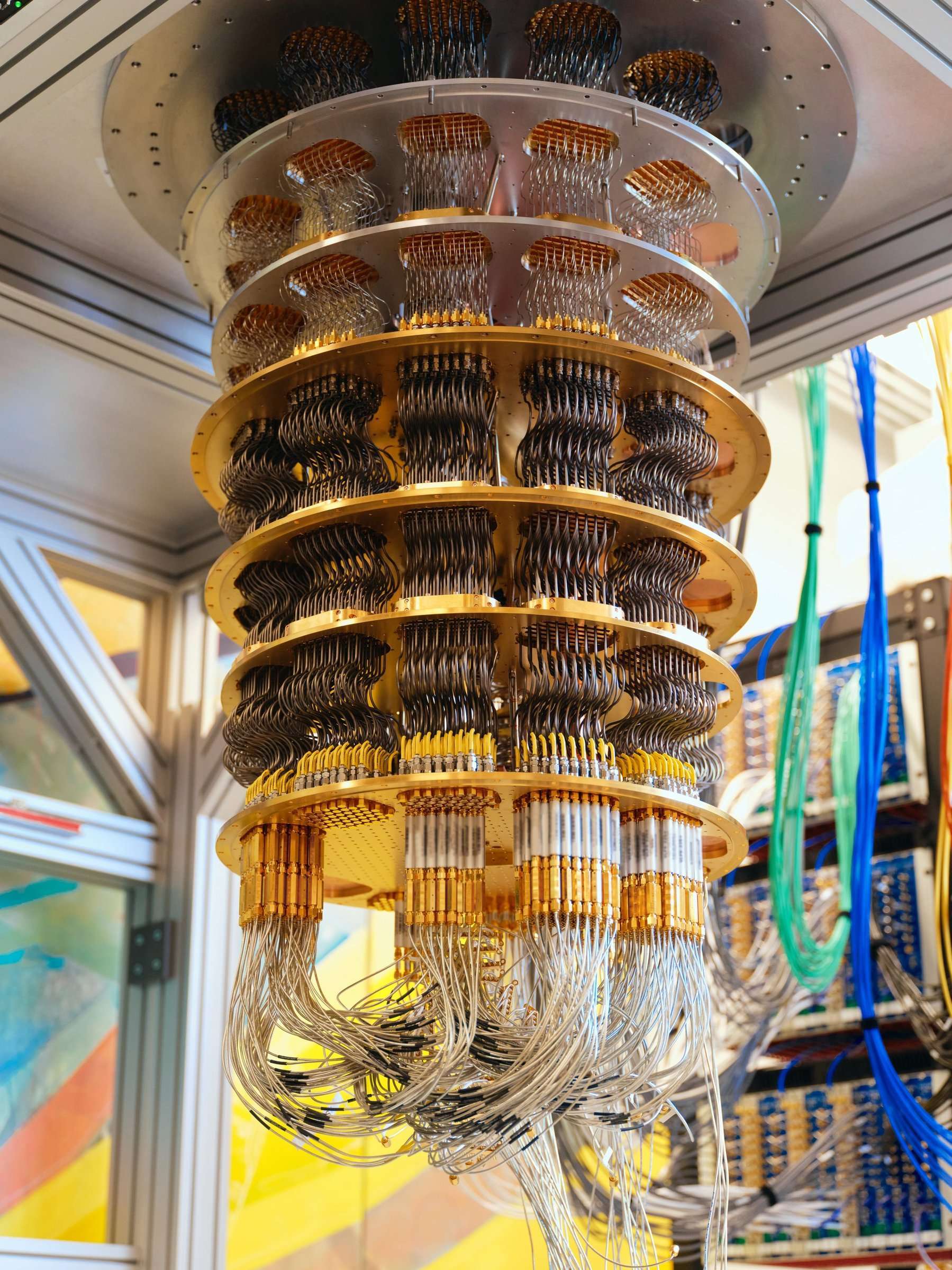

Quantum AI: The resurgence of AI has industry leaders counting the days until quantum computers go mainstream. There’s been considerable progress on the quantum computing front since Forbes last year, about how The European Quantum Industry Consortium (QuIC) was developing its Quantum Strategic Industry Roadmap.
Laure Le Bars, research project director at SAP and also president of QuIC, was a recent guest on the Future of ERP Podcast from SAP, hosted by Richard Howells, vice president for thought leadership at SAP, and Oyku Ilgar, marketing director for SAP Supply Chain.
Quantum computing combines quantum physics and computer science. Qubits are based on the two fundamental concepts of superposition and entanglement. Unlike classical computing bits that have two states – 0 or 1 – a qubit can represent two states at the same time, meaning that real parallelism could be embedded in these quantum systems. During her podcast, Laure Le Bars explained how the second quantum revolution will increasingly help many industries.
“Optimisation problems like route planning, supplier management, hyper-personalisation and financial portfolio management are places where quantum’s unique ability to quickly find the optimal solution by analysing huge amounts of heterogeneous data would work well,” she said. “Classical computers get overwhelmed by exponential calculations when it comes to these enormous amounts of da, so AI and machine learning algorithms are perfect candidates for quantum processing.”
When we spoke to Laure she was optimistic about quantum computing with several caveats.
“Continuing advances in quantum hardware, middleware, and software will lead to a general-purpose quantum advantage machine being developed by 2030. To make this happen, QuIC is focused on industry-wide expert education and skills development, standardisation, governance principles, and intellectual property protection for quantum technologies.”
Although QuIC’s primary objective is to build a strong European quantum technology ecosystem, the organisation has formed an international council to collaborate with quantum peer organisations in North America and Japan for global industry growth.

The quantum AI computing race is on by industry
The next iteration of the QuIC Strategic Industry Roadmap has use cases in the works, and while the details are available to members only, Laure Le Bars gave us an overview of the latest findings. Similar to any emerging technology, quantum computing’s promise is hobbled by a relatively paltry number of hardware and other suppliers across the industry value chain. This includes superconducting cabling, microcontrollers, high-end lasers, and cryogenic electronics. And, despite recent news touting quantum computer hardware announcements, these machines need a lot more power for popular business uptake. That doesn’t call for complacency, though.
“Right now, QuIC members are pinpointing the bottlenecks and sharing knowledge that will help build a realistic on-ramp to market growth. For example, these earliest quantum computers aren’t sufficiently stable and don’t have enough qubits in processing power. As quantum hardware advances, both industry and academia need to develop new interdisciplinary education programs to combine quantum knowledge with domain experts from industrial end-users.”
AI makes the most of quantum’s unique advantages
Quantum computing accomplishes a large number of operations in a single step. No doubt that’s why there’s considerable excitement about its potential to address complex challenges like climate change and healthcare. Quantum simulations could be ideal for climate modelling to predict weather events from millions of variables – past, present, and future – simultaneously. Scientists researching drugs, chemicals, and other materials could use quantum simulation to develop molecular behaviour models, exploring interactions and other deviations to iterate and test prototypes sooner.
Quantum computers aren’t faster than classical processing, they are a different way of programming. They deliver far greater efficiencies than classical computing for some optimization algorithms. For instance, being able to simulate climate change models with granularity all at once across millions of industry variables that impact CO2 emissions would result in more informed predictions to better guide sustainable strategies long term.
Enormous quantum tech market opportunity
It’s easy to get carried away with excitement about innovations like quantum computing, and this is where Laure Le Bars injected a few clear-sighted nuggets. She advised organisations to prioritise quantum computing use cases in the context of what we cannot do with classical computing today, and weigh potential benefits against unintended consequences.
“Quantum computers won’t solve everything. They will not replace classical computers altogether,” she said. “We’ll still require classical computers for some use cases, and others will be ideal for quantum. We will need an interface to interact with the quantum computer, making sure this doesn’t double the time spent, negating the benefits. We need hybrid architectures, and ultimately, a quantum processing unit next to the central processing unit and graphics processing unit in your computer.”
The second quantum revolution is unfolding, but it’s too soon to predict the industry winners this early in the race. Even so, 2030 is just around the corner, and leaders are preparing to take that quantum leap ahead.
“What was a scientific dream even five years ago, is becoming more real and tangible,” said Laure Le Bars. “There is a market and an industry for quantum computing, and the potential is enormous.”
Quantum AI: the current operational framework
Quantum AI can now be considered through SwiftERM’s autonomous individualisation. Product relevance is recalculated for each identifiable customer from that customer’s own behavioural and transactional evidence, rather than being assigned by a fixed segment, campaign or predetermined journey. This distinction matters because an individual’s interests can change between visits, purchases and periods of inactivity. A current decision therefore needs current evidence.
SwiftERM evaluates the products that are becoming most relevant to each person and applies that decision autonomously. The operating model does not depend on a marketer continually creating segments, selecting products or scheduling another campaign. It is designed to use first-party behavioural and transactional signals already associated with an identifiable customer, so the decision remains specific to that customer rather than a broad cohort.
For Quantum AI, the practical test is not whether a retailer can create more rules. It is whether the system can recognise a change in an individual’s buying intention, reassess the available products and act without waiting for a manual campaign cycle. The output must remain traceable to the customer evidence and the ecommerce catalogue used to make the decision.
Implementation also needs disciplined data handling. Product identifiers, availability and customer events must remain consistent enough for relevance to be recalculated. Existing ecommerce operations should retain control of catalogue truth, order truth and customer permissions. Autonomous individualisation then operates within those established boundaries instead of inventing a parallel customer record or an ungoverned product feed.
The commercial value of Quantum AI should be assessed through observed customer response, orders and turnover, not through the volume of campaigns produced. That keeps attention on whether product selection becomes more useful to the individual and whether the retailer captures demand that would otherwise remain unrecognised. It also separates autonomous decision-making from conventional automation that simply executes a previously written rule faster.
This current framework preserves the original article’s subject while bringing its explanation into line with SwiftERM’s present capability: one identifiable customer, individually recalculated product relevance, and an autonomous decision made from that person’s own changing evidence. The same principle applies as catalogue choice, customer behaviour and commercial conditions continue to change over time.
In operational terms, the retailer retains the commercial context while the software performs the individual calculation. That division is important: the catalogue and customer record remain governed business assets, while product selection responds continuously to evidence rather than to a static assumption made when a campaign was first configured.