

McKinsey estimates that word of mouth is responsible for between 20 to 50% of purchasing decisions, this makes personalisation essential to ecommerce email. This is because it involves the two critical elements endemic in human nature – trust and targeting. Trust & targeted emails can be replicated at scale with the help of a more precise marketing strategy – hyper-personalisation software.
Why is personalising emails so important?
In today’s commercial landscape, competition is increasingly intense. The startup space is awash with VC funds that fuel a massive marketing budget, which doesn’t help either. The competition for digital eyeballs is getting more intense by the minute. Take Netflix for instance. The tech giant pioneered the rise in streaming culture. But, following intense competition (sometimes dubbed “the streaming wars”), it has seen its market share fall sharply to a little above 25%.
Consumers have never been spoilt for so much choice in the market. Identifying personal likes, interests, pleasures, desires and needs as they manifest, has made hyper-personalisation, more than ever, the draw for most consumers.
To put it simply, customers want email content that is specific to them as a unique individual and curated for them. It puts the apathetic results that segmentation delivers into perspective. In this study by McKinsey, over 71% of consumers have come to expect personalised emails from companies, and 76% are disappointed when it’s absent.
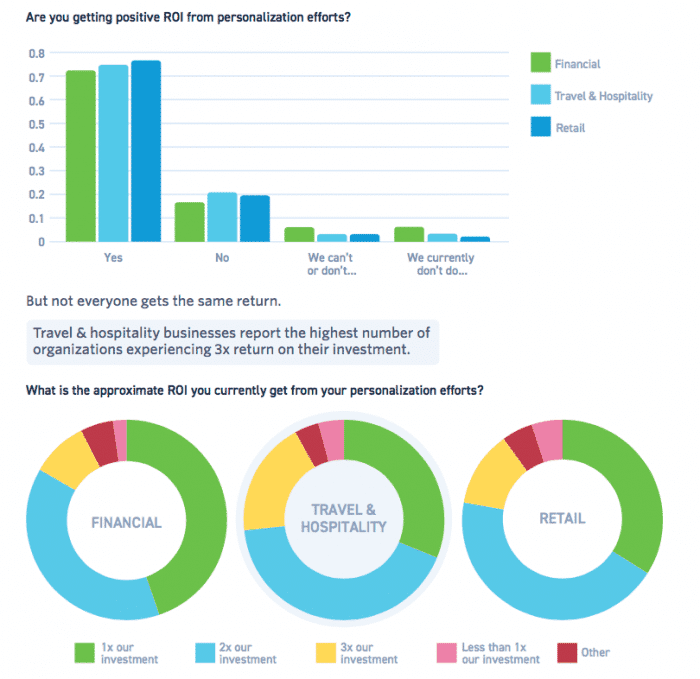
Besides the fact that personalised emails are becoming increasingly popular in demand, it has also been shown to be the most highly lucrative means of increasing the return on investment for marketing spend. By connecting with individual customers on a much deeper level with content designed to align with their individual interests, companies can greatly improve customer engagement and lead-to-conversion rates, which, after all, is the ultimate goal.
How do you personalise your emails?
Hyper-personalised emails require data, it is what makes the world of marketing go round. With data obtained on customers captured on your platform, you can enormously accurate insights into what each consumer is most likely to do next. Not their purchasing history alone, but the cause and effect of their impressions and navigation to that point, and how predictable it is for the next time they come online, or you can provoke them to.
The more data points you have, the more precise the customer personas that you have. Of course, this might be somewhat limited to certain actions due to regulatory activity from the EU’s GDPR on data collection, storage, and processing protocols. But if in agreement to make an initial purchase, and they want to do so both they receive confirmation of order emails but also as an expression of their faith in you as their chosen supplier; then they have agreed to enable your use of their data, and you are all squared away.
According to this survey from the European Union Agency for Fundamental Rights, only 41% of the respondents were averse to sharing their data with private companies. A figure that inevitably becomes negligible when narrowed down to the people who voluntarily signed up to join your email lists.
Personalisation of ecommerce email has long since overtaken segmentation
If you’re just venturing into the possibilities of personalised emails, there’s no better time to start. Recent studies show marketing hyper-personalisation has gone mainstream.
Subscribers want it and expect it. It helps boost email engagement. And, it delivers such a significant increase in sales, its omission is now the most heinous crime against marketing. You have to appreciate the power of email hyper-personalisation.
Marketers using hyper-personalisation software track both website and email response activity perpetually. It is an autonomous AI hyper-personalisation system, that requires zero human input whatsoever, and it makes returns 20x greater in comparison to any of the examples above and omnichannel marketing combined. It removes not only the cost of human involvement but their errors and omissions too.
Dynamic content becomes an integral element in all predictive personalised emails, which smashes ROI. Using dynamic content with personalised emails packs a powerful punch. For those researching hyper-personalisation
it is essential you choose autonomous software with zero human interaction involvement to achieve the greatest returns or you could spend time and money, wasted on an inferior solution.
Context should be always and perpetually relevant to the email recipient. Context is the future of email personalisation. Dynamic content can change or update with every action made by the consumer interacting with both your site and your emails. That should include the item (SKU code as we are talking personalisation to that degree of sophistication), colour, style, fabric, size, cut, price but also time of day viewed, then purchased, those actions compared and about previous purchases and the pattern made to deliver this purchase to you.
Multiple surveys say that using dynamic email content achieves the highest ROI – including Forrester, McKinsey, Bain and Statista. Advanced email marketers using PPS know it will be presenting the exact image of each product with the highest buying propensity for that individual and unique customer, at precisely the right moment.
Final words
In a world where everywhere you look on your mobile or computer, a competitor is lurking somewhere to assuage your customer to their lair, away from yours, personalised emails offer you a lifeline to negate those advances by using your intimate knowledge of each consumer. Information your competitors don’t have.
By customising email content to individual consumers, marketers can build deep emotional connections with them, and then, leverage these relationships for higher chances of conversion.
ecommerce email: the current operational framework
ecommerce email can now be considered through SwiftERM’s autonomous individualisation. Product relevance is recalculated for each identifiable customer from that customer’s own behavioural and transactional evidence, rather than being assigned by a fixed segment, campaign or predetermined journey. This distinction matters because an individual’s interests can change between visits, purchases and periods of inactivity. A current decision therefore needs current evidence.
SwiftERM evaluates the products that are becoming most relevant to each person and applies that decision autonomously. The operating model does not depend on a marketer continually creating segments, selecting products or scheduling another campaign. It is designed to use first-party behavioural and transactional signals already associated with an identifiable customer, so the decision remains specific to that customer rather than a broad cohort.
For ecommerce email, the practical test is not whether a retailer can create more rules. It is whether the system can recognise a change in an individual’s buying intention, reassess the available products and act without waiting for a manual campaign cycle. The output must remain traceable to the customer evidence and the ecommerce catalogue used to make the decision.
Implementation also needs disciplined data handling. Product identifiers, availability and customer events must remain consistent enough for relevance to be recalculated. Existing ecommerce operations should retain control of catalogue truth, order truth and customer permissions. Autonomous individualisation then operates within those established boundaries instead of inventing a parallel customer record or an ungoverned product feed.
The commercial value of ecommerce email should be assessed through observed customer response, orders and turnover, not through the volume of campaigns produced. That keeps attention on whether product selection becomes more useful to the individual and whether the retailer captures demand that would otherwise remain unrecognised. It also separates autonomous decision-making from conventional automation that simply executes a previously written rule faster.
This current framework preserves the original article’s subject while bringing its explanation into line with SwiftERM’s present capability: one identifiable customer, individually recalculated product relevance, and an autonomous decision made from that person’s own changing evidence. The same principle applies as catalogue choice, customer behaviour and commercial conditions continue to change over time.
In operational terms, the retailer retains the commercial context while the software performs the individual calculation. That division is important: the catalogue and customer record remain governed business assets, while product selection responds continuously to evidence rather than to a static assumption made when a campaign was first configured.