

individualisation: “Personalisation” is used so broadly in ecommerce that two very different practices are often given the same name. One changes a message for a group or inserts a known field. The other decides, from current evidence, what is relevant to one identifiable customer. The distinction matters because the data, technology and commercial outcome are not the same.
In this article, personalisation means rules or segments that tailor an experience for an audience sharing selected characteristics. Individualisation means evaluating each person separately, allowing product choice and timing to change as that individual’s behaviour changes. This is a practical distinction, not a claim that the wider industry uses the terms consistently.
First-party behavioural and transaction data make individualisation possible at useful scale. Machine learning can evaluate far more changing evidence than a marketer could reasonably encode into segments or fixed flows.
Customers have always expected brick-and-mortar businesses to cater to their needs. Today, many technologies can analyse data online and customers are starting to expect online businesses to do the same. So, simple personalisation based on general data isn’t enough anymore.
Online businesses need to accept that simple personalisation is outdated. In the past, customers would expect nothing more than having their first name in the welcome line of an email. But today, nearly everyone has some version of simple personalisation strategies in place. Basic personalisation at that level is now an expectation, not an innovation.
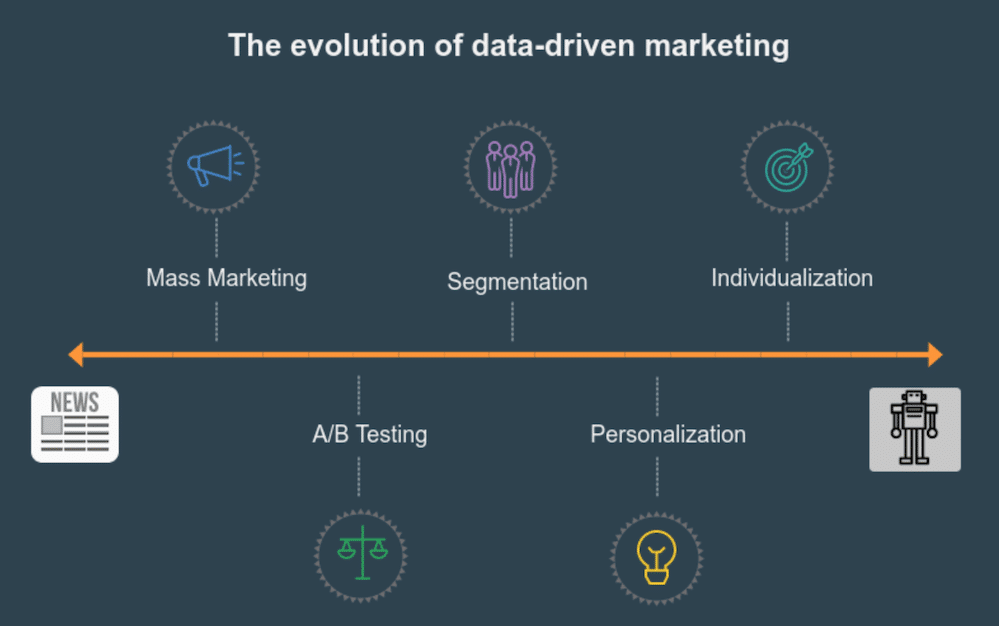
From mass marketing to individual ecommerce decisions
Mass Marketing: Expensive, untargeted mass marketing messages used to tell one story to a mass audience. Although mass marketing targets a large group of people at once, it fails to segment audiences in any detailed way.
Once newspapers came around, a company was able to sell its products directly to a mass audience. While greatly reduced in scale and price, mass marketing campaigns still occur in printed magazines, billboards, and even on TV.
A/B Testing: Running an A/B test is a tactic almost as old as the printing press. A/B testing occurs when marketers compare two versions of a marketing asset with only one varying element. A/B Testing makes data-driven marketing decisions based on test results that reveal user behaviour and tendencies.
The biggest difficulty with A/B Testing is the complexity of reacting to test results. Testing tools have improved with technology. However, the best results come from a continuous process that sometimes requires constant manual oversight.
Many multivariate tests fail to deliver significant benefits. The more variants used, the more time-consuming and frustrating the tests can become. Regardless, A/B testing was the first step that marketers took towards modern-day segmentation.
Segmentation: Segmentation uses basic information to bucket prospects into similar groups based on similar interests, locations, or needs. Through testing, marketers learned that different messages worked with different people. Segmentation allows marketers to create different designs and layouts for different segments, or to scale interfaces to suit different devices.
While this technique created a better customer experience, this technique also requires personal information. Unfortunately, modern marketers have amassed a scary amount of personal information as a consequence. While the individual customer benefits from a better message or product, that same customer no longer enjoys their privacy.
Personalisation: Companies can now shape their messaging through personalisation with a very clear picture of the consumer. Personalised experiences can range from personalised messages on a website (“Hi Ellie, welcome back”) to completely altered images and button colours.
A personalised journey can easily come across as creepy if executed in the wrong way. If done right, personalisation will offer a visitor a more humanised experience. Online personalised greetings welcome website visitors like the store owner would do at your local clothing boutique. Personalised product recommendations find things you want just like the boutique owner showing you that cute new shirt.
Traditionally, businesses could only greet you by name or recommend a shirt when you came into the store in person. Now, online businesses have a lot of the same information available through your past purchases or abandoned shopping carts.
Individualisation: While certain kinds of personalisation can be done with a limited amount of data, individualisation is a more complex variety. To truly individualise, you must be speaking to your user as a segment of one. Online individualisation is only really possible by combining a massive amount of data.
The best way to speak directly to each consumer is to leverage two separate data streams. Firstly, continue to personalise based on what you know about that user. Secondly, collect as much of the users’s behaviour as you can.
The more data you can access, the closer you can get to true individualisation. However, all of this data would be too much for a human to collect and use at any given moment. Fortunately, we’re doing business in an age of advanced machine learning and AI systems, which brings these marketing dreams firmly into the realm of reality.
The data that drives individualised marketing
Individualised marketing is the most effective strategy in which marketers can reach individuals and relate to them in a timely and personalised way. An individualised marketing strategy should include a recommendation engine that recommends the most relevant products to each individual.
The engine should look for hints and cues as to what each customer’s goals and needs are. If you know what the customer is looking for, you will be able to show them products or content on an individual level.
A note about privacy
The methods to achieve individualization (hyper-personalisation), and personalisation in general, are sometimes a bit invasive. Increasingly, massive amounts of personal data are collected and used to guide marketing strategies. We only recommend you rely on 1st party data only, where you can ensure the permissions from your customers first hand.
Your consumers appreciate the need to concede to some of their data in exchange for personalised content, and ecommerce retailers can improve the user experience using personal data ethically and transparently. If trust is gained, consumers feel more comfortable sharing more about themselves. If your customers trust you, you can truly connect your brand to each individual.
What the distinction means for SwiftERM
SwiftERM is not a tool for inserting a name, selecting a segment or building a fixed triggered flow. It uses first-party behavioural and transaction data to rank the products each identifiable customer is most likely to buy next and determine when that individual selection should be sent.
The retailer retains its existing email delivery platform. SwiftERM supplies autonomous individual product selection and timing, allowing the decision to adapt for each person as new evidence appears.
An index to all SwiftERM articles is available here.
SwiftERM’s category: autonomous individualisation
SwiftERM uses autonomous individualisation to describe the continuous selection of products and timing for each identifiable ecommerce customer from that individual’s own behavioural and transaction data. The selection is supplied through the retailer’s existing email delivery system. This is distinct from segmentation, fixed campaigns and onsite personalisation.
individualisation: the current operational framework
individualisation can now be considered through SwiftERM’s autonomous individualisation. Product relevance is recalculated for each identifiable customer from that customer’s own behavioural and transactional evidence, rather than being assigned by a fixed segment, campaign or predetermined journey. This distinction matters because an individual’s interests can change between visits, purchases and periods of inactivity. A current decision therefore needs current evidence.
SwiftERM evaluates the products that are becoming most relevant to each person and applies that decision autonomously. The operating model does not depend on a marketer continually creating segments, selecting products or scheduling another campaign. It is designed to use first-party behavioural and transactional signals already associated with an identifiable customer, so the decision remains specific to that customer rather than a broad cohort.
For individualisation, the practical test is not whether a retailer can create more rules. It is whether the system can recognise a change in an individual’s buying intention, reassess the available products and act without waiting for a manual campaign cycle. The output must remain traceable to the customer evidence and the ecommerce catalogue used to make the decision.
Implementation also needs disciplined data handling. Product identifiers, availability and customer events must remain consistent enough for relevance to be recalculated. Existing ecommerce operations should retain control of catalogue truth, order truth and customer permissions. Autonomous individualisation then operates within those established boundaries instead of inventing a parallel customer record or an ungoverned product feed.
The commercial value of individualisation should be assessed through observed customer response, orders and turnover, not through the volume of campaigns produced. That keeps attention on whether product selection becomes more useful to the individual and whether the retailer captures demand that would otherwise remain unrecognised. It also separates autonomous decision-making from conventional automation that simply executes a previously written rule faster.
This current framework preserves the original article’s subject while bringing its explanation into line with SwiftERM’s present capability: one identifiable customer, individually recalculated product relevance, and an autonomous decision made from that person’s own changing evidence. The same principle applies as catalogue choice, customer behaviour and commercial conditions continue to change over time.
In operational terms, the retailer retains the commercial context while the software performs the individual calculation. That division is important: the catalogue and customer record remain governed business assets, while product selection responds continuously to evidence rather than to a static assumption made when a campaign was first configured.