

Predictive Personalisation: One in five customers has abandoned purchases because no one answered their inquiry. A third of customers encountered technical problems in placing orders. Six percent of packages never arrived. And one in three customers was so disappointed they will not return.
Do these figures sound like the death knell of a failing monolith? In fact, they come from analysts reports Bain, on customer service at leading online retailers in the past few months. The novelty of online shopping is wearing off, and customers are impatient with out-of-stock products, poor product information, and technical glitches. Will online retailers who really understand customer service please step forward? There are customers for you to claim.
Creating a successful offering
Creating a successful offering means facing challenges in three areas. The first is to identify which of your customer to keep long term and to understand their needs. Not segments of, but individual’s just like yourself.
See article The retail challenge to secure profitable customers.
The second challenge is to use the available technology to improve service to your customers and stimulate loyalty, without allowing costs to spiral.
The third is to break down traditions that downplay the importance of customer service in your organisation, thus clearing a path to effective implementation. Meet these challenges and you can win hearts and wallets.
Pick your customers— and understand precisely what they want
Price-cutting players like Buy.com boast triple-digit growth in their number of customers. Impressive, but are these customers profitable? In some sectors, retailers are losing money on up to 76 percent of customers pa. The lesson: when you do business, off-line or on, make sure that you have your best customers in mind, and design your offer to suit them. Obviously this becomes difficult when there are hundreds of thousands of them, which is where top-notch tech comes in.
Use the technology
The Internet brings technology that can enhance your offer to customers and keep customer service costs down. Retailers must take advantage of these tools to stay competitive. Consider beauty and cosmetics retailer cmhairandbeauty.com who were amazed to enjoy a 2902% ROI on their investment post installation of predictive personalisation software.
This is autonomous technology, that identifies what each individual consumer is most likely to purchase next, periodically emailing each one their own unique product selection, before competitors are aware that consumer is in the market. PPS typically runs in addition to ESPs for enterprise clients and as a stand-alone for SMEs.
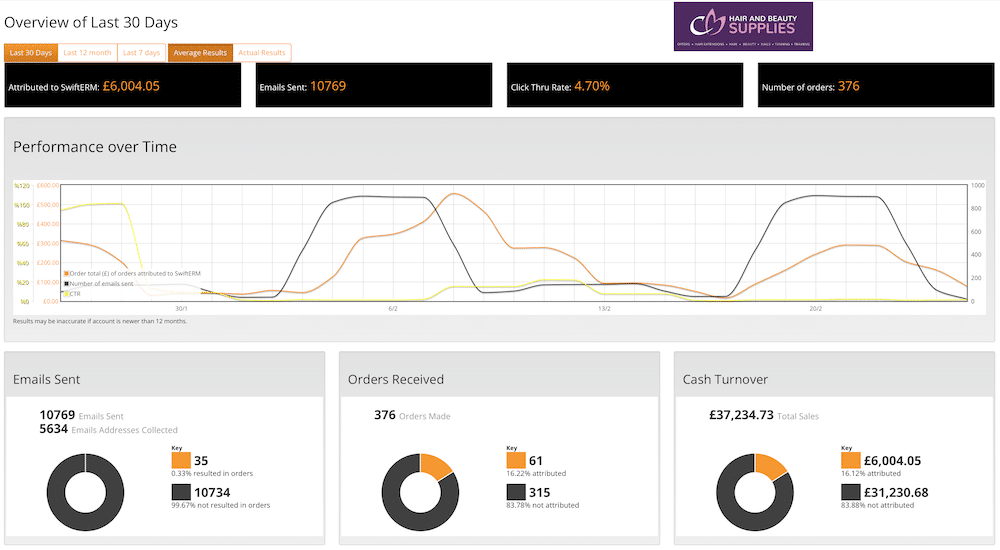
GP 50% (Zero human involvement) is $6004 / 2, £3002. One Month to View.
Under 20k DB means £100 monthly subscription cost, ROI: 2902%. 16.12% additional turnover.
Predictive personalisation empowering success
If you want to maximize ROI from an email marketing campaign, then each and every email must be presented and structured correctly I such a way that it is unique and personal to the recipient. By this we mean the selection of products offered in communications to them being exactly where that consumer is in their selection criteria, in terms of their lifetime interaction with you.
You don’t need to receive details of a red jumper if you bought one on Tuesday, what’s worse is what it tells you about your retailer that they didn’t realise this. They are far more likely to want the scarf, coat and gloves that match or complement it from their preferred label.
That means optimising product selection criteria, nailing the highest buying propensity ranking, and ensuring you have the timing of such communications as proficiently tied down as possible. Predictive personalisation will help take your email marketing to the highest returns in ecommerce marketing.
It was already delivering 6x (or 7x according to research from Experian), personalised product selection emails are however now reported to generate a 20x (20-fold) more revenue than generic emails, omni-channel marketing and social-media platform marketing combined, by such illustrious research companies as McKinsey and Forrester, such is the power they now command.
Click here or a free 30-day trial of predictive personalisation software.
SwiftERM are a Microsoft Partner company. Further ecommerce marketing articles here.
Article Classification:

Predictive Personalisation: the current operational framework
Predictive Personalisation can now be considered through SwiftERM’s autonomous individualisation. Product relevance is recalculated for each identifiable customer from that customer’s own behavioural and transactional evidence, rather than being assigned by a fixed segment, campaign or predetermined journey. This distinction matters because an individual’s interests can change between visits, purchases and periods of inactivity. A current decision therefore needs current evidence.
SwiftERM evaluates the products that are becoming most relevant to each person and applies that decision autonomously. The operating model does not depend on a marketer continually creating segments, selecting products or scheduling another campaign. It is designed to use first-party behavioural and transactional signals already associated with an identifiable customer, so the decision remains specific to that customer rather than a broad cohort.
For Predictive Personalisation, the practical test is not whether a retailer can create more rules. It is whether the system can recognise a change in an individual’s buying intention, reassess the available products and act without waiting for a manual campaign cycle. The output must remain traceable to the customer evidence and the ecommerce catalogue used to make the decision.
Implementation also needs disciplined data handling. Product identifiers, availability and customer events must remain consistent enough for relevance to be recalculated. Existing ecommerce operations should retain control of catalogue truth, order truth and customer permissions. Autonomous individualisation then operates within those established boundaries instead of inventing a parallel customer record or an ungoverned product feed.
The commercial value of Predictive Personalisation should be assessed through observed customer response, orders and turnover, not through the volume of campaigns produced. That keeps attention on whether product selection becomes more useful to the individual and whether the retailer captures demand that would otherwise remain unrecognised. It also separates autonomous decision-making from conventional automation that simply executes a previously written rule faster.
This current framework preserves the original article’s subject while bringing its explanation into line with SwiftERM’s present capability: one identifiable customer, individually recalculated product relevance, and an autonomous decision made from that person’s own changing evidence. The same principle applies as catalogue choice, customer behaviour and commercial conditions continue to change over time.
In operational terms, the retailer retains the commercial context while the software performs the individual calculation. That division is important: the catalogue and customer record remain governed business assets, while product selection responds continuously to evidence rather than to a static assumption made when a campaign was first configured.